
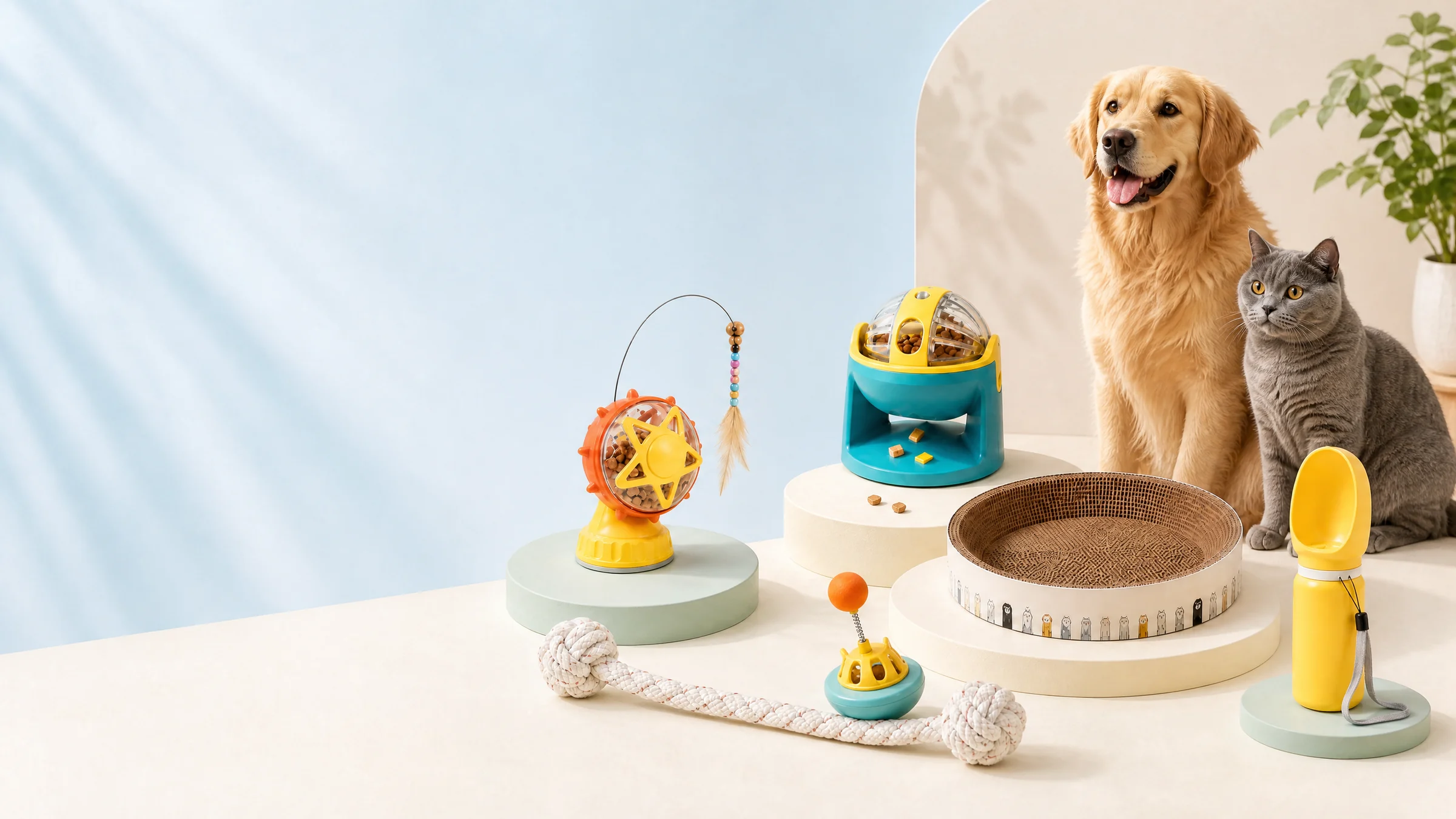
For importers, retailers, distributors, and private-label buyers, sourcing wholesale dog and cat accessories is an exercise in assortment control. A product may look appealing in a catalogue, yet still require review of intended use, construction, packaging, documentation, landed cost, and channel fit. A disciplined process helps buyers compare options without unsupported claims.
This guide presents a neutral framework for reviewing accessories such as toys, scratching products, grooming tools, travel items, and slow-feeding bowls. A slow feeder or slow-feeding bowl should be treated here as a non-food pet accessory: the sourcing review concerns the bowl’s construction, cleanability, packaging, and intended-use communication. This article does not provide food, portion, nutrition, allergy, medical, or veterinary guidance. For every actual specification, material, package format, compliance record, price, minimum order, lead time, or availability point, confirm with the supplier and buyer.
Define the role of every SKU
A coherent range starts with a written reason for including each item. A dog toy, cat scratching board, grooming accessory, travel bottle, or slow-feeding bowl may occupy a different merchandising role, but the role should be based on the buyer’s channel and documented product information rather than a universal promise. A retailer might group items by species, room, activity, or season, while a distributor may need compact account-specific assortments.
Before requesting a quotation, create a shortlist with the intended species, use case, target channel, display method, and acceptable price architecture. Keep the language factual. If an item is presented for play, scratching, grooming, travel, or non-food accessory use, ensure that the packaging and product page describe the same scope. Confirm target pet size, usage boundaries, warnings, care instructions, and package contents with the supplier and buyer.
Review construction and foreseeable use
Durability is not a blanket marketing adjective. Buyers should inspect seams, joints, edges, attachments, moving parts, coatings, rope ends, fasteners, and any area likely to receive repeated handling. Consider ordinary use and reasonably foreseeable misuse in the destination market. The applicable obligations vary by product and jurisdiction; the U.S. Consumer Product Safety Commission explains that its jurisdiction covers many consumer products, while European product-safety requirements apply within the relevant EU framework 1 2.
Request a representative sample and compare it with a written specification. Record dimensions, component descriptions, finishes, color references, and any changes made during sampling. If the proposed item includes a bowl or other contact surface, ask the responsible parties to confirm the intended material, cleaning instructions, and any market-specific documentation. Do not infer food-contact, child-safety, chemical, or other regulatory status from appearance, a generic test report, or an unverified logo.
Packaging deserves the same attention as the product. Check whether the item can be hung, stacked, scanned, stored, and protected during ordinary transport. Confirm pack dimensions, inner and master-carton configuration, barcode ownership, language requirements, artwork version, warning placement, and recycling or disposal information where applicable. GS1 describes barcodes as a way to identify products and logistics units, with additional data structures available for certain attributes 3. Confirm which identifiers and data fields apply to the program.
Use a supplier-comparison framework
The following table keeps open fields open. It is a checklist for a sourcing discussion, not a statement that any particular supplier offers a particular feature.
| Buying dimension | Questions to ask | Details to confirm with supplier and buyer |
|---|---|---|
| Product role | What shopper need and channel placement does the SKU serve? | Intended use, target pet size, usage boundaries, instructions |
| Construction | Which parts face pulling, scratching, bending, moisture, or repeated handling? | Materials, assembly, finish, inspection criteria, sample version |
| Range architecture | Does the item fit the proposed species, price, and visual system? | Colors, variants, dimensions, SKU coding, assortment limits |
| Packaging | Can the unit be displayed, scanned, stored, and opened efficiently? | Pack dimensions, barcode, carton details, artwork, languages |
| Private label | What branding elements are necessary for the market? | Logo method, packaging files, approvals, minimums, ownership |
| Compliance | Which records and warnings may be required in the destination? | Applicable rules, testing scope, declarations, traceability |
| Commercial fit | What assumptions drive the landed-cost model? | Quotation basis, quantities, payment, freight, logistics terms |
A structured inquiry should separate confirmed facts, options, and unresolved questions. Buyers should not treat a supplier’s catalogue, sample, or quotation as a final specification until the responsible parties approve it in writing. If an item, material, package, or process changes, reopen the review and retain the change history.
Plan private-label and documentation control
Private-label sourcing requires more than adding a logo. Establish who owns the brand assets, who approves artwork, who supplies translations, and who keeps the final specification. Confirm whether product images, packaging mockups, instruction copy, or photography are available for the specific project and whether the buyer has permission to edit or publish them.
For each SKU, maintain an approval record containing the product description, approved sample reference, specification sheet, artwork, packaging version, inspection criteria, and responsible approvers. Ask the supplier and buyer to confirm whether any testing, material declaration, warning, traceability record, or market filing is needed. A compliance document is meaningful only when its product version, test scope, date, laboratory, and destination-market relevance have been checked.
Build channel-specific merchandising
A wholesale dog and cat accessories assortment should be translated into a clear retail story without overstating benefits. A store may organize products by “indoor play,” “cat home accessories,” “care and grooming,” or “travel,” provided each label matches the actual products. An online listing should show dimensions, materials where confirmed, package contents, care instructions, intended use, and limitations. Avoid claims such as “indestructible,” “universally suitable,” “guaranteed to change behavior,” or “best-selling” unless the buyer has substantiated and approved them.
For slow-feeding bowls, keep the product communication limited to non-food accessory information: dimensions, material, surface design, cleaning instructions, packaging, and intended-use boundaries as confirmed by the responsible parties. Do not add feeding schedules, quantities, diet claims, allergy statements, or health outcomes. Confirm all such copy with the supplier and buyer before publication.
Frequently asked questions
How should a buyer compare wholesale dog and cat accessories?
Start with the intended channel, product role, construction, packaging, documentation, and landed-cost assumptions. Compare like-for-like samples and written specifications, then confirm every actual value with the supplier and buyer. A neutral scorecard is more useful than an unsupported “best” list.
Can a buyer request private-label packaging?
A buyer can ask whether private-label packaging is available for a specific SKU and market. Provide brand guidelines, package language, artwork requirements, target channels, and approval steps. Logo application, package format, minimums, sampling, production timing, and file ownership must be confirmed in writing with the supplier and buyer.
What should an importer request before approval?
Request the applicable product specification, material information, sample reference, packaging details, warnings, traceability information, and relevant test or declaration records. The required set depends on product and destination. Have the importer or qualified compliance adviser determine what is necessary; U.S. and EU frameworks are not interchangeable 1 2.
How should a slow-feeding bowl be described in a wholesale catalogue?
Describe it as a non-food pet accessory and limit the copy to confirmed product facts, such as construction, dimensions, cleanability, packaging, and intended-use boundaries. Do not provide food, formula, quantity, nutrition, allergy, medical, or veterinary advice. Confirm the final wording with the supplier and buyer.
Request a buyer-specific range review
If you are evaluating wholesale dog and cat accessories, send PawViso your target countries, channels, species mix, preferred categories, package languages, branding requirements, and purchasing assumptions through the PawViso contact page. The discussion can then be organized around samples, specifications, packaging, documentation, and commercial questions. Prices, minimum order quantities, production timing, shipping arrangements, capacity, and availability are project-specific and must be confirmed with the supplier and buyer before commitment.
References
- 1U.S. Consumer Product Safety Commission, Business Education
- 2European Commission, Product safety
- 3GS1, Barcodes
Editorial note: This article is an informational sourcing draft for trade buyers. It is not legal, regulatory, medical, veterinary, nutrition, or product-safety advice. Confirm market-specific requirements and all product, packaging, testing, and commercial details with the responsible supplier, importer, buyer, and qualified advisers before sale.