
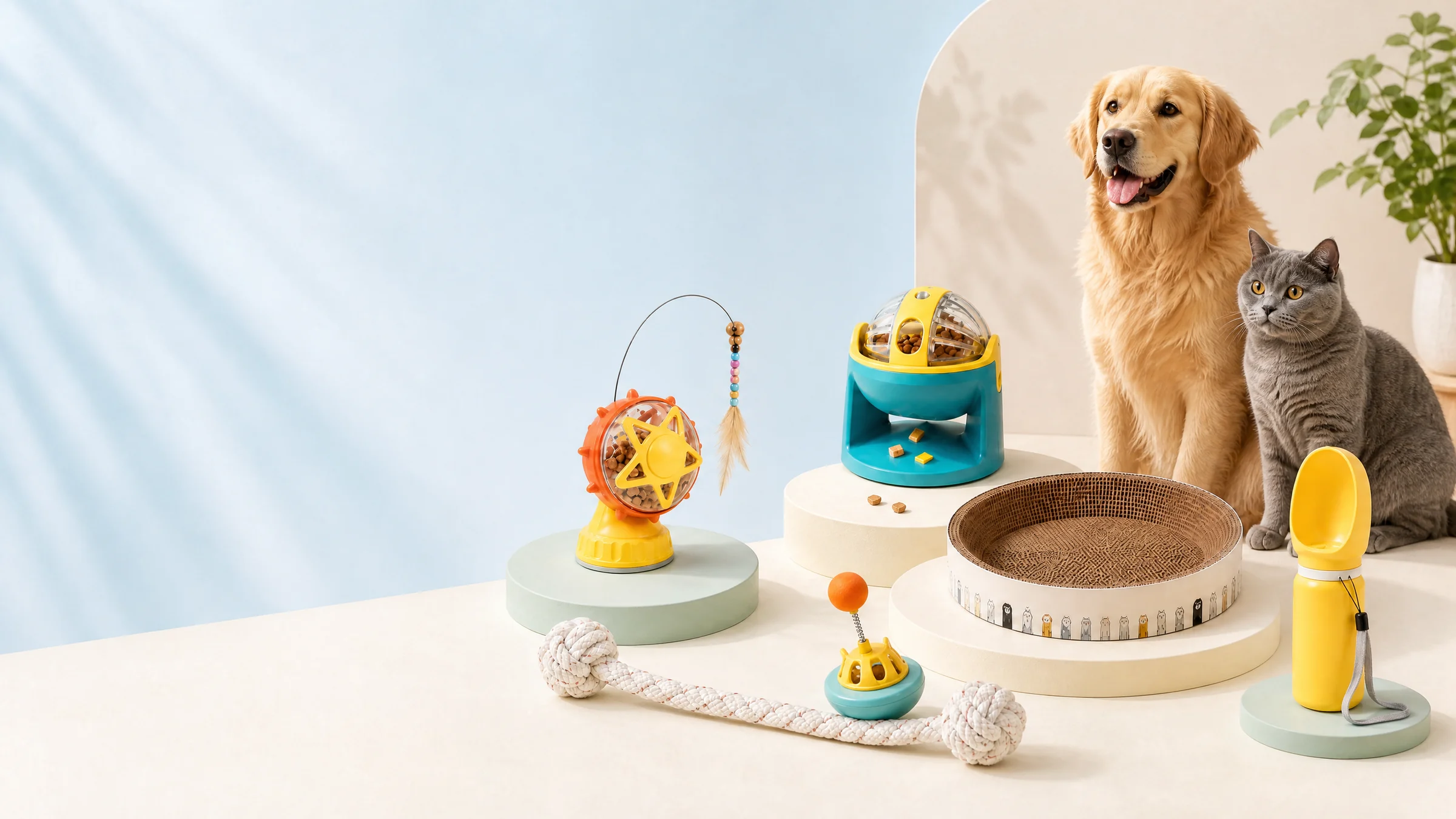
For importers, distributors, pet-specialty retailers, e-commerce operators, and private-label teams, a wholesale pet starter kit is an assortment and packaging project, not simply a collection of unrelated products. The buyer must decide which accessories belong together, how the bundle will be identified, how it will be presented, and which requirements apply in the destination market. The final product list, specifications, materials, packaging, claims, commercial terms, and compliance documents must always be confirmed with the supplier and buyer for the specific project.
This guide focuses on non-food pet accessories. It does not provide feeding, nutrition, allergy, medical, or veterinary advice. A slow-feeding bowl or slow feeder may be considered as a non-food accessory category, but its intended use, materials, dimensions, cleaning instructions, warnings, and market wording must be confirmed with the supplier and buyer before listing or production.
What should a wholesale pet starter kit accomplish?
A useful starter kit answers a merchandising question: which accessories can a new pet owner understand and purchase together? The answer depends on the channel, animal category, occasion, packaging format, and target price architecture.
Begin with a specific retail proposition rather than a maximum item count. Possible directions include an indoor activity assortment, a new-cat-home assortment, a walk-and-travel assortment, or a grooming-and-engagement assortment. These are planning frameworks, not claims that a particular combination is suitable for every animal or customer. Review the product’s intended use and instructions with the supplier and buyer.
A coherent kit generally has one lead category and a limited number of supporting accessories. Decide whether the bundle is a separate retail SKU or a promotional grouping of existing SKUs.
How can buyers structure the product mix?
A buyer brief should identify the target market, customer type, channel, pet category, retail format, assortment logic, and whether products are fixed-bundled, packed together, or promoted together without common packaging.
The following matrix can be used before requesting samples. Every row is a starting point only. Confirm all actual specifications, materials, dimensions, colors, packaging, labeling, and market requirements with the supplier and buyer.
| Kit direction | Possible lead category | Supporting categories | Merchandising question | Confirmation points |
|---|---|---|---|---|
| Indoor activity | Interactive puzzle toy | Teaser toy or cat scratcher | Can the assortment be explained clearly on one shelf or product page? | Confirm intended use, materials, dimensions, warnings, packaging, and inspection criteria with supplier and buyer |
| Walk and travel | Travel water bottle | Suitable toy or accessory | Does the set fit the channel’s parcel and display requirements? | Confirm capacity, closure design, leak-related wording, carton fit, labeling, and instructions with supplier and buyer |
| New cat home | Cat scratcher | Teaser toy or grooming tool | Can the set support a focused new-home presentation without overpromising outcomes? | Confirm size, assembly, surface materials, colorways, bundle configuration, and care wording with supplier and buyer |
| Everyday play | Cotton-rope tug toy | Interactive puzzle toy | Are the component roles and use instructions easy to distinguish? | Confirm construction, warnings, packaging artwork, product inspection points, and intended-use language with supplier and buyer |
| Grooming and engagement | Grooming tool | Toy or accessory | Can the kit be presented as a practical accessory selection? | Confirm tool design, care instructions, claims, packaging, translations, and private-label artwork with supplier and buyer |
| Non-food feeding accessory | Slow-feeding bowl | Mat or related non-food accessory | Can the listing describe the product without food, nutrition, or health claims? | Confirm food-contact status if applicable, materials, cleaning directions, dimensions, warnings, and market requirements with supplier and buyer |
Avoid “best,” “bestselling,” and similar superlatives unless the buyer has reliable evidence and the claim has passed review. A neutral comparison is more useful for procurement.
Which procurement details should be confirmed before quotation?
Before requesting a quotation, provide the destination market, customer type, sales channel, product families, packaging format, estimated order range, and whether items are sold separately or bundled. For private label, include brand guidelines, artwork dimensions, barcode expectations, carton marks, languages, approval stages, and the final compliance-review owner.
Plan identification early. GS1 describes a GTIN as a unique identifier for products traded online or in stores [1]. Decide how each product and assembled kit will be identified in inventory and marketplace systems, then confirm the structure with the relevant GS1 organization, sales channel, and supplier.
Imported goods may require country-of-origin marking and other market information. U.S. Customs and Border Protection explains that origin marking informs the ultimate purchaser where an imported article was made [2]. This source is U.S.-specific; buyers elsewhere must review local rules and approve artwork with the supplier and buyer.
Product-safety obligations vary by jurisdiction and category. The U.S. Consumer Product Safety Commission explains that businesses may have responsibilities relating to product safety and certification for applicable products [3]. Do not assume one document, test report, label, or warning covers every market; identify applicable classifications, documents, warnings, and reporting processes with the supplier and buyer.
Procurement rule: Treat a starter kit as a controlled retail configuration. No component list, specification, claim, label, package, inspection criterion, or commercial term is final until it has been confirmed with the supplier and buyer.
How should packaging and private-label artwork be reviewed?
Packaging should state the kit concept and included categories clearly. Add contents, care information, responsible parties, required languages, and applicable warnings where required. Print only claims supported and approved for the destination market.
Confirm whether components are packed together, packed individually, or supplied in buyer-provided packaging. Request a physical sample or artwork proof before mass production. Confirm packed dimensions, carton arrangement, label placement, barcode treatment, carton marks, and whether the bundle is one retail unit or several inventory items.
For private-label work, start with a controlled number of variations. A consistent visual system may be easier to approve than many unrelated designs. Any MOQ, tooling charge, sample cost, lead time, customization scope, capacity, or delivery arrangement is project-specific and must be confirmed with the supplier and buyer.
What should buyers check during sampling and pre-production review?
The sample stage should verify the components and bundle experience against the approved brief: finishes, colors, dimensions, package operation, labels, translations, instructions, warnings, barcode placement, carton marks, and artwork. If a slow-feeding bowl is included, review it only as a non-food accessory unless applicable food-contact requirements are separately confirmed. Do not add feeding quantities, nutritional statements, allergy advice, or medical claims.
Document inspection criteria in writing. “Premium quality” is not an inspection standard. Specify acceptable visible, functional, packaging, and labeling characteristics, the sampling or inspection approach, and the responsible party for testing, certification, market review, and corrective action.
Compare the kit with its channel: can a distributor describe it accurately, can a retailer display it without repacking, and can an online operator list the exact configuration? If not, revise it before production.
Frequently asked questions
Are wholesale pet starter kits always fixed combinations?
No. A kit may be a fixed retail bundle, a buyer-selected assortment, or a promotional grouping of individually stocked products. Confirm the component list, packing method, SKU treatment, artwork process, and replenishment logic with the supplier and buyer before quotation or production.
Can buyers request private-label packaging?
Private-label packaging may be possible depending on the product, artwork, order plan, packaging process, and destination-market requirements. The buyer should provide brand guidelines and confirm customization scope, sample approval, packaging materials, barcode responsibilities, any minimum quantities, and the final approval owner with the supplier and buyer.
How many accessories should be included?
There is no universal number. Select enough complementary items to create a clear customer proposition without making the package difficult to explain, stock, inspect, or ship. Test the intended retail price, package size, assortment logic, and channel presentation with the buyer before finalizing the count.
What should an importer confirm before ordering?
Confirm the exact components, product specifications, materials, packaging, labeling, country-of-origin requirements, barcode plan, inspection criteria, carton configuration, documentation, and market-specific compliance responsibilities. Confirm all parameters with the supplier and buyer for the project.
References
[1]: GS1, “Get a barcode” [2]: U.S. Customs and Border Protection, “Marking of Country of Origin on U.S. Imports” [3]: U.S. Consumer Product Safety Commission, “Retailers: Product Safety and Your Responsibilities”
Start a wholesale pet starter kit review
Prepare a buyer brief covering the destination market, channel, pet category, product direction, packaging format, labeling needs, and estimated quantity. Contact PawViso to discuss the project. Product availability, specifications, materials, packaging, customization, MOQ, pricing, documentation, compliance responsibilities, and delivery arrangements must be confirmed with the supplier and buyer before approval.
Editorial status: Review pending; product, legal, market, and packaging review is required before publication.