
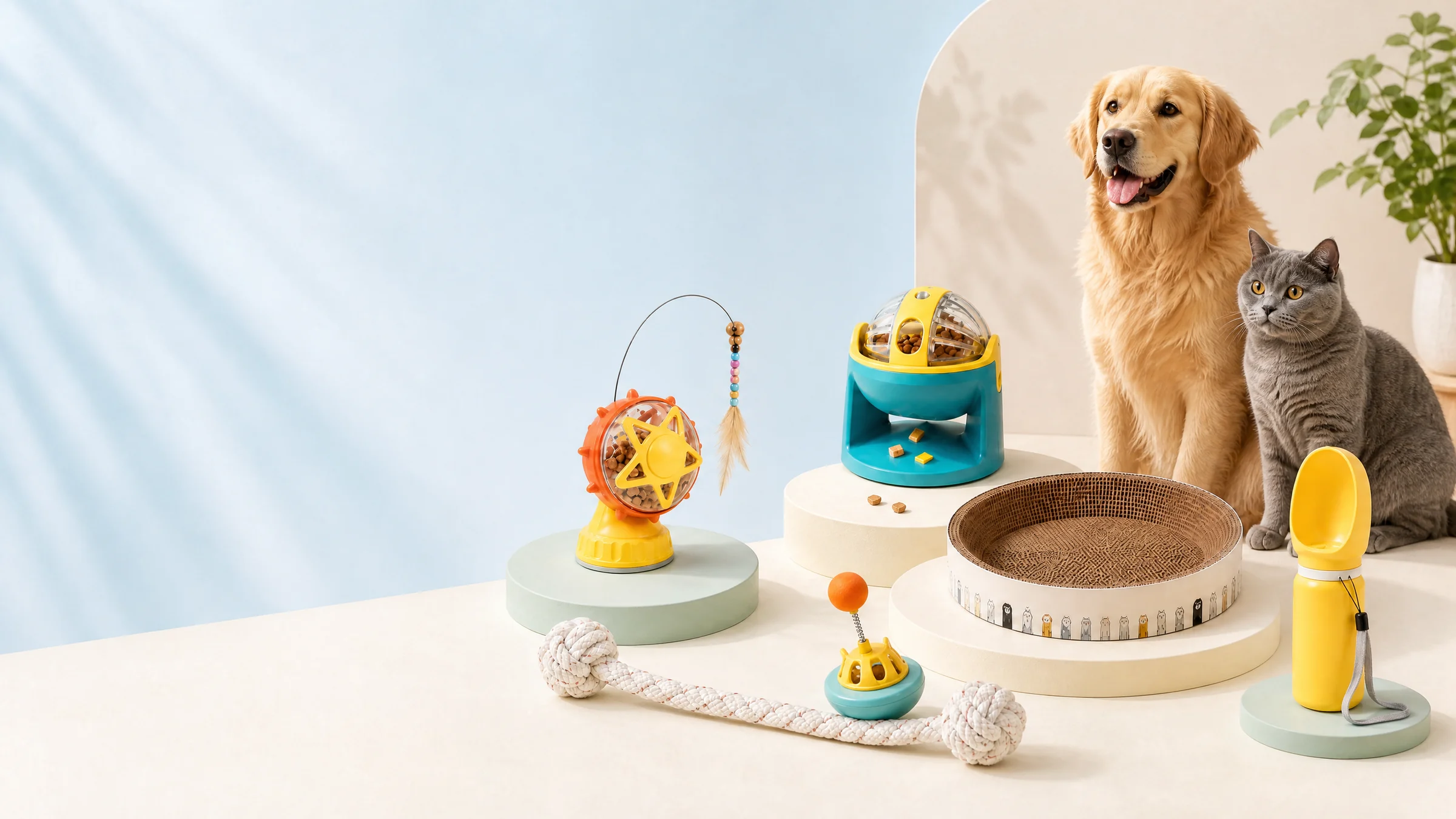
For importers, retailers, distributors, and private-label buyers, “where to buy wholesale pet accessories” is a sourcing question rather than a simple search for the lowest quote. A suitable route should make it possible to compare product fit, documentation, packaging, quality controls, and shipment terms before a purchase commitment. The same approach applies to cat and dog accessories, including toys, scratchers, grooming tools, travel accessories, and slow-feeding bowls treated strictly as non-food pet accessories.
This guide presents a neutral purchasing framework. It does not make claims about any supplier’s product range, factory capacity, customization capability, certifications, customers, pricing, minimum order quantity, lead time, or market performance. For every SKU, confirm the actual specification, material, packaging, compliance file, and commercial terms with the supplier and buyer.
What sourcing routes can buyers compare?
A buyer may compare direct manufacturers, export trading companies, online marketplaces, trade fairs, sourcing agents, and established distributor channels. Each route can offer a different balance of communication, assortment access, documentation, sampling, and logistics support. The practical task is to define the buying brief first, then ask every candidate supplier the same core questions.
Start by identifying the destination market, sales channel, product categories, expected retail positioning, packaging language, and required delivery documents. Ask whether each quoted detail is standard, sample-dependent, artwork-dependent, or subject to approval. For products placed on the EU market, the General Product Safety Regulation establishes responsibilities relating to safe products, risk management, and economic operators.[1] In the United States, obligations vary by product classification and applicable rule; retailers and importers should review the relevant requirements and documentation for the specific product.[2] Confirm the applicable route with the responsible compliance professional, supplier, and buyer.
How should buyers evaluate a wholesale pet accessory supplier?
A useful evaluation combines commercial fit, product information, quality assurance, and documentation. Request a quotation that identifies the exact SKU, version, materials, dimensions, packaging assumptions, inspection basis, and shipment terms. If any item is provisional, record the condition in writing rather than treating it as a promise.
| Buyer checkpoint | Questions for the supplier | Buyer confirmation needed | Examples of records |
|---|---|---|---|
| Assortment fit | Which categories and SKU versions are currently available? | Channel fit, target pet type, assortment gaps, and SKU identity | Current catalog, SKU list, sample photos |
| Materials and construction | What materials, finishes, joins, and replaceable parts are used? | Material declaration, intended use, durability expectations, and restrictions | Specification sheet, material statement |
| Safety and testing | Which product-specific tests or reports are available? | Applicable rules, laboratory scope, report date, and product identity | Test report, declaration, risk review |
| Packaging and labeling | What pack formats, inserts, marks, and carton data are possible? | Language, warnings where applicable, barcode, dimensions, and artwork | Dieline, artwork proof, carton specification |
| Quality control | What inspection steps and acceptance criteria are proposed? | Sample approval, defect definitions, inspection timing, and remedies | Inspection checklist, approved sample |
| Customization | Which colors, logos, bundles, or packaging changes are feasible? | Ownership, artwork approval, change control, and order conditions | Artwork proof, revision log |
| Logistics | What shipment terms and carton information can be confirmed? | Incoterm, destination, carton count, weights, documents, and schedule | Quotation, packing list template |
This matrix is a request framework, not a product guarantee. Confirm specifications, materials, packaging, compliance, and market requirements with the supplier and buyer.
How can buyers classify products without overclaiming?
Product descriptions should match the intended use and the evidence available. A teaser toy, scratcher, grooming tool, travel water bottle, or rope tug toy should be described by its physical function and supplied specification. A slow feeder or slow-feeding bowl may be included in an accessory assortment as a non-food pet accessory. This article does not provide food, formula, portion, nutrition, allergy, medical, or veterinary guidance.
For each SKU, record the intended pet type, electronics or battery content, magnets, coatings, adhesives, textiles, detachable parts, and packaging claims. Do not infer suitability, durability, or regulatory status from a photograph. Confirm claims, warnings, instructions, and test scope with the supplier and buyer.
For U.S. programs, do not assume that every pet accessory requires the same certificate. The U.S. Consumer Product Safety Commission distinguishes requirements by product category; children’s products can involve testing, a Children’s Product Certificate, and tracking information, while certain non-children’s products may require a General Certificate of Conformity.[3] Determine classification and document needs for each SKU with the responsible party.
How should a buyer build a commercially useful brief?
A clear brief reduces quotation revisions. Specify the destination country or countries, sales channel, target customer, assortment size, preferred retail presentation, and expected order structure. For every item, list the category, product identity, relevant dimensions or capacity, preferred materials, color references, logo method, packaging format, barcode requirements, carton limits, and requested documentation. Every parameter remains subject to confirmation with the supplier and buyer.
Private-label buyers should use approval gates: concept, quotation, physical sample, artwork proof, pre-production sample, inspection, and shipment release. The brief should state which changes require a new approval. This matters when a component, material, label, instruction, or package changes, because the change may affect product identity, testing, risk review, or market information.
How can buyers manage samples, quality, and replenishment?
A sample should be reviewed for more than appearance. Compare the physical item with the written specification, checking finish, assembly, handling, dimensions, packaging fit, labeling space, and consistency with the approved version. Record the sample date, version number, photographs, material description, open questions, and any agreed deviation. If a substitution is proposed, request written confirmation and a new approval decision before treating it as equivalent.
The purchase order should connect the commercial description to the approved sample and inspection plan. Confirm cosmetic tolerances, functional checks, packing count, carton marks, document set, and remedies for non-conforming goods. For repeat orders, maintain a change log and re-confirm the specification whenever a material, component, package, or manufacturing source changes.
EU-facing buyers should identify the relevant economic operator and retain product-specific technical and risk information where required.[1] Businesses may also need to address unsafe products through corrective action or communication, depending on their role.[4] Plan traceability before shipment and confirm required records with the supplier and buyer.
Frequently asked questions
Can a buyer compare several suppliers fairly?
Yes. Use the same written brief, SKU definitions, packaging assumptions, inspection standard, and delivery basis for each quotation. Separate confirmed facts from estimates and record every exception. This creates a more meaningful comparison than ranking suppliers by a headline unit price alone.
Can slow-feeding bowls be included in a pet accessory assortment?
They can be evaluated as non-food pet accessories when the buying brief concerns the physical product, materials, packaging, and intended use. Do not add food, feeding quantities, nutrition, allergy, medical, or veterinary claims. Confirm the actual design, materials, labeling, and market requirements with the supplier and buyer.
What should a private-label buyer approve before production?
Approve the product version, written specification, physical sample, artwork, translations, barcode placement, applicable warnings or instructions, packaging dimensions, carton marks, and inspection method. Confirm who owns the artwork and which changes trigger a new review. No customization capability, MOQ, price, lead time, or production capacity should be assumed without written confirmation.
What information should be included in an initial inquiry?
Include the destination market, buyer type, product categories, estimated assortment, packaging preference, private-label scope, requested order structure, target documents, and desired review milestones. Ask the supplier to identify what is currently available and what remains subject to sampling or approval.
How can buyers start an inquiry with PawViso?
Prepare a concise buying brief and submit it through the PawViso contact page. Ask for written confirmation of the relevant product identity, specifications, materials, packaging, testing scope, order terms, and shipment details. Treat all commercial and operational information as provisional until it has been reviewed and confirmed by both supplier and buyer.
References
[2] U.S. Consumer Product Safety Commission, “Retailers: Product Safety and Your Responsibilities”
[3] U.S. Consumer Product Safety Commission, “The Consumer Product Safety Improvement Act (CPSIA)”
[4] Netherlands Food and Consumer Product Safety Authority, “Offering safe products within the EU”