
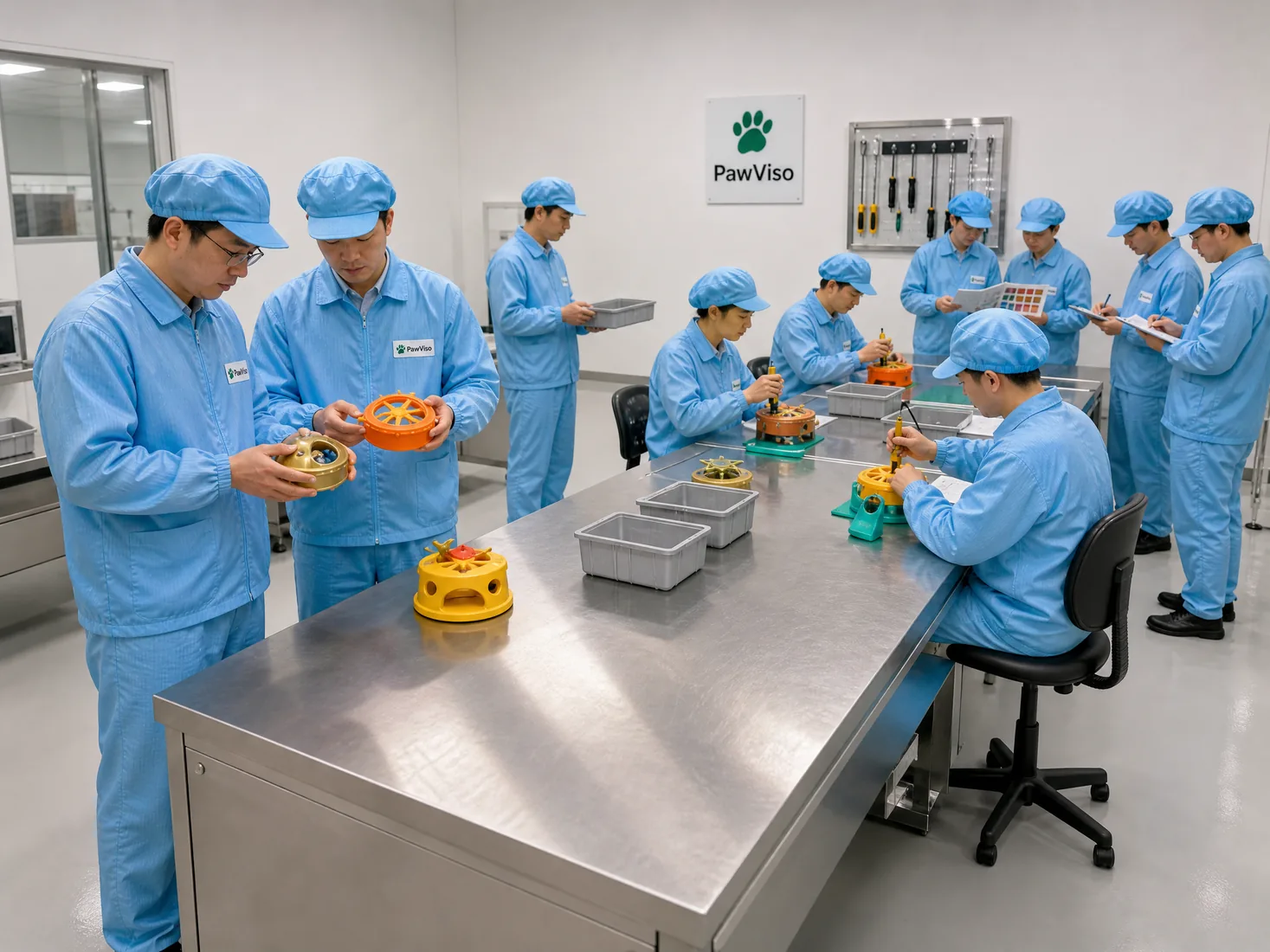
This guide gives U.S.-market retail, import, distribution, and private-label buying teams a structured, practical approach for sourcing pet product manufacturers in the United States. It focuses on procurement-critical items: supplier screening, product specifications, material/component evidence, sampling and pilot-run checks, packaging and retail readiness, quality controls, and commercial tradeoffs. It does not provide legal, veterinary, or product-performance guarantees; final claims and market obligations must be confirmed by the buyer/importer.
Decision framework
Sourcing for the U.S. pet market requires balancing product fit, regulatory risk, cost, and time-to-market. Use a stage-gate framework that maps supplier capability to your commercial objectives.
Stage gates
- Stage 0 — Opportunity definition: SKU family, unit economics, target retail channel, and logistics footprint.
- Stage 1 — Supplier short list: desk research and initial RFQ.
- Stage 2 — Technical validation: specifications, component evidence, and pre-production sample.
- Stage 3 — Pilot production: small production run, packaging validation, shrink/wear testing, QC plan.
- Stage 4 — Scale: full production, incoming inspection, ongoing monitoring.
Minimum internal checkpoints
- Risk review: regulatory/claims exposure, materials restricted lists, and tariffs.
- Cost-to-serve: landed cost including duties, inland freight, returns, and warranty provisions.
- Time buffer: buffer for additional test cycles, tooling lead times, and seasonal peaks.
Decision criteria (prioritized)
- Technical competence — documented capability to make the exact class of product (examples below include rigid containers, textile apparel, mattress fabrication, leads and harnesses).
- Evidence trail — lab test reports, material certificates, and inspection history.
- Commercial fit — MOQ, pricing, packaging options, lead time.
- Quality systems — documented QC, corrective actions, and inspection pass rates.
- Logistic & contract terms — Incoterms, payment terms, and warranty/recall cooperation.
Quick supplier triage checklist
- Do they produce the specific SKU family domestically? (If not, do they have a U.S. partner or warehousing?)
- Can they provide a recent COA, MSDS, and traceable material chain for primary components?
- Are tooling and customization lead times compatible with your launch date?
- Do they accept tiered sample stages (prototype, engineering sample, pilot lot)?
Use these criteria to move suppliers through the stage gates. Keep supplier evidence organized and versioned; require dated documents with contactable labs or certifiers.
Product specifications
A clear, prioritized specification controls cost, compliance, and sample success. Separate must-haves (non-negotiable) from nice-to-haves (cost drivers).
Specification structure
- Functional requirements: dimensions, weight capacity, closure performance, fastener pull-out force, load ratings, resistance to abrasion/moisture.
- Material definitions: polymer grade (e.g., HDPE 2.0 g/cm³), textile knit type, foam density and ILD for mattresses, metal grade and surface finish.
- Component callouts: zippers (size/type/finish), webbing width/denier, buckles by spec, stitching type by seam.
- Tolerances: linear tolerances, color tolerances with Delta E values, thickness ranges.
- Performance tests: lab test methods (e.g., ASTM numbers relevant to durability, flammability, or tensile strength) where applicable.
- Labeling & documentation: material content labels, care instructions, country of origin marking, UPC or barcode placement.
Example: dog mattress spec highlights
- Outer textile: 600D polyester with PU coating, color A Pantone XXXX, seam double-stitch with 3.5–4.5 stitches/inch.
- Foam core: 2-inch memory foam + 3-inch high-resiliency foam; total thickness 5±0.2 in; ILD 18–24.
- Cover: removable via #10 zipper; zipper pull rated 30 N pull.
- Tolerances: finished dimensions for standard size 30×40 in ±0.5 in.
- Tests required: compression set after 50% compression for 72 hours (ASTM D3574), seam strength 20 N/mm.
Include exact tolerances and test methods in the RFQ to avoid ambiguity. This reduces late-stage rework and cost escalation.
Use cases for keywords in specs
- If you require rigid storage for food or treats, specify material and wall thickness to solicit quotes for pet plastic cans wholesale with exact volume and lid-seal performance.
- Private-label apparel lines should call out knit weight, ink types for print, and size grading to compare luxury pet clothes wholesale offerings to lower-cost suppliers.
- For small goods like leashes and leads, define webbing denier, stitch pattern, hardware metal grade and plating to get accurate dog leads bulk buy quotes.
State explicitly which aspects are vendor-managed (e.g., color matching) and which are buyer-approved (e.g., final fabric choice). Maintain a change-log for each SKU.
Material and component evidence
Buyers must insist on traceable evidence. Ask for documents and validate against originals where possible.
Essential evidence list
- Certificate of Analysis (COA) for key polymer or textile lots, dated within the last 12 months.
- Mill test reports or supplier declarations for foam density and metal plating.
- Material Safety Data Sheets (MSDS) or Safety Data Sheets (SDS) for chemical components.
- Third-party lab reports for applicable tests (electrical safety is rare in pet products; mechanical and chemical tests are more common).
- Photographic evidence and vendor-run sample batch logs.
How to evaluate evidence
- Check chain-of-custody: COA should name the lot number, production date, and supplier contact.
- Verify lab accreditations where applicable (e.g., ISO/IEC 17025) and, when needed, request raw data instead of summary pages.
- Sample consistency: request photos of the exact material roll/lot and the sample produced from it.
- For textiles and dyes, require colorfastness and migration tests if products are for puppies or oral contact is plausible.
Table: Evidence checklist by product family
| Product family | Core evidence required | Typical tests or proofs |
|---|---|---|
| Rigid containers (cans) | COA for resin, extrusion/injection trace | Melt flow index, tolerances, food-contact declaration if for treats |
| Apparel/cloth | Mill certificates, yarn or knit spec | Colorfastness, fiber content, flammability where applicable |
| Mattresses | Foam test report, cover fabric COA | Compression (ASTM), ILD, VOC limits |
| Leads/collars | Webbing COA, hardware material certs | Tensile, buckle shear, plating thickness |
Request originals and if possible, have samples retested at an independent lab before production approval. Always remind suppliers that buyer/importer confirmation is required for final claims and target-market obligations.
Sampling and pilot-run checks
A structured sampling program reduces launch risk. Define sample types and acceptance criteria in advance.
Sample types and purpose
- Proto sample: early form-check — verifies fit, scale, and basic function.
- Engineering sample: uses correct materials — verifies assembly, tolerances, and initial performance.
- Pre-production sample (PPS): produced on intended line and tooling — used for final approval.
- Pilot lot: small production run (e.g., 1–5% of intended full lot, minimum practical quantity) — used to validate processes and packaging.
Acceptance criteria
- A/B checklist that maps each sample to spec rows with PASS/FAIL outcomes and severity (critical, major, minor).
- Non-conformance rework protocol and maximum cycles (e.g., two iterative sample cycles; third cycle triggers senior management review).
- Sample retention: retain reference samples for at least one year or until end-of-life of the version.
Pilot-run KPIs
- First-pass yield on pilot lot (target ≥ 95% for mature SKUs).
- Average defect per hundred units (DHU) and types of defects (cosmetic vs. functional).
- Packaging pack-out accuracy and cartonization checks.
Table: Sample approval flow
| Sample stage | Purpose | Decision trigger |
|---|---|---|
| Proto | Fit/form check | Proceed to engineering sample if no critical issues |
| Engineering | Material & assembly validation | Proceed to PPS if major functions pass |
| PPS | Production tooling/line verification | Approve pilot run on acceptance |
| Pilot run | Process validation & packaging | Approve scale production if KPIs met |
Document QC results and require corrective actions with root-cause analysis for critical failures. Keep the supplier accountable for tooling updates or process changes that arise from pilot findings.
Packaging and retail readiness
Retail-ready packaging reduces returns and improves shelf presence. Define pack-out and on-shelf requirements up front.
Packaging specification essentials
- Primary packaging: materials, barrier requirements, child resistance if applicable, and recyclability claims (note: verify regional recycling standards; buyer/importer confirmation needed).
- Secondary packaging: inner tray, polybag size, desiccants, and single-unit barcode placement.
- Tertiary packaging: master carton dimensions, pallet stacking pattern, and protective measures for transit.
- Labeling: care instructions, warning statements, country of origin marking, size and weight declaration, and UPC/EAN placement. Confirm that any consumer-facing claims are approved by your marketing and legal teams and are actionable in the U.S. market.
Retail readiness checks
- Shelf mock-ups: confirm dimensions, hangability, and visibility for POS displays.
- Shipping tests: carton compression and drop tests to confirm transit resilience; include humidity exposure for hygroscopic items like foam.
- Barcode and scan checks: verify that UPCs scan on the intended POS systems.
- Sustainability and claims: if packaging includes recycling or compostable claims, require supporting documentation and confirm compliance with local/State rules.
Example packaging brief elements for a dog mattress
- Fold method for compact shipping, internal retention to prevent shifting, vacuum packing allowed if it does not degrade foam.
- Inner polybag thickness ≥ 60 μm with printed care instructions; outer carton 200–300 ECT depending on palletization.
- Master carton pattern: 6 units/carton, weight limit 50 lb, 4-way forklift pallet stacking up to 1.2 m.
Commercial tradeoffs: sometimes increased packaging robustness raises landed cost but reduces damage rate. Model both scenarios to identify overall cost-per-sellable-unit.
Quality-control controls
Define inspection levels, frequency, and corrective action timelines to manage quality across production cycles.
QC program elements
- Incoming material inspection: grade and lot-based COA checks and sample physical inspection.
- In-line quality checks: first-article inspection, in-line critical checks (e.g., seam strength, welding integrity), and random sampling percentages.
- Final random inspection (FRI): AQL levels to apply (commonly AQL 1.5% for major defects, but adjust for product risk).
- Third-party inspection: use independent inspectors for pre-shipment checks and witnessed testing.
Inspection matrix example
| Checkpoint | Frequency | Responsibility |
|---|---|---|
| Incoming resin/textile | Every lot | Supplier + buyer spot-check |
| First-article | Each new tool/run | Supplier + buyer engineering |
| In-line critical | Continuous per shift | Supplier QC |
| Final random inspection | Every shipment | Third-party inspector |
Corrective actions and escalation
- Define severity and response SLAs (e.g., 24–48 hours for containment, 7–14 days for root-cause).
- Require documented corrective action reports with preventive measures.
- Trigger contract remedies for repeated critical failures: price deduction, rework at supplier cost, or suspension of shipments.
Measure and report
- Track defects per million opportunities (DPMO) or DHU monthly.
- Review supplier performance quarterly and tie preferred supplier status to objective KPIs.
Regulatory and safety claims
- Do not assume passing an internal QC test satisfies regulatory requirements. For any claim that involves safety, materials, or labeling obligations, buyer/importer confirmation is required and third-party testing or legal review should be used where appropriate 1.
Commercial tradeoffs and negotiation points
Sourcing decisions require explicit tradeoff analysis between price, lead time, customization, and quality risk.
Key tradeoff axes
- Price vs. MOQ: lower pricing often requires higher minimum order quantities. Consider staged scaling to match sales velocity.
- Lead time vs. tooling cost: faster lead times may require additional tooling or overtime; decide whether to amortize tooling across more SKUs.
- Customization vs. unit cost: bespoke components (custom zippers, unique hardware) increase unit cost and lead time; evaluate which design elements justify that premium.
- Domestic manufacturing vs. imported: domestic U.S. production reduces lead-time variability and simplifies logistics but often increases unit cost; quantify landed cost, inventory carrying cost, and potential shortage risk.
- Warranty/returns terms: extended warranty or lenient return policies increase expected after-sales costs; model the expected return rate with supplier input.
Negotiation levers
- Payment structure: consider pay-on-acceptance, milestone payments, or letters of credit. Negotiate retention for corrective-action completion.
- Tooling ownership: determine who owns tooling at the end of the program and associated costs for maintenance or transfer.
- Escalation clauses: include price adjustment mechanisms for raw-material index changes, with defined baselines and caps.
- Capacity reservation: if seasonality matters, negotiate priority production windows with penalties for missed slots.
Example scenario decisions featuring keywords
- If you are launching a national line of dog products private label with multiple SKUs, negotiate lower MOQs in exchange for a multi-year purchase commitment.
- If you need dog products in bulk for a pet-care service client, prioritize suppliers that can offer consistent DHU metrics and fast replenishment.
- For premium apparel, compare quotes for luxury pet clothes wholesale against standard lines to quantify margin impact.
- If you plan to offer a co-branded storage solution, solicit bids for pet plastic cans wholesale and compare sealed-lid performance vs. cost.
Document negotiation outcomes and convert them into contract attachments: approved specification sheets, QC KPIs, price schedules, and tooling agreements.
Frequently asked questions
Q: How should I prioritize tests for different pet product categories? A: Prioritize tests based on contact exposure and failure mode. For textiles, focus on colorfastness and fiber content tests; for foam, test ILD/compression and VOCs; for hardware, tensile and plating thickness. Use documented risk assessment and request third-party lab evidence where risk is material. Buyer/importer confirmation is required for final test selection.
Q: What MOQ should I expect when sourcing domestic U.S. pet manufacturers? A: MOQs vary widely by product and process. Injection-molded plastic and metal hardware often have higher MOQs driven by tooling amortization; sewn textiles and small-batch foam can often accommodate lower MOQs but at higher unit prices. Negotiate pilot lots or staggered deliveries to reduce initial inventory risk.
Q: Can suppliers make sustainability or recycling claims for packaging? A: Suppliers can provide documents, but any consumer-facing claim (recyclable, compostable, recycled content percentage) should be verified by the buyer with supporting documentation and aligned to applicable U.S. or State definitions. Buyer/importer confirmation is required before publishing sustainability claims 3.
Q: When is third-party testing necessary? A: Use third-party testing when claims are technical, safety-related, or regulatory (e.g., chemical migration or confirmed tensile failures). It’s also prudent when changing suppliers or materials. Maintain original test reports and require labs to be appropriately accredited for the test method used 4.
Conclusion
Sourcing pet product manufacturers in the U.S. needs a disciplined, evidence-driven process that balances technical clarity with commercial realities. Use the stage-gate decision framework, prioritize clear and measurable specifications, demand traceable material evidence, execute structured sampling and pilot runs, validate packaging for retail readiness, and enforce a rigorous QC program. Make commercial tradeoffs explicit in negotiation and contract terms. Finally, require buyer/importer confirmation for final claims and regulatory obligations; engage third-party labs or legal reviewers where uncertainty remains.
This guide equips your procurement and product teams to compare suppliers, manage risk, and make vendor choices with measurable criteria. Remember to keep documentation auditable and to update specifications iteratively as you move from prototype to scale.
Buyer search scope
This guide addresses the following U.S. B2B procurement search phrases. Each phrase is considered in the context of supplier selection, product specifications, samples, packaging and quality evidence rather than as a consumer recommendation.
| Search phrase | Buyer use |
|---|---|
| pet product manufacturers usa | Primary procurement focus for this guide |
| pet plastic cans wholesale | Related specification, supplier or range-planning query |
| luxury pet clothes wholesale | Related specification, supplier or range-planning query |
| dog products private label | Related specification, supplier or range-planning query |
| dog products in bulk | Related specification, supplier or range-planning query |
| dog mattress custom size | Related specification, supplier or range-planning query |
| dog leads bulk buy | Related specification, supplier or range-planning query |
Final CTA — Prepare a focused private label & supplier sourcing sourcing brief with PawViso.
Share your target U.S. channel, product format, estimated order structure, packaging direction and customization requirements for a practical B2B discussion.
Email: info@PawViso.com
WhatsApp: +86 186 8106 4480
Related PawViso resources
- Continue with How to Build a Private Label Pet Product Line to compare a related supplier, sample and quality-control route.
- Browse the PawViso product catalogue to identify product formats for your purchasing brief.
- Follow the PawViso sourcing process and review the B2B buyer FAQ before sharing requirements.
External reference
Use ISO 9001 quality-management systems guidance as general quality-system context, and confirm the product-specific evidence that applies to the selected SKU, channel and target market.