
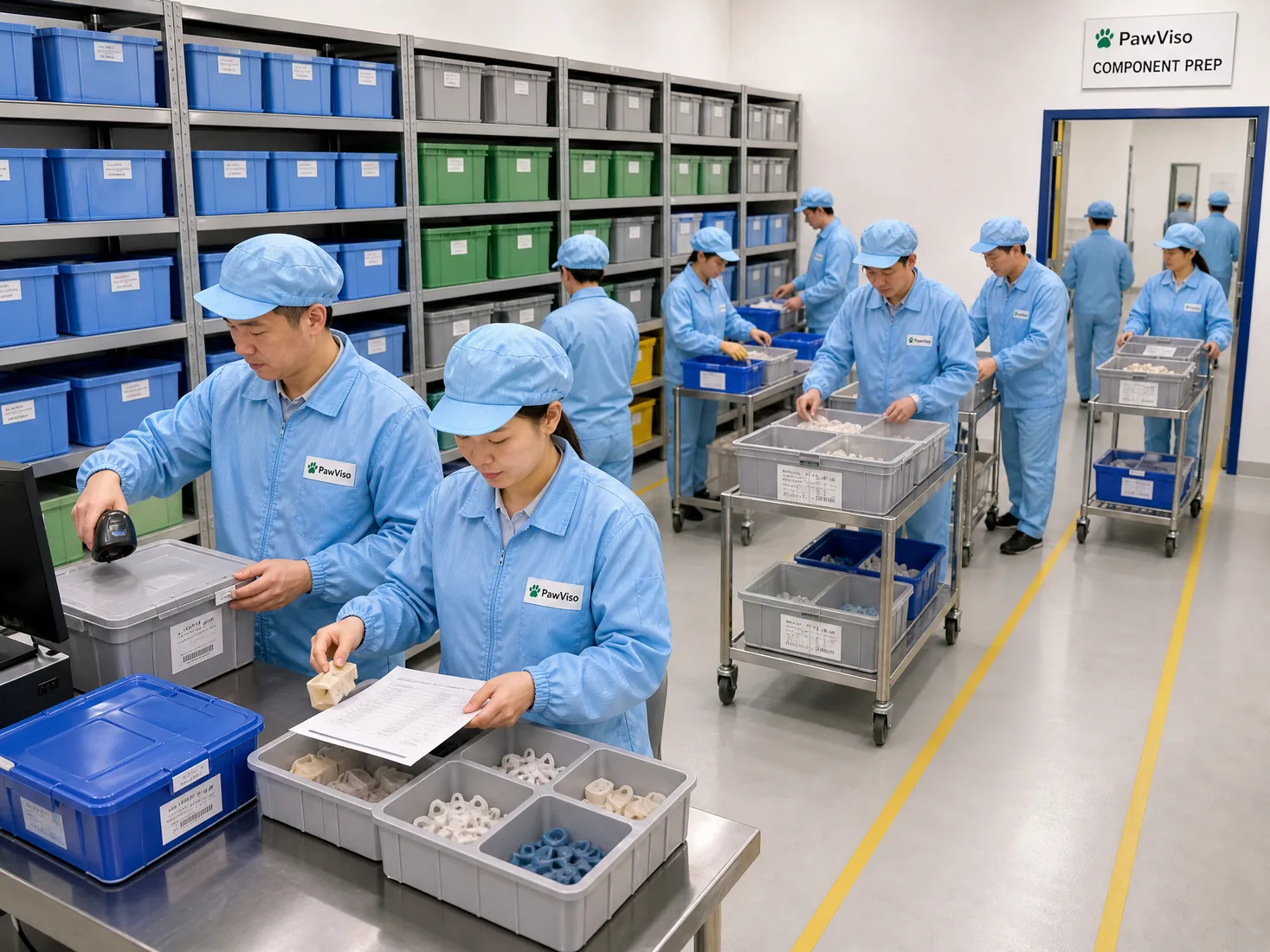
This guide gives U.S.-market buyers a practical, procurement-first framework for sourcing dog bandanas bulk and adjacent pet apparel categories. It focuses on what retail, import, and private-label teams need to compare suppliers, validate materials and components, run sampling programs, prepare retail-ready packaging, design quality-control checkpoints, weigh commercial tradeoffs, and turn findings into an actionable buyer plan. It does not provide legal, veterinary, safety, or regulatory guarantees—final confirmation by the buyer or importer is required for obligations in the target market.
Decision framework: what to define before contacting suppliers
Before outreach, clarify four decision drivers. These will focus conversations, reduce wasted samples, and shorten lead times.
- Product scope: define which SKUs and categories you want to evaluate—dog bandanas bulk primarily, and whether you also plan to source complementary items such as dog leashes wholesale, dog harnesses wholesale, dog harnesses bulk, dog collars wholesale, dog collars manufacturers relationships, or dog booties bulk.
- Volume and cadence: monthly or seasonal reorder quantities, target EOQ, and initial pilot-run size. Establish your minimum order quantity (MOQ) flexibility requirement.
- Price bands and landed-cost target: target FOB and landed-cost with cushion for duties, freight, and U.S. customs brokerage. Include packaging and labeling costs in landed-cost models.
- Requirements list: must-have attributes (materials, performance thresholds, printing/embellishment, labeling), and must-not-have attributes (restricted substances, banned trims). Put these in a short spec sheet you can send with RFQs.
Use this checklist in first supplier conversations to triage quickly: ability to produce specified MOQ; factory location; sample policy and lead time; evidence of materials and testing; capacity for private-label printing and packaging; OTD (on-time delivery) performance metrics.
Supplier screening and verification (module 1)
Goal: narrow suppliers to a vetted shortlist with production capability and commercial fit.
Screening steps
- Request a company profile: factory vs. trading company, years operating, export markets, and in-country business registration. For private-label control, prioritize factory partners or trading partners that provide audited factory assignments.
- Ask for production data: standard lead times, peak capacity, minimums by SKU, and current backlog. Confirm ability to scale from a pilot (hundreds) to commercial (thousands+) runs.
- Financial and compliance checks: request proof of export sales, bank reference or trade reference, and copies of relevant factory audits or inspection reports (e.g., social compliance). Do not treat a supplied audit as exhaustive—plan verification sampling.
- Request supplier references: two or three references on similar product types. Ask about communication responsiveness and change-management during production.
- Confirm IP and tooling approach: who owns patterns, printed artwork setup files, and sample molds. Agree IP terms in writing.
Red flags
- Refusal to identify factories or provide production photos.
- No sample policy or unreasonable sample costs/time.
- Unclear MOQ or inability to show previous exports of similar goods.
Quick supplier scorecard (example)
| Screening item | Good indicator | Bad indicator |
|---|---|---|
| Factory transparency | Factory name, photos, production lines | Vague, no factory info |
| MOQ flexibility | Pilot MOQs available | Rigid high MOQ only |
| Lead time | Confirmed lead time for samples & bulk | “Depends” without details |
| Test & material evidence | Can supply material specs & test reports | No documentation |
Use the scorecard to reduce to three suppliers for detailed RFQs and sampling.
Product specifications and material/component evidence (module 2)
Goal: write a concise spec pack for dog bandanas bulk purchases that aligns expectations and reduces rework.
Specification elements to include
- SKU level description: dimensions (length/width/gusset), shape (triangle, band, kerchief), size variants (XS–XL), and closure type (snap, Velcro, tie).
- Materials: fabric content (e.g., 100% cotton canvas, cotton-poly blend, microfiber), thread type, label and care tag composition, hardware materials (plastic snaps, metal rivets).
- Manufacturing tolerances: measurements ± allowed variance (e.g., ±0.25 in), seam allowance, stitch density (stitches per inch).
- Decoration specs: print method (rotary screen, digital DTG, heat transfer), print colors with Pantone references, placement tolerances, embroidery stitch count and backing.
- Trims and accessories: snap size and specification (material, tensile rating), Velcro width and peel strength, reinforcement patches.
- Care and labeling: country of origin wording, fiber content statements, care instructions, and UPC/GTIN placement.
Material and component evidence
- Request mill certificates and material data sheets for fabric and trims. For textiles, a composition certificate and weight (gsm or oz/yd²) are baseline evidence.
- Ask suppliers for photos and technical scans of trims and hardware. For plastic parts, ask for material grade (e.g., PA+GF, ABS) and supplier.
- For printed or dyed fabrics, request colorfastness and wash test results where available; obtain lab test reports if the volume justifies it.
- If you will target specialty claims (e.g., OEKO-TEX, recycled content), request valid certifications and chain-of-custody documentation from the supplier.
Table: Minimum spec pack checklist for a bandana SKU
| Spec area | Minimum required evidence |
|---|---|
| Fabric composition | Fiber content %, weight (gsm), weave type |
| Closure hardware | Material, supplier, tensile or peel test data |
| Decoration | Print method, color references, proof image |
| Labeling | Sample care tag and placement photo |
| Tolerances | Measurement tolerance table |
Remember: these are specification controls, not performance guarantees. Buyer/importer confirmation required for regulatory and safety obligations in the U.S.
Sampling, pilot-run checks and validation (module 3)
Goal: validate production capability and confirm finished product meets your spec pack before committing to larger orders.
Sample types and sequencing
- Initial pre-production sample (PPS): made to your spec pack and used for approval of size, materials, print alignment, and basic quality. Accept or request corrections.
- Material swatches and hardware samples: individual pieces (fabric swatches, snaps, Velcro) to test compatibility with your supply chain and confirm tactile/ease-of-use expectations.
- Size set samples: full-size samples across XS–XL to verify grading and fit for different dog sizes.
- Pilot production run: an intermediate run of 200–1,000 units to expose production variability, packaging issues, and quality defect rates.
Checks to run on samples
- Dimensional check: measure against spec with tolerance table.
- Stitch and seam inspection: sample 10 units for stitch density, skipped stitches, seam slippage.
- Attachment strength: pull test for snap and reinforced areas.
- Decoration durability: rub, wash, and colorfastness checks if print/dye is used.
- Labeling and compliance: verify care labels and country-of-origin labeling are correct and durable after washing.
Acceptance criteria Define acceptable defect rates (e.g., AQL levels) and defect categorization: critical, major, minor. For wearables, critical defects include choking hazards or loose hardware; major defects affect function or appearance; minor defects are cosmetic.
Sampling logistics and cost management
- Agree sample costs and lead times up front. Typical practice: supplier charges for PPS and returns costs.
- For overseas suppliers, consider third-party sample consolidation domestically to accelerate evaluation.
- If you plan to expand into related product lines (dog leashes wholesale, dog harnesses wholesale, etc.), negotiate bundled sample discounts to reduce per-item sample cost.
Packaging, retail readiness, and supply-chain considerations (module 4)
Goal: ensure bandanas arrive retail-ready, protect product integrity, and optimize cost and display.
Packaging levels
- Inner pack: polybag or compostable bag, size label, UPC sticker, SKU marking.
- Retail-ready pack: header cards, hang tags, eco-friendly card wrap, or blister packaging depending on your shelf/display strategy.
- Bulk carton: quantity per carton, carton dimensions, gross/net weight, palletization instructions.
Retail readiness checklist
- Barcode/GTIN accuracy and placement: confirm size of barcode for retail scanners and placement per retailer requirements.
- Labeling durability: test that care tags and printed labels survive expected handling and washing.
- POS and merchandising: request dielines and mock-ups for hang tags or header cards. Confirm hole placement and hang orientation.
- Environmental and material claims: if using recycled or compostable packaging, request supplier certifications and decomposition evidence.
Table: Packaging decision tradeoffs
| Packaging approach | Pros | Cons |
|---|---|---|
| Minimal polybag (low cost) | Lowest unit cost, lightweight | Lower retail presence, lower perceived value |
| Branded card hang tag | Better shelf appeal, easy merchandising | Higher cost per unit, extra SKUs to manage |
| Recyclable/compostable pack | Consumable brand value | Potentially higher cost, supply variability |
Freight and lead-time alignment
- Consolidate packaging specs with cartonization to calculate freight volume (CBM) and weight. Small changes in packaging can change container utilization and landed cost significantly.
- For fast-moving seasonal SKUs, prioritize ocean booking windows and confirm buffer lead times with suppliers.
Regulatory note: final labeling and safety confirmations must be validated by the buyer/importer for U.S. obligations.
Quality control, commercial tradeoffs, and buyer action plan (module 5)
Goal: put controls in place to sustain product quality across repeated production cycles while managing cost and time tradeoffs.
Quality control program components
- Pre-production checklist: confirm raw-material receipts match certified materials prior to cutting.
- In-line inspection: sample inspection at key production stages—after cutting, after decoration, after assembly.
- Final random inspection (FRI): AQL-based acceptance for finished goods before shipment. Define sample size and defect criteria.
- Third-party inspection or lab testing: for critical tests (strength, colorfastness, restricted-substance screening) use accredited labs or inspection providers.
AQL guidance (example)
- Critical defects: 0 tolerance.
- Major defects: AQL 1.5–2.5% depending on SKU value.
- Minor defects: AQL 4.0–6.5%.
Commercial tradeoffs explained
- Price vs. quality: lower unit price frequently requires higher defect tolerance or higher breathing room for returns. If private-label reputation is key, budget for higher-quality fabrics and stricter QC.
- Lead time vs. MOQ: shortened lead times usually increase per-unit cost or require higher runway inventory—negotiate lead-time tiers tied to pricing.
- Customization vs. flexibility: bespoke prints or custom hardware raise setup costs and tooling lead time; offset by higher retail margin if differentiation matters.
- Consolidation vs. agility: multi-product orders from the same supplier reduce logistics costs but increase risk concentration.
Buyer action plan (practical 8-step)
- Create a one-page spec pack covering all SKUs and send to shortlisted suppliers.
- Request PPS and material swatches from the top three suppliers within a fixed timeline.
- Evaluate samples against predefined acceptance criteria and rank suppliers.
- Run a pilot production (200–1,000 units) with the chosen factory; run in-line and final inspections.
- Negotiate terms: MOQ, price bands with volume breaks, payment terms, lead times, and defect allowances.
- Finalize packaging dielines and order a pre-shipment sample in full retail pack.
- Arrange third-party lab testing or inspection for critical attributes as needed during pilot.
- Approve full production after pilot results meet acceptance criteria; set rolling re-order cadence and a re-audit schedule.
Include parallel sourcing options for related items you plan to carry (dog leashes wholesale, dog harnesses wholesale, dog harnesses bulk, dog collars wholesale, dog collars manufacturers, dog booties bulk) to protect assortment continuity and manage seasonal spikes.
Frequently asked questions
Q: What minimum documentation should I require before placing a bulk order? A: At minimum, require a supplier profile, factory or production photos, material certificates for main textiles and trims, sample approval, and agreed packaging/Packing list. Buyer/importer confirmation is required for regulatory duties and final documentation.
Q: How many samples should I expect to approve before production? A: Plan for at least three iterations: material swatch, pre-production sample (PPS), and a full retail-pack pre-shipment sample. Additional rounds may be required for custom prints or hardware.
Q: Can a trading company reliably manage private-label design? A: Yes, if they disclose the producing factory, provide technical files, and agree IP ownership and tooling arrangements. Prefer factories when close control and customization are critical.
Q: How should I set acceptable defect rates? A: Define critical defects at zero tolerance. Major and minor defects should match product value and brand tolerance—common ranges are 1.5–4.0% for majors and 4.0–6.5% for minors. Adjust after pilot runs and align with supplier contracts.
Conclusion
Sourcing dog bandanas bulk for the U.S. B2B market requires concise specifications, a controlled sampling cadence, and disciplined supplier verification. Build a spec pack that covers fabric, closures, decoration, labels, and tolerances; insist on material evidence and appropriate tests for your commercial risk threshold; run pilot production with defined inspection gates; and align packaging and cartonization to landed-cost targets. Balance commercial tradeoffs—price, lead time, customization, and quality—against brand positioning and margin goals. Include contingency suppliers for adjacent categories (dog leashes wholesale, dog harnesses wholesale, dog harnesses bulk, dog collars wholesale, dog collars manufacturers, dog booties bulk) when planning assortment and scale. No regulatory, safety, or performance guarantee is made here—buyer/importer confirmation is required to satisfy U.S. market obligations.
Buyer search scope
This guide addresses the following U.S. B2B procurement search phrases. Each phrase is considered in the context of supplier selection, product specifications, samples, packaging and quality evidence rather than as a consumer recommendation.
| Search phrase | Buyer use |
|---|---|
| dog bandanas bulk | Primary procurement focus for this guide |
| dog leashes wholesale | Related specification, supplier or range-planning query |
| dog harnesses wholesale | Related specification, supplier or range-planning query |
| dog harnesses bulk | Related specification, supplier or range-planning query |
| dog collars wholesale | Related specification, supplier or range-planning query |
| dog collars manufacturers | Related specification, supplier or range-planning query |
| dog booties bulk | Related specification, supplier or range-planning query |
Final CTA — Prepare a focused dog walking & apparel sourcing brief with PawViso.
Share your target U.S. channel, product format, estimated order structure, packaging direction and customization requirements for a practical B2B discussion.
Email: info@PawViso.com
WhatsApp: +86 186 8106 4480
Related PawViso resources
- Continue with How to Source Adjustable Dog Harnesses to compare a related supplier, sample and quality-control route.
- Browse the PawViso product catalogue to identify product formats for your purchasing brief.
- Follow the PawViso sourcing process and review the B2B buyer FAQ before sharing requirements.
External reference
Use ISO 9001 quality-management systems guidance as general quality-system context, and confirm the product-specific evidence that applies to the selected SKU, channel and target market.