
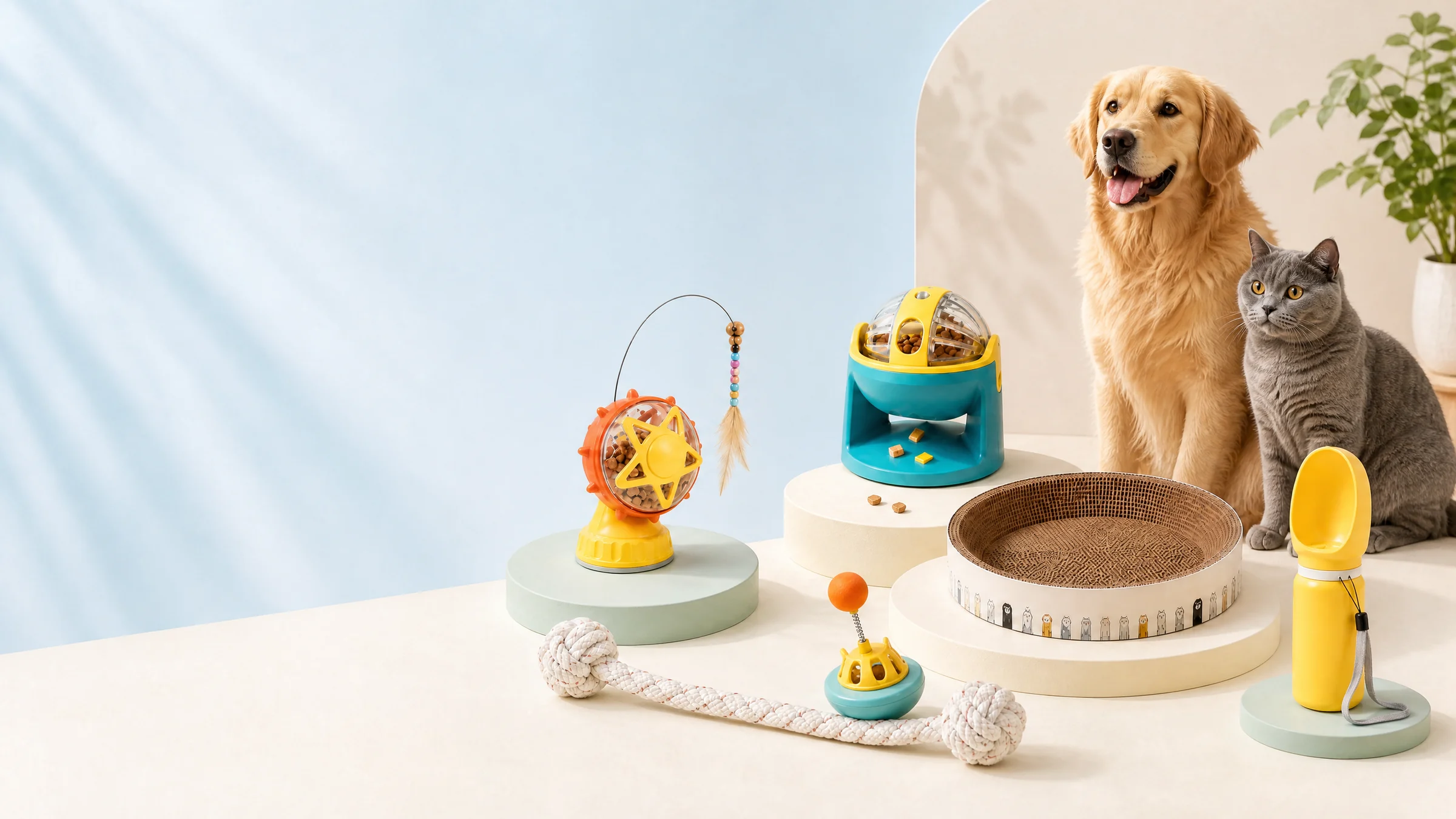
This guide helps U.S. retailers, importers, distributors, and private-label teams source pet accessories reliably from Chinese manufacturers. It focuses on practical procurement steps: how to screen suppliers, define specifications, verify materials and components, run samples or pilot production, prepare retail-ready packaging, set quality controls, assess commercial tradeoffs, and convert findings into an actionable buying plan. This is sourcing guidance, not regulatory, legal, or performance assurance. Buyer/importer confirmation is required for final product claims and target‑market obligations.
Decision framework: prioritize risk, cost, and time to market
Sourcing decisions balance three core priorities: product risk (safety, compliance, durability), cost (unit price, landed cost, MOQ), and speed (sample lead time, production cadence, shipping). Define which priority wins for each SKU before engaging suppliers.
- If safety/compliance is the priority (e.g., toys with small parts, chewable items), budget more time and third-party testing.
- If cost is the priority (basic collars, plain bandanas), expect higher MOQs and more supplier choices.
- If speed is the priority (seasonal assortment), accept shorter lead times at higher unit cost or use air freight.
Use this simple scoring to compare suppliers quickly—score 1–5 on Risk, Cost, Time and weight them to match your business objective.
| Decision weight example | Risk (safety/compliance) | Cost sensitivity | Speed requirement |
|---|---|---|---|
| Safety-first | 5 | 2 | 2 |
| Cost-first | 2 | 5 | 2 |
| Speed-first | 2 | 3 | 5 |
Translate your weighted score into supplier requirements: higher Risk score → require factory certifications, full BOM, and lab test history; higher Cost score → prioritize factories with tooling in place and higher-volume capabilities; higher Speed score → favor local warehouse stock or shorter shipping lanes.
Note that for many pet accessory categories (leashes, collars, harnesses, beds, toys, bowls), material evidence and construction detail drive risk and performance. When engaging "pet accessories manufacturers in china" and "dog accessories manufacturers in china", you should request objective material and test evidence early.
Supplier screening: how to filter and validate manufacturers
A robust screening step prevents wasted time. Use a layered approach: desk screening, pre-qualification questionnaire (PQQ), document review, and an in-person or third-party factory audit if risks or order size justify it.
Essential desk screening items:
- Business license and export license scans.
- Years in business and main product lines.
- Factory vs trading company status; request factory photos and production lines.
- Export references and recent US export experience.
- Typical MOQ, lead times, and normal payment terms.
Key PQQ fields to collect:
- Production capacity (units per month per SKU).
- Mold/tooling ownership for injection-molded or molded-plastic items.
- Materials list (BOM) and available material test reports (e.g., SGS, Intertek).
- Secondary processes (sewing, welding, bonding, surface finishing).
- Available quality certifications (ISO 9001 for process, BSCI/SMETA for social compliance).
- Sample policy and sample lead time.
Compact screening checklist (use for quick scoring):
| Screening item | Must have | Acceptable | Red flag |
|---|---|---|---|
| Factory capability | Dedicated production line for pet accessories | Works with subcontractors | No factory photos or inconsistent answers |
| Materials evidence | Provides third-party test reports or material certificates | Internal test data only | No material info |
| MOQ & lead time | Matches buyer’s volume strategy | Higher MOQ but acceptable | MOQ > buyer budget and no flexibility |
| Compliance experience | Exported to U.S./EU before | Export experience but no US refs | No export history |
When you move from trading companies to direct factories, confirm legal entity matching on license, VAT, and customs records. For "pet accessories wholesale suppliers" and "pet accessories bulk buy" enquiries, trading companies sometimes add value for lower order sizes but increase the verification you need for quality chain visibility.
Always ask for recent samples of similar SKUs, not just promotional photos. For private label requirements, make clear ownership of tooling, artwork, and packaging rights in contract drafts.
Product specifications and material/component evidence
Precise specifications are the single biggest determinant of reproducible quality. A good spec reduces back-and-forth and protects you during inspection and testing.
What to include in a product spec:
- Technical drawing with tolerances (mm) and exploded view for assemblies.
- Bill of materials (BOM) with explicit material names, grades, and supplier options.
- Critical dimensions and function points (e.g., load-bearing points on harnesses).
- Manufacturing process notes (seam type, stitch count, welding parameters, glues and adhesives with chemistries).
- Finish and color systems (Pantone, dye lot, surface texture).
- Packaging and label placement.
Material/component evidence you must collect:
- Supplier material safety data sheets (MSDS) for chemicals, adhesives, and plastics.
- Certificates of conformance (CoC) stating material grade—e.g., nylon PA6, 100% cotton, food-grade silicone.
- Third-party test reports for priority risks (phthalates, lead, flammability) where relevant.
- Photos or micrographs of critical parts (stitch reinforcement, joint welds).
If the item is intended for dogs (collars, leashes, chew toys), use the exact keyword "dog accessories manufacturers in china" when requesting factory references so suppliers understand niche experience. For larger assortments and B2B replenishment, ask suppliers for batch traceability procedures: lot codes on raw materials, certificate retention time, and internal QC records.
Table: Minimal material evidence by product type
| Product category | Minimal material evidence |
|---|---|
| Collar / leash / harness | Fiber grade, hardware metal spec (zinc alloy vs stainless steel), coating details, pull-test results |
| Textile bandanas / clothing | Fiber content, colorfastness test, shrinkage rate |
| Toys (soft/plush) | Fabric fire retardancy rules, stuffing origin and filler spec, small-parts retention test |
| Bowls / feeders | Food-contact grade polymer or stainless spec, migration testing if polymer |
| Beds / mats | Fill material composition, flammability class if sold in jurisdictions that require it |
Do not accept vague statements such as “food-grade plastic” without supplier-supplied certificates. For private-label pet accessories, align material evidence with your brand claims and provide suppliers with written approval gates.
Buyer/importer confirmation is required for any final regulatory or safety claims; this guide does not substitute for legal compliance checks.
Sampling, pilot runs, and verification checks
Sampling is where specifications meet reality. Structure sampling to reduce iterations: prototype sample, pre-production sample (PPS), and a pilot production batch.
Sampling plan:
- Prototype sample: validates design and fit. Usually a one-off made by pattern-makers or prototyping machines.
- Pre-production sample (PPS): made on the intended production line with final materials and labels. Use PPS to confirm assembly steps and fixtures.
- Pilot run: short-run batch (50–500 units depending on complexity) to test packaging, logistics, and QC sampling plans.
What to test on samples:
- Dimensional checks against spec (use calipers, gauges).
- Functional tests (load tests, zipper pull cycles, buckle fatigue).
- Material tests (colorfastness, tensile strength) — either in-house or sent to labs.
- Wear tests where applicable: abrasion for fabric collars; chew resistance for toys.
- Retail-ready tests: shelf-fit, hang-tag placement, UPC/label scanning.
Checklist for a PPS approval meeting:
- All critical dimensions within tolerance.
- BOM verified: supplier changes documented and approved.
- Packaging prototype: dielines, barcodes, and retail-ready markups approved.
- Test reports for any required materials received and accepted.
- Final unit cost and lead time confirmed.
Sampling lead times vary: expect 1–3 weeks for simple textile items, 3–6 weeks for items requiring molds or tooling. For private label pet accessories with custom tooling, include tool sample reviews and pre-production part approvals.
Do not proceed to full production unless PPS meets acceptance criteria. For "pet accessories wholesale suppliers" or "pet accessories bulk buy," treat pilot runs as mandatory risk mitigation for large orders.
Packaging and retail readiness
Retail success depends on how products present and withstand logistics. Packaging decisions affect cost, shelf presence, and damage rates.
Key packaging considerations:
- Primary packaging: how product is presented (blister, paper wrap, bag).
- Secondary packaging: cartons, inner trays, dividers for mixed SKUs.
- Retail hangers, UPC placement, barcode type (EAN/UPC), and scannability tests.
- Retail size and shelf compatibility (pegboard holes, shelf footprint).
- Tamper-evidence and child-safety considerations where relevant.
- Sustainability goals: recycled content, recyclable vs compostable, and any claim substantiation.
Use the following compact table to decide packaging options by channel:
| Channel | Typical packaging focus | Minimum packaging test |
|---|---|---|
| Big-box retail | High shelf presence, bulk carton efficiency | Drop test (carton), scannability |
| Specialty pet stores | Premium presentation, hang tags | Shelf-fit mockup, hang-test |
| E-commerce direct-to-consumer | Damage protection, branding unboxing | Transit vibration and crush test |
| Wholesale palletized | Carton optimization, pallet patterns | Compression test, pallet stability |
Packaging details to require from suppliers:
- Carton dimensions, material GSM, and test certs (e.g., Edge Crush Test values).
- Unit-per-carton and corkage rates for mixed SKU cartons.
- Proofed dielines, print-ready artwork, and a color mockup.
- Packaging supplier contact and supply lead times.
Labeling and compliance: ensure all labels meet U.S. import and retail requirements for textiles, toys, and food-contact items when applicable. Remember: buyer/importer confirmation is required for any regulatory label claims.
For private label pet accessories, establish brand protection measures: trademark use permissions, packaging mockup approvals in writing, and tooling ownership clarity if custom packaging components are produced.
Quality control and inspection protocols
A layered QC regime reduces defects and disputes. Your QC plan should be proportionate to order value and product risk.
QC stages:
- Incoming material inspection (IMI): verify raw materials against supplier CoCs.
- Inline inspection: periodic checks during production (e.g., first shift, mid-run, final shift).
- Pre-shipment inspection (PSI): AQL-based checks or 100% inspection for critical items.
- Factory test records: maintain copies of production tests and batch samples.
Inspection checklist items:
- Appearance and cosmetic defects (stitching, seams, surface blemishes).
- Functional checks (buckle strength, zipper operation).
- Measurement verification against spec (critical dims).
- Packaging and label verification.
- Lot traceability: lot numbers, date codes, and test records attached to cartons.
AQL and sampling plans: define acceptance quality limit (AQL) based on defect criticality:
- Critical defects (safety hazards): zero tolerance; 100% inspection or stop shipment until resolved.
- Major defects (function failures): stricter AQL (e.g., 0.65–1.0).
- Minor defects (cosmetic): AQL can be higher (e.g., 2.5–4.0) depending on channel.
When working with "pet accessories manufacturers in china" and planning "pet accessories bulk buy" orders, include a clear defect-resolution and credit memo process in the contract. Specify rework rates, allowable rework procedures, and disposition authority (who decides to accept/reject after rework).
Third-party testing labs and inspection providers can be engaged to conduct product testing and pre-shipment inspections. Keep copies of all inspection and test reports in your supplier performance file. Buyer/importer confirmation is required for any test-based compliance and market-entry decisions.
Commercial tradeoffs: cost, MOQ, lead time, and tooling
Commercial characteristics of Chinese pet accessory suppliers typically involve tradeoffs:
- Price vs MOQ: Lower unit prices usually require higher MOQs to justify setup and material runs.
- Lead time vs cost: Faster production or air freight increases landed cost; sea freight saves but adds transit time.
- Customization vs unit cost: Private label, custom hardware, or unique tooling adds one-time tooling cost but can reduce per-unit cost over larger runs.
- Quality vs speed: Higher-quality finishes and tighter tolerances usually increase lead time and cost.
Quick decision matrix to evaluate tradeoffs:
| Tradeoff point | Lower cost option | Lower risk/high quality option | Typical consequence |
|---|---|---|---|
| MOQ | Consolidate SKUs, accept standard sizes | Pay tooling or order MOQ premium | Lower cost per unit vs higher inventory |
| Lead time | Use existing stock or air freight | Allow sea transit and extended production | Higher transport cost vs lower unit cost |
| Custom hardware | Use standard off-the-shelf hardware | Invest in custom dies/metal working | Differentiation vs higher initial spend |
| Testing | Rely on supplier CoCs | Commission third-party lab tests | Faster sourcing vs increased certification cost |
Negotiation levers:
- Consolidate orders across SKUs to meet MOQs.
- Commit to longer-term contracts for lower pricing tiers.
- Offer rolling production schedules to smooth capacity needs.
- Share partial tooling costs for exclusivity or brand protection.
Factor in landed cost with a full cost build-up: FOB price, packaging, internal QC, testing, inland freight, sea or air freight, duties, customs brokerage, insurance, and handling. For private label dog accessories and other custom assortments, account for design and artwork approval cycles. Use conservative timelines for customs clearance, and build buffer stock for peak seasons.
Frequently asked questions
Q: What basic documents should I require from a new Chinese manufacturer? A: Request a scanned business license, export registration, VAT or tax ID, product photos and recent shipment references, material CoCs, sample photos, and a PQQ with capacity and lead-time info. For significant orders, require factory audit reports and third-party test reports.
Q: How do I ensure a supplier uses the correct materials rather than substitutes? A: Require MSDS and CoCs for materials, specify unique material identifiers in the BOM (grade, supplier), request material supplier contacts, and perform incoming raw-material inspections. Include penalties for unauthorized material substitution in contracts.
Q: When should I require third-party lab testing? A: For any product where safety, chemical migration, or food-contact concerns exist, or when selling to big-box retail requiring verified tests. Also for new materials, custom finishes, or when liability and brand reputation are high. Buyer/importer confirmation is required for final compliance determinations.
Q: Can trading companies be a viable source for wholesale and bulk buys? A: Yes—trading companies can consolidate SKUs and handle small MOQs, but they add a layer between you and the factory. Verify their supplier network, request traceability documents, and apply the same QC and testing expectations as you would with a factory.
Conclusion
Sourcing pet accessories in China for the U.S. market is a structured process: set your priority (risk vs cost vs time), screen and pre-qualify suppliers, lock down precise specifications and BOMs, validate materials with evidence, execute staged sampling and pilot runs, confirm retail-ready packaging, and enforce a tiered QC regime. Commercial tradeoffs are inevitable—map them to your margin and inventory strategy and negotiate accordingly.
This guide outlines operational best practices and decision tools for engaging "pet accessories manufacturers in china", "dog accessories manufacturers in china", "pet accessories wholesale suppliers", "pet accessories bulk buy", "dog accessories wholesale market", "private label pet accessories", and "private label dog accessories". It does not replace any legal, regulatory, or veterinary review; buyer/importer confirmation is required to meet final market obligations. Use the checklists and tables here to create an actionable purchase order and inspection plan before committing significant budget or tooling investments.
Buyer search scope
This guide addresses the following U.S. B2B procurement search phrases. Each phrase is considered in the context of supplier selection, product specifications, samples, packaging and quality evidence rather than as a consumer recommendation.
| Search phrase | Buyer use |
|---|---|
| pet accessories manufacturers in china | Primary procurement focus for this guide |
| dog accessories manufacturers in china | Related specification, supplier or range-planning query |
| pet accessories wholesale suppliers | Related specification, supplier or range-planning query |
| pet accessories bulk buy | Related specification, supplier or range-planning query |
| dog accessories wholesale market | Related specification, supplier or range-planning query |
| private label pet accessories | Related specification, supplier or range-planning query |
| private label dog accessories | Related specification, supplier or range-planning query |
Final CTA — Prepare a focused pet accessories & assortments sourcing brief with PawViso.
Share your target U.S. channel, product format, estimated order structure, packaging direction and customization requirements for a practical B2B discussion.
Email: info@PawViso.com
WhatsApp: +86 186 8106 4480
Related PawViso resources
- Continue with How to Build a Pet Travel Accessories Range to compare a related supplier, sample and quality-control route.
- Browse the PawViso product catalogue to identify product formats for your purchasing brief.
- Follow the PawViso sourcing process and review the B2B buyer FAQ before sharing requirements.
External reference
Use ISO 9001 quality-management systems guidance as general quality-system context, and confirm the product-specific evidence that applies to the selected SKU, channel and target market.