
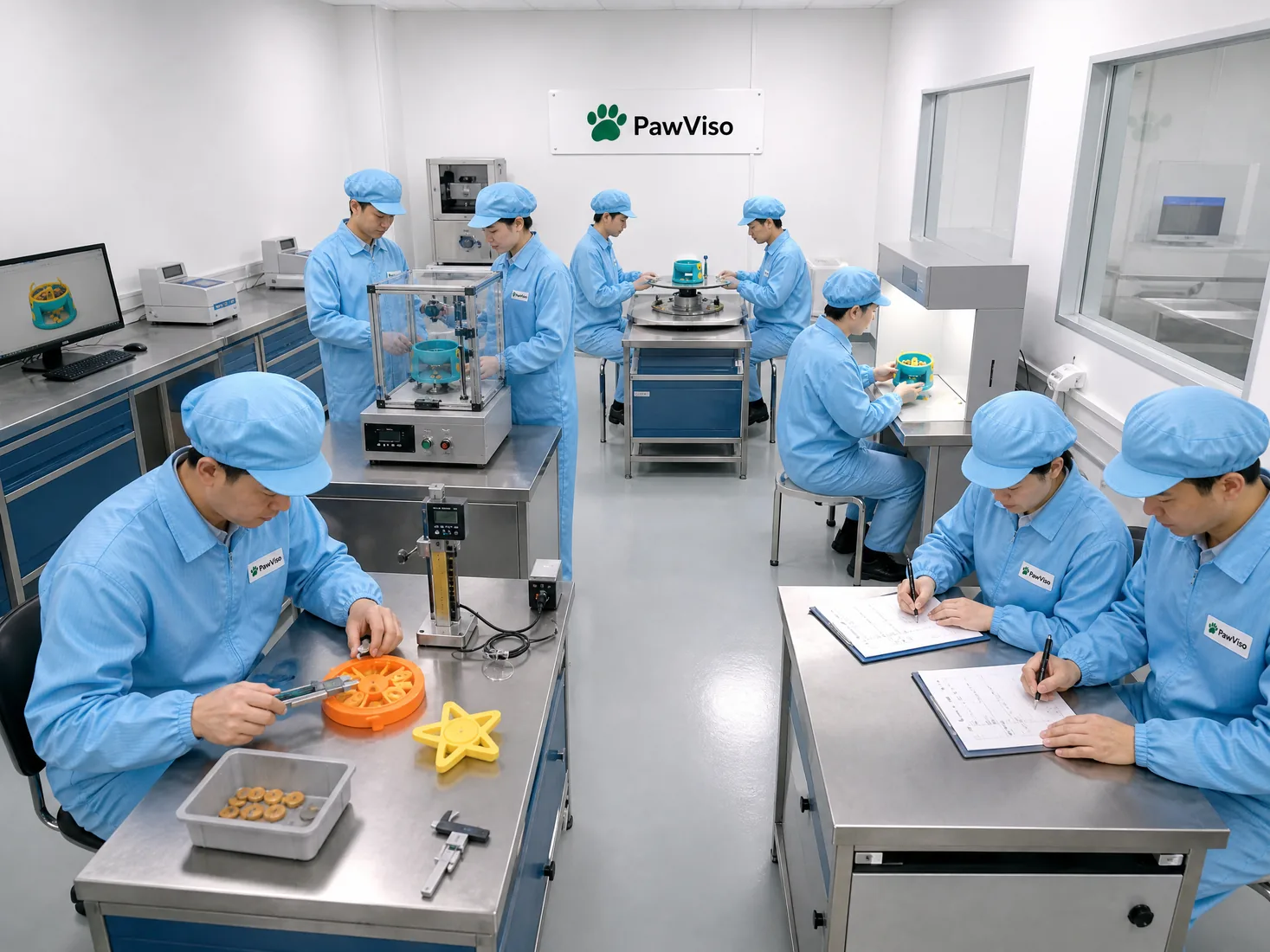
Module 1 — Buyer intent and decision boundary
Buyers planning a product launch need a clear, written intent that defines what a retained sample is for and what it is not. A retained sample can support later visual comparisons, clarify approval decisions and act as evidence in commercial disputes. It must never be treated as a substitute for a formal specification, a test record, or final compliance documentation. Buyers and importers must confirm final product, claim, testing, documentation, contract and destination-market decisions.
Start by defining the decision boundary: the specific decisions for which launch samples will be admissible evidence (e.g., visual appearance, packaging artwork match, assembly fit) and those for which they cannot be used (e.g., material composition, chemical safety, flammability). Documenting the boundary prevents later misinterpretation when commercial pressure mounts or when a supplier claims a retained sample is a definitive test result.
Practically, your sample-retention policy should answer the following upfront:
- Who is the owner of the retained sample while in transit, at inspection, and once archived?
- What types of artifacts are retained (final boxed product, inner components, photographs, approvals, negative/exception notes)?
- For which business decisions will retained samples be admissible?
- What is the retention period and disposal plan?
- Who must sign off to release or dispose of archived samples?
A quality-management context helps: maintain alignment with your broader quality-control and record-keeping systems so retained samples are traceable to the supplier lot, production date and approval point 1. This ensures that samples play a clear, auditable role in post-launch comparisons without being used improperly as a stand-in for testing or regulatory submission documents.
Module 2 — Scope, roles and evidence
Define scope clearly: which SKUs and lots are in scope for pet product launch sample retention? Are you retaining only first-article samples, pre-production approvals, master production samples, or periodic reference samples? Clarify whether packaging approvals, hang tags and assembly jigs are included.
Assign roles and responsibilities across buyer, supplier and any third-party inspector. Roles should be discrete and recorded in your buyer supplier sample records:
- Buyer: defines retention policy, authorizes archival, receives and verifies samples, maintains the approved sample archive.
- Supplier: produces, labels and ships launch samples; certifies if a sample reflects production intent.
- Third-party agent: conducts inspection, photographs, and may store or return samples under instruction.
Table — Role matrix (concise decision aid)
| Responsibility | Typical primary actor | Typical secondary actor |
|---|---|---|
| Produce labeled sample | Supplier | Buyer (approval check) |
| Initial inspection and photography | Third-party inspector | Buyer QC |
| Archive custody and cataloging | Buyer | 3PL/archival vendor |
| Exception notification | Buyer | Supplier |
(Use this table as an illustrative guide; assign exact roles in contract.)
Different markets and product types may require different supporting evidence. Note that guidance for children's toys and applicable toy-safety standards is distinct and should not be automatically applied to pet products; toys guidance may be a point of reference but does not necessarily map to pet-product classification or testing 2.
Types of evidence to collect and index in the approved sample archive:
- Physical sample labeled with supplier lot, serial number, production date.
- High-resolution photographs showing designated angles, packaging artwork, label copy and SKU identifiers.
- Signed approval documents, including versioned artwork approvals and any written exceptions.
- Inspectors’ checklists and notes that align individual physical attributes with specification clauses.
- Chain-of-custody logs documenting transfers and storage conditions.
Table — Minimum evidence checklist for each archived sample
| Evidence item | Why it matters |
|---|---|
| Physical sample with lot label | Links archive to production run |
| Inspection report | Records measured checks vs. spec |
| Approval signature and date | Shows buyer authorization point |
| Photographic record | Supports visual comparisons later |
| Exception log (if any) | Documents agreed deviations |
All items listed above form a practical "approved sample archive." The archive is not a substitute for test reports, certificates of analysis or full technical specifications. Keep the difference explicit in your records so auditors or legal reviewers can see what the archive is intended to prove and what decisions still require formal testing or regulatory documentation.
Module 3 — Product and data control points
Control points are the moments and places where custody and data capture must be consistent to make a retained sample useful later. Identify control points from supplier production to your archive and document them in your process maps. Typical control points include: production completion, final packaging, pre-shipment inspection, arrival at your warehouse/3PL, and archival storage.
At each control point, capture standardized metadata. Minimum metadata fields:
- SKU/GTIN (if applicable) and internal product code.
- Supplier identifier and lot/batch number.
- Date of manufacture and date sample was taken.
- Sample ID and archive reference number.
- Inspection location and inspector identity.
- Storage conditions (temperature/humidity if relevant).
- Chain-of-custody transfer signatures.
If you use GTINs/trade-item codes for SKUs, reference trade-item identification best practice so archives can link to retail systems and barcode records 3. Use GTINs where available to avoid ambiguity between similar variants.
Table — Control-point data capture template (concise)
| Control point | Metadata required |
|---|---|
| Production completion | SKU, lot, date, production notes |
| Pre-shipment inspection | Inspection report ID, photos, nonconformances |
| Handover to buyer | Transfer receipt, carrier, LRN |
| Archive entry | Archive ID, storage location, retention period |
Implement electronic record capture whenever feasible. Photographs, inspection reports and PDF approvals should be indexed to the sample's archive ID. Where paper documents are used, scan immediately and store both paper and digital with cross-references.
Document version control for specifications and approvals: archive the exact version and date of the specification that the sample purports to represent. This prevents later disputes where a supplier claims the retained sample reflects a different specification revision.
A formal chain-of-custody log should be appended to every physical sample. The log needs consistent, timestamped handover entries so that later forensic comparisons — for example, checking a component against contamination claims — can be contextualized.
Module 4 — Supplier communication and approvals
Clear, written communications with suppliers are essential to avoid misunderstandings about what a retained sample represents and how exceptions were managed. Use structured approval forms and require supplier acknowledgment for two areas: sample representativeness and exception acceptance.
Representative statement: require the supplier to state whether the submitted sample is a “production-intent sample” that replicates the intended production process, tooling and materials, or if it is a pre-production prototype. This statement should be included in the archive.
Exception handling: any deviations from the specification discovered during inspection must be documented as exceptions and either rejected, accepted with agreement or subject to corrective action. Exception agreements should be in writing, dated, and signed by an authorized buyer representative.
When approvals are given, capture the approval scope explicitly:
- Does the approval allow the supplier to ship the lot to customers or only to proceed to production?
- Are the approval and sample intended to serve as a living reference in the approved sample archive?
- Does the approval cover packaging artwork only, or does it also cover material changes?
Use a standard approval form that captures the above and annex photos and inspector comments. This form should be stored with the approved sample archive.
Communicate expectations about photographic records and claims. Photographs document visual features but are not evidence for technical claims such as material composition or environmental claims; make sure suppliers and approvers understand that photos support visual comparisons but do not replace testing or certificates. If the buyer will accept documented environmental marketing claims, such claims must be supported by the appropriate, evidence-backed documentation (e.g., qualified certification or test data) and linked to those records, not solely to images 4.
For frequent or complex product lines, establish a supplier-sample protocol that standardizes angle shots, measurement points and labeling formats. This reduces interpretation variability when reviewers change.
Module 5 — Sample, packaging and operational checks
When retaining launch samples, conduct a layered set of checks that separates objective measurement from visual assessment and contractual approvals.
Physical checks (objective):
- Dimensional verification against the specification (record measured values and tolerance).
- Material identification where relevant (e.g., polymer type visually marked or accompanied by material declaration).
- Safety-critical features (e.g., small parts, fasteners, closures) verified against the safety checklist.
Visual checks (comparative):
- Color consistency in photos under controlled lighting.
- Print and artwork alignment on packaging.
- Label content match (mandatory statements, barcodes, legal copy).
Operational checks (functional):
- Assembly/disassembly steps recorded.
- Fit of accessories or replacement parts.
- Basic durability motions (not a substitute for lab tests).
Table — Sample check matrix (illustrative checklist)
| Check type | Example check | Record to capture |
|---|---|---|
| Physical | Measured dimensions | Measurement sheet, tolerances |
| Visual | Artwork color match | Controlled photos, color notes |
| Operational | Closure snaps | Video or inspector note |
(Use table as an illustrative template.)
Create a triage approach for issues identified during checks:
- Minor visual variance (document, accept with notation).
- Nonconformance to safety-critical spec (raise as an immediate hold and require corrective action).
- Documentation mismatch (suspend approval until buyer confirmation).
Ensure the procedures for returning or disposing of samples that fail checks are written and agreed with the supplier, including cost allocation for returns or disposal. Recording these decisions in the approved sample archive is essential to preserve the context of why a sample was archived or withdrawn.
Remember that a retained sample may not substitute for formal regulatory testing. If a product requires lab testing to meet destination-market regulations, preserve samples specifically labeled for testing and do not use archive samples as test specimens unless that was predefined and agreed.
Module 6 — Quality controls and exception decisions
Quality control around retained samples requires consistent criteria and escalation paths. Define acceptance criteria for what constitutes an “approved sample” and an “archive sample.” The approved sample is usually the physical artifact that matches the specification and has buyer sign-off to serve as the visual reference; the archive sample is the stored record that may also include packaging and approval documentation.
Exception decisions should follow a documented matrix that explains the type of deviation, the proposed disposition and required approvals. Exceptions typically fall into categories:
- Cosmetic deviations
- Fit/function deviations
- Safety-critical deviations
- Documentation or labeling deviations
Table — Exception-decision quick matrix (illustrative)
| Deviation type | Immediate action | Approval required |
|---|---|---|
| Cosmetic | Note and accept/reject | Buyer product manager |
| Fit/function | Hold and investigate | Buyer QA + supplier |
| Safety-critical | Stop shipment | Buyer QA + regulatory counsel |
| Labeling | Correct and reissue | Buyer marketing + legal |
Adopt a two-person rule for accepting exceptions that affect safety or compliance: one operations or procurement manager plus a quality or regulatory expert must sign the exception. This helps prevent unilateral acceptance that later becomes a liability.
Keep audit trails for all decisions. Use timestamps, electronic signatures where possible and store incident narratives in the approved sample archive. Quality-system alignment is important: ensure sample retention and exception logs are auditable as part of your wider quality management processes 1.
Note: While photos and retained samples provide valuable evidence, they are not the same as third-party lab reports or certificates. Use retained samples to corroborate issues and support traceability, not to certify compliance.
Module 7 — Commercial and change-control tradeoffs
There are commercial tradeoffs when deciding how many samples to retain, who stores them, and who pays for storage and return. Decisions about cost, risk, and responsibility should be negotiated into contracts and purchase orders before sample submission. Use contract language to allocate responsibilities for custody, storage fees, loss/damage, and testing costs where archive samples are requested back for follow-up analysis.
When drafting these contractual terms, consider including:
- Who pays for initial sampling and inspection?
- Who bears shipping and return costs for retained samples?
- Who pays for long-term storage or destruction?
- How are costs allocated if a sample is required for dispute testing?
Explicit allocation of cost, risk and responsibilities is good contract planning practice. Consider using standard clauses that allocate sample-related costs and dispute-resolution procedures to avoid later disagreements 5.
Change control: treat any supplier change (material, process, tooling) as requiring a new sample and explicit re-approval. Define thresholds that trigger re-sampling (e.g., changes to material supplier, manufacturing location, tooling, or safe-use labeling). Maintaining a living log of changes tied to your approved sample archive is key for post-launch quality tracking.
Table — Change-trigger examples (illustrative)
| Change | Trigger re-sample? | Typical justification |
|---|---|---|
| Material grade change | Yes | Different properties may affect performance |
| Secondary packaging change | Maybe | If it affects shelf presentation or protection |
| Artwork color tweak | No | If minor and within agreed tolerance |
| Manufacturing site move | Yes | Process variation risk |
Ensure that buyers retain authority to require a re-sample and formal approval before accepting changed lots. Again, buyer/importer confirmation is required for final product, claim, testing, documentation, contract and destination-market decisions.
Module 8 — Logistics, handover and record retention
Logistics and handover are practical execution points where custody is established. Decide whether the buyer or supplier will physically store approved samples. Options include buyer-held in a 3PL archive, supplier-held under buyer instruction, or third-party archival services. Each option has operational and legal implications for access, physical security, and cost.
Table — Custody options and tradeoffs (illustrative)
| Custody model | Pros | Cons |
|---|---|---|
| Buyer-held (warehouse/3PL) | Direct control, easier access | Storage cost to buyer |
| Supplier-held (per contract) | Lower buyer storage cost | Access delays, higher dispute risk |
| Third-party archival service | Professional preservation | Additional vendor management |
(Use table as an illustrative decision aid.)
Handover process — standard steps:
- Supplier labels sample with archive ID and production metadata.
- Carrier or inspector records in a transfer receipt with timestamp.
- Buyer or designated 3PL inspects and records arrival condition.
- Archive entry created: physical location, storage condition, retention term.
- Chain-of-custody signed and attached.
Record retention: set retention periods based on business needs, regulatory considerations, and the cost of storage. Common retention drivers include warranty periods, shelf life, and dispute windows. Document the retention schedule in policy and attach it to each approved sample archive entry. When planning retention duration, consider the cost of long-term physical storage versus digital records and high-quality photographs.
Table — Retention-duration decision factors (illustrative)
| Driver | Example consideration |
|---|---|
| Warranty/returns | Retain through warranty period + buffer |
| Shelf life | Retain through expected shelf life for reference |
| Regulatory follow-up | Retain until regulatory issue resolved |
| Litigation risk | Retain until statute of limitations or claims closed |
Prepare a disposition plan for archived samples: a documented pathway for return to supplier, destruction, donation (if appropriate and compliant), or long-term storage. The plan should include notification steps to the supplier and a buyer sign-off for disposition actions.
When shipments cross borders, be explicit about who will handle customs declarations and any cross-border restrictions on the movement of samples. This is particularly important for certain materials, coatings or treated textiles that may be subject to import/export controls.
Finally, maintain secure access control for physical archives and digital records. Ensure that only authorized personnel can request release or destruction of archived samples, and that requests are logged.
Module 9 — Buyer implementation plan
Translate policy into an implementable plan with responsibilities, timelines and resources. A practical implementation plan contains four components: policy drafting, pilot, tools and escalation.
-
Policy drafting — create a written sample-retention policy that includes scope, roles, custody options, documentation standards, retention periods and exception workflows. Seek legal review where contractual obligations are affected.
-
Pilot — run a pilot with 2–3 suppliers and a limited SKU set. The pilot validates labeling, photographic standards, inspection templates and the handover process. Use pilot results to refine the approved sample archive format.
-
Tools — select or configure tools to capture and store records. Typical tools include:
- A simple database or spreadsheet linking archive IDs to digital evidence.
- A document management system for signed approvals.
- A secure photo repository with metadata tagging.
- Optional: barcode or RFID tagging to speed physical retrieval.
-
Escalation — document the escalation path for disputes about sample representativeness, storage damage, or supplier noncompliance. Include timelines for supplier corrective action and buyer decision points.
Project timeline example (illustrative):
- Week 1–2: Policy draft and legal review.
- Week 3–6: Supplier onboarding and pilot.
- Week 7–10: Tool configuration and training.
- Week 11–12: Pilot review and policy finalization.
Training is critical. Conduct role-based training: procurement on contractual clauses, quality on inspection and archive standards, and logistics on custody and chain-of-custody procedures.
Operational metrics you can track:
- Rate of sample acceptance at first inspection.
- Time from handover to archive entry.
- Number of exceptions recorded per SKU.
- Access requests for archived samples.
Documented metrics help refine retention policy and justify storage costs.
Remember: the implementation plan is only effective when backed by buyer/importer confirmation on final product, claim, testing, documentation, contract and destination-market decisions. That confirmation must be captured in the archive when relevant.
Module 10 — Frequently asked questions
What is the difference between an approved sample archive and a specification?
An approved sample archive is a physical and documentary record showing an example of a product that received buyer approval. A specification is the formally documented technical description and performance requirements. The archive supports visual and contextual comparisons but does not replace a specification or independent test reports. Always refer to the written specification and laboratory reports for compliance and safety decisions.
How long should we retain launch samples?
Retention length depends on your business drivers: warranty periods, shelf life, expected dispute window, and regulatory considerations. There is no universal period; set retention rules in your policy and document them per SKU. Use archival metadata to track the retention trigger and planned disposition. (Illustrative retention durations were discussed earlier for planning; adapt to your legal and commercial context.)
Can photographs in the approved sample archive be used as evidence of compliance?
Photographs are useful for showing visual matches and identifying packaging or labeling discrepancies, but they are not sufficient to prove technical compliance (e.g., chemical content, flammability). Use photos as supporting evidence and store them alongside official test reports, certificates and inspection records.
Who should pay for sample storage and disposal?
Allocate storage and disposal costs in procurement contracts. Options include buyer paying storage for buyer-held archives, supplier paying if they retain custody, or shared arrangements. Clarify who pays return shipment, destruction costs and costs for dispute testing. Include these allocations in purchase orders and sample agreements so expectations are clear and enforceable 5.
Module 11 — Conclusion and buyer action plan
Retaining launch samples is a tactical capability that supports sourcing, quality and commercial decision-making. The approved sample archive and product reference sample custody processes serve as an important adjunct to specifications and test data, not a replacement. Keep these final points in mind and set the concrete next steps for your team:
Immediate actions (30–60 days):
- Draft a one-page sample-retention policy that includes scope, roles, custody and retention triggers.
- Identify 2–3 pilot SKUs and 1–2 supplier partners to validate the process.
- Create a simple digital index (spreadsheet or lightweight database) and archival naming convention.
Medium-term actions (60–120 days):
- Run the pilot, capture lessons in a process playbook, and update your approval and exception forms.
- Negotiate and finalize contract clauses that allocate cost, risk and responsibility for sample handling and storage.
- Train procurement, quality and logistics teams on the new protocol and decision boundaries.
Long-term governance:
- Integrate sample-retention records with your quality-management system so archives are auditable and version-traceable 1.
- Periodically review retention periods, custody costs and access requests; prune archives according to your disposition plan.
- Use archived evidence responsibly: for visual comparison, dispute support, and traceability — always deferring to formal specifications and test documents for compliance or safety determinations.
Final reminder: buyer/importer confirmation is required for final product, claim, testing, documentation, contract and destination-market decisions. Maintain this as an explicit control so archived samples serve as supportive evidence within a complete decision framework rather than as a substitute for formal approvals.
Recommended immediate next steps checklist:
- Approve and publish the sample-retention policy.
- Update procurement templates to include sample custody and cost clauses.
- Start the pilot and track metrics.
This approach keeps the approved sample archive practical, defensible and aligned with commercial realities while protecting the buyer’s position during post-launch comparisons and potential disputes.
Final CTA — Prepare a focused product development brief with PawViso.
Share the intended product or process scope, target channel, evidence already available, packaging direction and order structure for a practical B2B discussion.
Email: info@PawViso.com
WhatsApp: +86 186 8106 4480
Related PawViso resources
- Continue with How to Compare Pet Product Samples Before Ordering for a related buyer-controlled sourcing route.
- Browse the PawViso product catalogue to identify relevant product formats for an enquiry.
- Follow the PawViso sourcing process and review the B2B buyer FAQ before sharing project requirements.
External reference
For product identification and supply-chain data context, review GS1 guidance on Global Trade Item Numbers (GTINs). Confirm the product- and channel-specific records required for the selected SKU.