
Planning a wholesale pet starter kit for an online store is not simply a matter of combining a fixed number of products. Importers, retailers, distributors, and private-label buyers need an assortment with a clear merchandising purpose, manageable shipping profile, understandable product information, and a specification that can be checked before ordering.
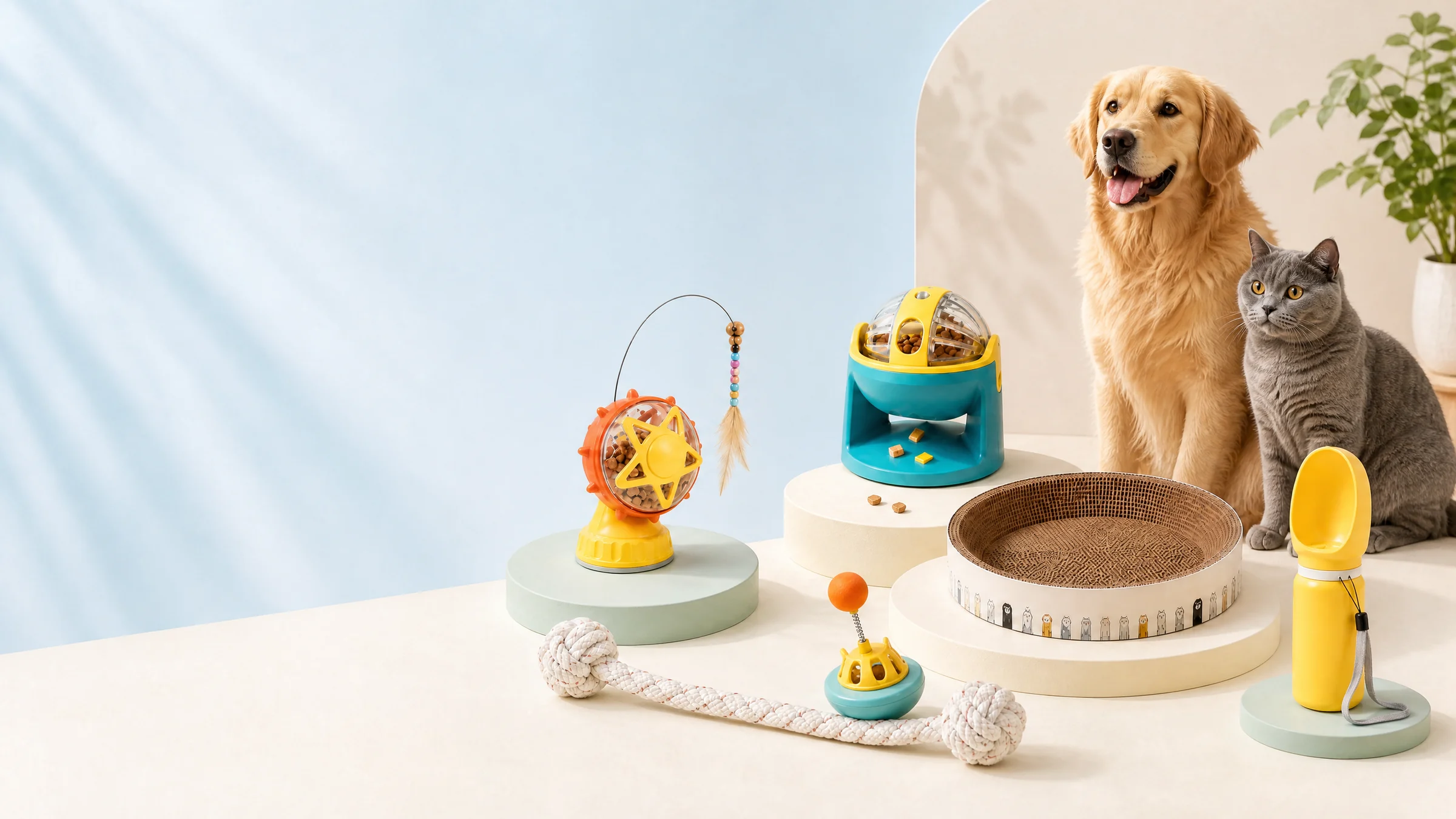
This guide focuses on non-food pet accessories, including interactive puzzle toys, slow-feeding bowls used as non-food accessories, cat scratchers, teaser toys, grooming tools, cotton-rope tug toys, and travel water bottles. It does not provide food, feeding quantity, nutrition, allergy, medical, or veterinary advice. For every actual product, material, dimension, packaging configuration, test document, minimum order quantity, and commercial term, confirm with the supplier and buyer before publication or purchase.
Define the retail job before selecting products
A starter assortment should answer a specific customer and merchandising need. A new-pet-owner collection may emphasize daily accessories, while a cat-focused collection may center on scratching and supervised play. A travel collection may require compact packaging and clear use instructions. These different briefs should not be combined without a defined retail story.
Record the sales channel, target market, customer segment, price architecture, shipping constraints, and launch season. A marketplace seller may need a compact bundle, while a specialist webstore may prefer coordinated collections. A private-label buyer may also need artwork, barcode, language, and repeatable-specification controls. Do not treat these as PawViso capabilities until confirmed with the supplier.
Keep food, treats, chews, supplements, and products carrying nutritional or remedy claims outside an accessory-only brief. Product classification and obligations can depend on intended use and advertising claims, so the buyer should review the destination market with the relevant authority or compliance adviser.1
Use a neutral assortment architecture
A practical assortment often pairs an anchor item with complementary accessories that share a customer scenario. For example, an enrichment direction could include an interactive puzzle toy, a teaser toy, and a cat scratcher. A daily-activity direction could combine a cotton-rope tug toy, an interactive toy, and a grooming tool. A travel direction could combine a travel water bottle with compact accessories. These are planning examples, not statements of available PawViso products.
The buyer should decide whether the range will be sold as one fixed bundle, as configurable kits, or as linked individual listings. A fixed bundle may simplify the retail story; separate listings may provide more replenishment flexibility. The appropriate choice depends on the buyer’s inventory system, fulfillment process, return policy, and target price.
| Assortment direction | Accessory categories to evaluate | Questions to confirm with supplier and buyer |
|---|---|---|
| Enrichment collection | Interactive puzzle toy, teaser toy, scratcher | Intended species, dimensions, materials, supervision wording, pack-out |
| Daily activity collection | Cotton-rope tug toy, interactive toy, grooming tool | Intended pet size, construction, care instructions, packaging, warnings |
| Cat-focused collection | Scratcher, teaser toy, interactive puzzle toy | Surface material, footprint, hanging parts, carton fit, labeling |
| Travel collection | Travel water bottle and compact accessories | Capacity, closure design, leak-control claims, packed dimensions, destination rules |
| Private-label test set | Selected categories from one defined theme | Artwork, barcode, language, inner pack, carton marks, sample approval |
This table is a procurement framework, not a product specification. Request a current data sheet and matching sample before approving a quotation.
Build a comparable wholesale brief
A supplier brief should allow comparison. Request an SKU-level quotation separating product cost, customization, packaging, sampling, tooling, inspection, and shipping assumptions. Confirm currency, trade term, named place, payment schedule, and validity. Incoterms provide a common framework for delivery responsibilities, but the rule and place must be agreed by the parties.2
For each SKU, request product name, intended use, dimensions, weights, packed dimensions, carton quantity, colors, materials, care guidance, warnings, and available test or inspection records. Do not publish safety, durability, environmental, certification, or universal-suitability claims without evidence for the exact product and configuration.
If customization is being considered, ask whether the proposed logo method, color, artwork, packaging format, barcode, and language version are feasible for the specific SKU. Confirm tooling, sampling, artwork approval, and repeat-order conditions with the supplier and buyer. Do not infer capability, MOQ, price, lead time, capacity, or delivery performance from a category description.
Review the physical sample and the retail package
Evaluate samples as products and retail experiences. Check finish, seams, edges, closures, attachment points, odor, color consistency, printed text, and packaging protection. For detachable or hanging parts, confirm accurate use, warnings, and supervision language. For a slow-feeding bowl treated as a non-food accessory, review only physical construction, dimensions, cleaning instructions, and packaging; do not add feeding, nutrition, health, or veterinary claims.
Test the unboxing sequence and confirm SKU identity, barcode handling, inner-pack count, carton configuration, and partial-return procedures. All actual packaging, material, labeling, and compliance details require confirmation with the supplier and buyer.
Prepare listings that reduce uncertainty
Because online shoppers cannot handle an accessory before purchase, make objective information easy to find. A listing set can include a hero image, dimension image, detail views, packaging image, use-context image, and concise specification block. Wholesale buyers may also need case-pack information and carton dimensions.
Use descriptive language that explains intended use rather than promising an outcome. “Interactive toy designed for supervised play” is more defensible than a guarantee of intelligence, behavior change, or engagement. Describe grooming tools by construction and intended function, not health outcomes. Adapt copy to local law and platform policy.
For private-label packaging, compare artwork with the approved sample. Check spelling, origin marking where required, warnings, care symbols, barcode readability, languages, and dimensions. Labeling duties can depend on product type, design, components, and intended age group.3 Confirm destination-market requirements.
Plan import, launch, and replenishment controls
The importer of record should confirm tariff classification, customs value, documentation, marking, and restrictions with a customs broker or relevant authority. U.S. Customs and Border Protection explains that imported merchandise is subject to entry procedures and generally customs duty unless exempt, while classification can affect the duty rate.4 These points are market-specific.
Review material composition when an accessory includes plant- or animal-derived content, coatings, adhesives, batteries, or mixed materials. Keep the product specification, invoice description, packing list, carton marks, sample approval, and inspection record aligned. Reopen review if the product, material, packaging, destination, or claim changes.
For the first launch, set measurable review points. Track sell-through by SKU, return reasons, listing conversion, damaged-in-transit rate, and customer questions. Use the observations to adjust assortment direction, content, or pack size. Confirm reorder thresholds, production assumptions, and lead-time estimates with the supplier each time.
FAQ for B2B buyers
What should a wholesale pet starter kit contain?
It should contain a coherent set of non-food accessories for a defined retail scenario, such as enrichment, supervised play, grooming, cat activity, or travel. The final categories, quantities, species focus, packaging, and specifications must be confirmed with the supplier and buyer.
Can a slow-feeding bowl be included in an accessory assortment?
It may be evaluated as a non-food pet accessory when the listing is limited to physical product information, such as construction, dimensions, cleaning instructions, and packaging. Do not add food recommendations, feeding quantities, nutrition, allergy, medical, or veterinary advice. Confirm the final intended use and claims with the supplier and buyer.
Is a fixed bundle better than separate listings?
Neither structure is automatically preferable. A fixed bundle can create a clear merchandising unit, while separate listings can support more flexible replenishment. Compare inventory, fulfillment, barcode, return, and pricing implications before selecting a format, and confirm the final configuration with the supplier and buyer.
Which documents should an importer request?
Request a product specification sheet, commercial quotation, packing information, sample approval record, available test or inspection documents, artwork proof, and shipping documents relevant to the agreed trade term. Separately verify classification, marking, and destination-market obligations with the appropriate authority or broker.2 4
Prepare a buyer-ready launch brief
An inquiry should state the target market, channel, categories, assortment direction, packaging, artwork, sample needs, and order structure. Contact PawViso to discuss the brief and confirm actual products, specifications, packaging options, customization feasibility, samples, and commercial terms with the supplier and buyer before moving to a purchase order.
Related PawViso resources
- Continue with How to Build a Private Label Pet Product Line. Use this guide to connect customization, packaging and MOQ decisions.
- Browse the PawViso product catalogue to identify product formats for a sourcing brief.
- Follow the PawViso sourcing process and review the B2B buyer FAQ before sharing project requirements.
External reference
For independent product identification and barcode context, review GS1 guidance on Global Trade Item Numbers (GTINs). Confirm the requirements that apply to the selected product, target market and order.
References
- 1American Pet Products Association, Before Entering the Pet Products Industry
- 2American Pet Products Association, Importing Pet Products into the US: Resources
- 3U.S. Consumer Product Safety Commission, CPSC Labeling Requirements Overview
- 4U.S. Customs and Border Protection, Tips for New Importers and Exporters
Editorial status: This article is a review-pending draft. Product parameters, destination-market requirements, claims, packaging, and commercial terms require confirmation with the supplier and buyer before publication or purchase.