
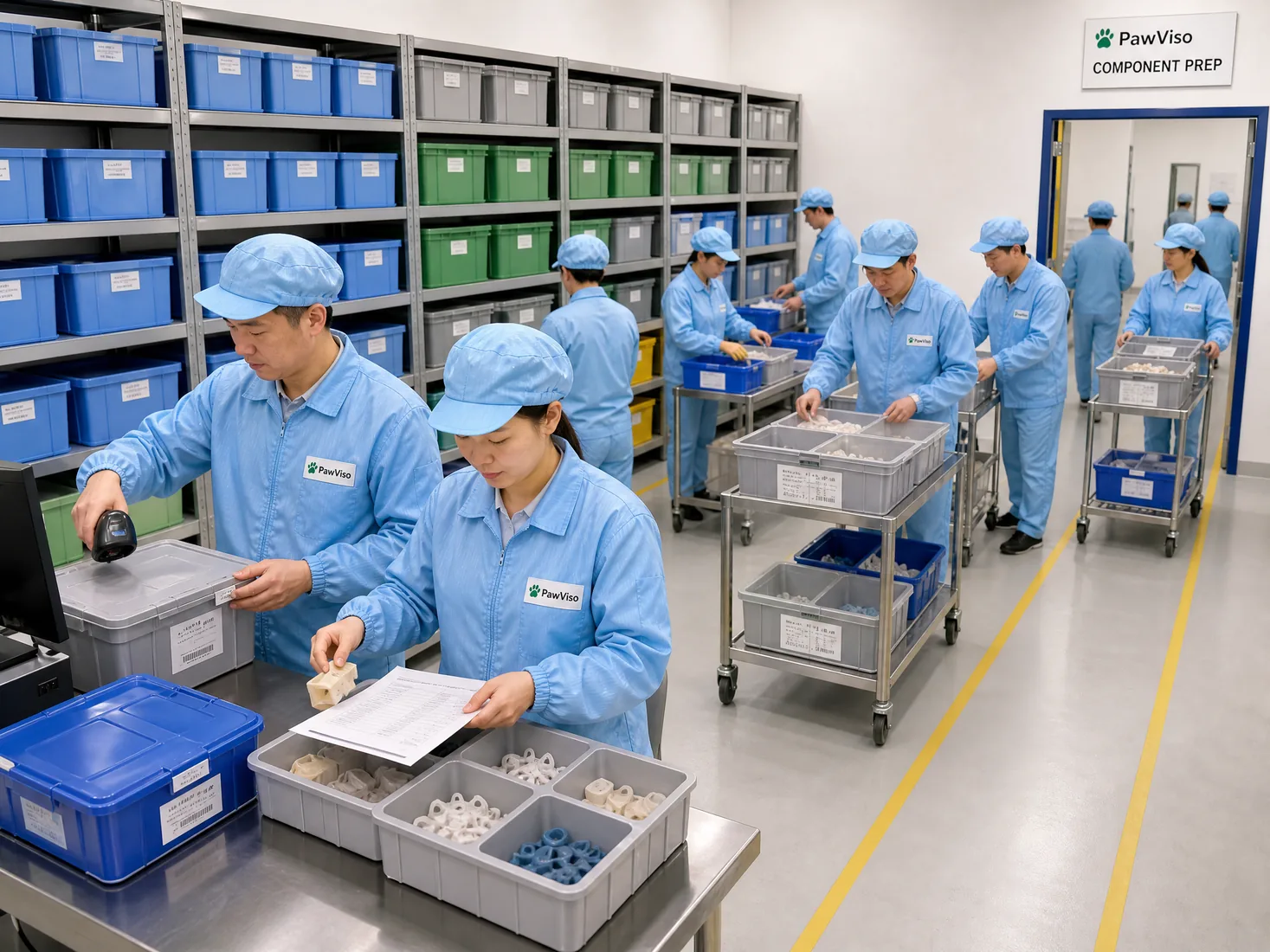
Module 1 — Buyer intent and decision boundary
Purpose and buyer intent
- The primary purpose of supplying materials to a factory is to control specification, reduce lead-time dependencies, preserve intellectual property, or meet a commercial constraint such as packaging continuity for an existing SKU. Buyers must decide whether the incremental complexity and cost of managing buyer-supplied pet product materials is justified by those benefits.
- This guide frames decisions from the buyer perspective: when and how to deliver materials or components, how to document custody, who accepts risk, and what release and disposition records are required.
Decision boundary: when to supply vs. when to buy through supplier
- Supply when the buyer must control a technical attribute (e.g., a proprietary fabric, printed artwork plate), maintain continuity of a trade item, or meet legal requirements tied to a specific source.
- Avoid supply when the supplier can reliably source equivalent material within acceptable specification and total landed cost, or when supply would create operational risk (extra handling, split-lot issues, customs complexity).
Minimum buyer confirmations
- Buyers must confirm final product acceptance, environmental or marketing claims, testing protocol, documentation sufficiency, contract terms and destination-market approvals in writing before production, shipment, or sale. This confirmation requirement is non-negotiable because it triggers release and transfer of responsibility to the buyer/importer.
Children’s-toy versus pet-product classification
- Note: guidance intended for children’s toys differs in scope and legal thresholds from pet products; any reference to toy standards should be used only for comparison, not applied automatically to pet-product decisions 2.
Checklist to decide whether to supply
- Does the material contain unique intellectual property or brand-design elements?
- Can the supplier meet spec, lead time and volume reliably?
- Are there customs, environmental, or disposal implications requiring buyer control?
- Is the cost and administrative overhead justified by the benefit?
If the answer to more than one of the items above is yes, proceed to a formal buyer-supplied plan with clear custody and records.
Module 2 — Scope, roles and evidence
Define scope early
- Specify what portion of production the buyer intends to supply: raw materials, components, sub-assemblies, packaging, or tooling. Define separate handling rules for each category (e.g., packaging versus functional components).
Roles and accountability
- Buyer: owner of supplied materials until written transfer; owner of final confirmation decisions; supplier of any buyer-specific documentation and labels.
- Supplier: acts as custodian after physically receiving material; responsible for handling, storage, traceability, processing and reporting as per the agreement; must not use materials for other orders without written permission.
- Third parties (logistics, inspection, testing labs): follow instructions in contract and report back to buyer and supplier.
Evidence and records required
- Every transfer event must be supported by documented evidence. Typical record types:
- Delivery receipts with quantities, lot numbers and condition notes.
- Physical condition photos at reception and prior to incorporation.
- Inventory control records that map buyer lot numbers to factory internal lot identifiers.
- Release authorizations and consumption logs.
Table — Standard evidence types and responsible party
| Evidence type | Typical owner/issuer | Minimum content |
|---|---|---|
| Delivery receipt | Logistics provider / supplier | Date, qty, buyer lot number, condition notes |
| Reception photo record | Supplier | Timestamped photos plus staff initial |
| Inventory ledger | Supplier (custodian) | Mapping buyer lot → factory lot, balances |
| Material consumption log | Supplier | Production order link, consumed qty, operator |
| Release authorization | Buyer | Written sign-off for shipment, claim, test acceptance |
Quality-system alignment
- Integrate buyer-owned material control into the buyer’s and supplier’s quality management system. Use quality-system practices for document control, nonconformance handling and corrective action 1.
Contract planning for allocation of cost, risk and responsibilities
- Contracts should specify cost allocation for damage, loss, add-on handling, customs delays and rework. Allocate risk and responsibilities explicitly—who pays for rework, replacement, testing, and disposal—so disputes are minimized 5.
Guidance on insurance and liability
- Clarify whether buyer-owned materials are covered under the supplier’s property insurance while in custody or whether the buyer maintains insurance. Specify limits and requirements in contract.
Module 3 — Product and data control points
Key control points across the supply chain
- Receipt: physical and documentary inspection on arrival.
- Storage: segregation, security and environmental controls.
- Inventory: lot tracking, first-expiry-first-out (where relevant), reconciliation.
- Issue to production: formal pick/consume procedures and linkage to production orders.
- Nonconforming material handling: quarantine and disposition.
- Release and shipment: documentation confirming acceptance and transfer of ownership/responsibility.
Data fields required to maintain buyer owned material control
- For each buyer-supplied pet product material batch or unit, maintain:
- Buyer lot number / unique ID
- Supplier reception date
- Factory internal lot or batch reference
- Quantity received and quantity available
- Condition at receipt and at issue
- Storage location and environmental parameters if applicable
- Production order(s) where material was used
- Disposition of surplus, damaged or returned items
Trade-item identification and commerce controls
- When buyer-supplied components will be used in finished goods that require trade-item identification at retail, include trade-item identifiers (GTINs) and maintain traceability between buyer lot and GTIN-level production. Ensure GTIN and trade-item mapping is part of your data controls and labeling checks 3.
Illustrative example — control-point data mapping (illustrative)
| Control point | Required data fields |
|---|---|
| Reception | Buyer lot, date/time, qty, photos, condition notes |
| Storage | Location ID, temperature/humidity, access log |
| Issue to production | Production order ID, qty issued, operator, timestamp |
| Shipment | Final qty, shipment date, customs docs (if export) |
Deciding traceability depth
- Choose the traceability depth based on product risk and regulatory expectations: simple lot-level mapping may be adequate for low-risk pet accessories; item-level serialization may be needed where warranty, theft prevention or recall speed is a priority.
Inventory system approaches
- Options include manual ledger, barcode-based system, or integrated ERP/WMS. Table below helps selection.
Table — Inventory system decision matrix
| Decision factor | Manual/Excel | Barcode/WMS | ERP-integrated |
|---|---|---|---|
| Volume of material | Low | Medium | High |
| Need for rapid recall | Low | Medium | High |
| Integration with production | Limited | Good | Best |
| Implementation complexity | Low | Medium | High |
| Suggested when | Small private-label startups | Growing brands with multiple SKUs | Large retail/importers with many factories |
Module 4 — Supplier communication and approvals
Set clear written expectations
- Before shipping buyer-supplied pet product materials, provide suppliers with a written plan that includes delivery windows, quantity tolerances, inspection checkpoints, storage requirements, and contact points for exception handling.
Required supplier approvals and buyer confirmation
- Require the supplier to confirm receipt and acknowledge custody conditions in writing. Buyers must provide written approval for:
- Any substitution or rework proposal
- Use of off-spec materials
- Final release for shipment when buyer-owned material was a critical component
- Reinforce that buyer/importer confirmation is required for final product, claim, testing, documentation, contract and destination-market decisions.
Communication format and cadence
- Recommend a three-stage communication cadence:
- Pre-shipment: buyer provides expected arrival details and documentation templates.
- On-receipt: supplier shares reception report and condition photos within a defined SLA (e.g., 24–48 hours).
- Pre-shipment of finished goods: supplier submits consumption and release documentation for buyer sign-off.
Approvals for marketing or environmental claims
- If the buyer intends to assert environmental marketing claims associated with buyer-supplied materials (e.g., recyclate content), require documented proof and third-party evidence where applicable. Any such claim should be approved by the buyer and supported by evidence in line with jurisdictional requirements and evidence-backed guidance 4.
Escalation pathway
- Define a clear escalation path for nonconformances, loss events, or delayed receipts. Include response time targets and the party responsible for corrective actions.
Supplier obligations on misuse
- Explicitly prohibit suppliers from using customer supplied components for other orders. Require that supplier material custody practices include locked storage and use logs.
Module 5 — Sample, packaging and operational checks
Sampling and receiving inspection
- Define acceptance criteria at receipt. A receiving inspection should cover:
- Quantity verification against shipment documentation
- Visual condition and damage checks
- Label accuracy and lot traceability
- Simple functional checks if feasible on-site (e.g., dimension checks)
Packaging requirements for buyer-supplied materials
- Specify packing methods to protect materials through logistics and storage. Include:
- Preferred packaging materials and internal protection
- Palletization and unitization rules
- Label placement and information elements (buyer lot, part number, handling warnings)
Operational checks at the factory
- Before materials enter production:
- Verify lot mapping into factory inventory system.
- Confirm storage assigned to buyer lot and segregation from supplier-owned stock.
- Conduct a pre-production check linking the buyer lot to the first production run.
Checklist for sample-based verification
- When samples accompany supplied materials or are sent separately, require:
- Fabric/trim swatch matching procedure with acceptance criteria.
- Visual comparison and measurement records.
- If packaging is provided, a pre-approval for fit-to-product and branding alignment.
Illustrative packaging acceptance table (illustrative)
| Requirement | Accept | Reject | Action |
|---|---|---|---|
| Correct buyer label present | Yes | No | Request missing label before release |
| No visible damage | Yes | No | Quarantine and report to buyer |
| Quantity matches docs | Yes | No | Count discrepancy report and inventory hold |
| Packing protects contents | Yes | No | Require repackaging or return to buyer |
Practical tips
- Use tamper-evident seals for high-value materials.
- Request incoming inspection photos from the supplier with timestamped metadata.
- For imported shipments, include customs-compatible documentation to avoid delays.
Module 6 — Quality controls and exception decisions
Determine inspection levels and sampling plans
- Select inspection rigor according to the material’s criticality and cost of failure. Options include:
- 100% inspection for critical components that affect safety or function.
- Statistical sampling based on AQL where acceptable for non-critical items.
- Any sampling plan should be documented in the supply agreement and aligned to the buyer’s quality system expectations 1.
Nonconformance categorization and actions
- Define categories: minor, major, critical. For each category specify buyer-preferred action such as:
- Minor: accept with price adjustment or rework at supplier cost.
- Major: reject batch or rework with approval; require 100% re-inspection.
- Critical: stop use, quarantine entire affected inventory, and notify buyer immediately.
Decision matrix for exceptions
- Establish decision triggers to quickly route issues to the right decision maker.
Table — Exception decision matrix
| Issue | Trigger | Initial action | Buyer involvement |
|---|---|---|---|
| Quantity short/over | > tolerance | Quarantine discrepancy; supplier investigation | Buyer confirmation for disposition |
| Damage at receipt | Any visible damage | Hold and document; proposal for rework/return | Buyer to approve replacement or credit |
| Specification nonconformity | Any fail | Stop production using that lot | Buyer to decide accept/reject/rework |
| Late receipt affecting production | > agreed window | Evaluate buffer stock; expedite | Buyer to approve schedule change or alternative sourcing |
Handling partial usage and split lots
- Where a buyer lot is consumed across multiple production runs, require the supplier to maintain consumption logs and map leftover inventory to original buyer lot IDs. Buyer must approve any decision to use remaining material on alternate orders.
Testing and lab work
- Specify who arranges tests, where samples are taken (buyer or supplier location), acceptance criteria and who pays for failure-related testing. Buyers should reserve rights to witness testing or send independent third-party labs.
Record of disposition
- For all exceptions, maintain a disposition record that includes corrective action, root cause, financial reconciliation and follow-up verification.
Module 7 — Commercial and change-control tradeoffs
Commercial tradeoffs when supplying materials
- Supplying materials reduces supplier sourcing cost variability but increases buyer administrative overhead and logistical complexity. Common tradeoffs include:
- Price stability vs. inventory carrying and replacement risk.
- Consistency in branding vs. flexibility for supplier optimization.
- Control over materials vs. higher operational overhead and potential lead-time friction.
Change-control process
- Define a formal change-control process covering:
- Who can initiate change: buyer, supplier, or jointly.
- Required approvals: technical, commercial and regulatory (destination-market).
- Communication timelines and implementation windows.
Table — Change-control decision table
| Change type | Likely owner of decision | Buyer approval required? | Typical considerations |
|---|---|---|---|
| Specification tolerance adjustment | Buyer (proposal by supplier) | Yes | Impact on functionality, test results, labeling |
| Supplier material substitution | Supplier proposes | Yes | Equivalence evidence, sample approval, cost |
| Packaging artwork update | Buyer-led | Yes | Repack approvals, inventory obsolescence |
| Pricing adjustment due to buyer supply | Negotiated | Possibly | Handling fees, storage charges, loss allocation |
Cost allocation and contractual clarity
- Use contracts to capture who pays for:
- Handling and storing buyer-owned materials in the factory.
- Rework, replacement and loss, including theft or damage.
- Additional inspection or testing triggered by supplied materials.
- Document cost-sharing models, for example: supplier handles normal storage; buyer covers abnormal destruction or one-time repackaging. Use the contract planning clauses to make allocation explicit 5.
Practical negotiation levers
- Ask suppliers to provide a handling fee schedule for buyer-supplied materials.
- Build incentives for supplier performance (e.g., service credits for late reporting or mishandling).
- Consider limited consignment models where supplier is paid only when finished goods are accepted.
Module 8 — Logistics, handover and record retention
Inbound logistics and handover
- The transfer moment is critical: define the precise handover point (e.g., EXW, FCA, DDP) and record it. At handover, the supplier must provide:
- Delivery receipt with buyer lot number and condition statement.
- Photos showing pallet labels and condition.
- Any relevant customs/import paperwork when crossing borders.
Storage and supplier material custody
- While in supplier custody, buyer-supplied materials should be segregated and access-controlled. Document custody rules:
- Locked storage area, access log and designated custodians.
- Environmental monitoring where required (temperature/humidity logs).
- Periodic inventory reconciliations (weekly/monthly depending on turnover).
Table — Custody responsibilities and records (operational)
| Responsibility | Supplier role (custodian) | Records to maintain |
|---|---|---|
| Physical security | Enforce restricted access | Access log, CCTV where available |
| Environmental control | Monitor per spec | Sensor logs, alerts |
| Inventory reconciliation | Conduct cycle counts | Count sheets, variance reports |
| Movement control | Update WMS on issue/receipt | WMS transaction logs |
Transfer of title and ownership records
- Contracts should state when title and risk transfer. Even if legal title transfers at a certain Incoterm, maintain operational records that show buyer intent and physical custody for internal audit.
Loss, damage and theft reporting
- Require immediate notification for loss/theft with preliminary report within a short SLA (e.g., 24 hours). Follow with a full incident report including root cause, financial impact and proposed remedial action.
Record retention and auditability
- Determine retention periods based on buyer’s internal audit cycles and destination-market requirements. Typical retention items:
- Reception receipts and photos
- Inventory ledgers and reconciliations
- Release authorizations
- Nonconformance and disposition records
- Make clear that the buyer/importer must confirm final documentation before goods are dispatched to market.
Export, customs and documentation
- Ensure documentation is consistent with customs declarations and origin rules. Maintain chain-of-custody documents that demonstrate the role and location of buyer-supplied components for tariff and compliance reviews.
Module 9 — Buyer implementation plan
Stepwise implementation roadmap
- Define scope and create a materials list:
- Identify SKUs or components to be buyer-supplied and document physical specs, lot-size norms, packaging and labeling needs.
- Contract amendment or addendum:
- Insert custody, handling fees, insurance, inspection and dispute-resolution clauses; include change-control and record-retention terms.
- Data and systems alignment:
- Map data fields and implement tracking (manual, barcode/WMS or ERP). Include GTIN linkages when required 3.
- Pilot run:
- Start with a single factory and limited material volume. Use the pilot to validate reception, storage, issuance and reconciliation workflows.
- Audit and continuous improvement:
- Audit supplier material custody and process compliance, capture KPIs and adjust SOPs.
Template tasks and responsibilities
- Assign clear owner for each task:
- Buyer: specification distribution, contract approval, and final release decisions.
- Supplier: receiving, storage, inventory control, and reporting.
- Logistics partner: physical movement, delivery receipts and customs paperwork.
KPIs and operational metrics to track
- On-time delivery of buyer-supplied materials to factory
- Accuracy of reception counts (% variance)
- Incidents of damage or loss per period
- Time from reception to production availability
- Reconciliation differences and resolution lead time
Pilot checklist
- Confirm label formats and readability under production conditions.
- Validate sampling and testing arrangements.
- Run a data reconciliation between buyer records and supplier ledger.
- Verify escalation process and SLA responsiveness.
Training and SOPs
- Provide supplier staff with written SOPs for handling customer supplied components, including emergency contact lists and inspection checklists. Ensure SOPs are version-controlled and that supplier personnel are trained and can demonstrate competence.
Scaling and multi-factory roll-out
- Once pilot KPIs are met, scale to additional factories. Consider centralizing coordination if you use multiple factories to reduce administrative duplication.
Risk mitigation planning
- Maintain a contingency stock or approved alternate suppliers for critical buyer-supplied materials. Incorporate regular reviews to decide whether continuing buyer supply remains justified.
Module 10 — Frequently asked questions
What documentation should accompany buyer-supplied materials on arrival?
Provide a delivery receipt keyed to the buyer lot number, photos of the sealed pallets, packing list with quantities and any certificates of analysis or compliance documents. The supplier should capture the reception in their inventory system and notify the buyer immediately.
Who is responsible for damage discovered after the supplier receives the material?
Responsibility depends on contractual allocation and timing of transfer. Operationally, the supplier in custody must document damage and notify the buyer; the buyer/importer and contract terms determine financial responsibility. Buyer confirmation is required to finalize disposition, replacement or credit arrangements.
How do I manage leftover or obsolete buyer-owned packaging when artwork changes?
Record leftover quantities, segregate them, and follow the change-control provisions in the contract. Decide whether the supplier should return, destroy (with authorization), or use the material per a written agreement. The buyer must approve the chosen disposition and document the decision.
Can the supplier use buyer-supplied components on other customer orders?
No—supplier material custody protocols must prohibit use of customer supplied components on other orders without explicit written buyer approval. Any breach should trigger an investigation and corrective action.
Module 11 — Conclusion and buyer action plan
Summary of core controls
- Managing buyer-supplied pet product materials requires clearly defined roles, documented custody, robust data mapping, contract clarity on cost and risk allocation, and an operational plan for reception, storage, issuance and exceptions. The buyer must maintain final confirmation authority for product acceptance, claims, testing, documentation, contract terms and destination-market decisions.
Immediate buyer action plan (practical steps)
- Decide material scope: produce the list of items you will supply and the desired level of traceability.
- Update contracts: add custody, insurance, handling fees, loss allocation and record-retention clauses. Use explicit language on who makes final confirmations and approvals 5.
- Create a data template: set required data fields (buyer lot ID, reception date, condition, production link), and ensure systems are ready to accept them (consider barcode/WMS where volumes justify).
- Pilot with one factory: confirm reception, storage, issue to production, and reporting; adjust SOPs accordingly.
- Define KPIs and audit cadence: agree on reconciliation frequency, incident reporting SLA, and audit schedule aligned with quality-system expectations 1.
- Approve environmental and marketing claims in writing and require supporting evidence where claims relate to buyer-supplied material attributes 4.
- Train supplier staff and confirm supplier material custody processes are in place: secured storage, access logs and quarantine procedures.
- Maintain contingency options: approved alternates, buffer stocks or contract clauses for rapid replacement.
Final reminder
- This guide establishes buyer-led practical controls for customer supplied components, buyer-supplied pet product materials, buyer owned material control and supplier material custody. Implementing these measures reduces operational risk and clarifies financial and legal responsibilities—but remember: buyer/importer confirmation is required for all final decisions on product acceptance, claims, testing, documentation, contract terms and destination-market readiness.
Final CTA — Prepare a focused supply chain governance brief with PawViso.
Share the intended product or process scope, target channel, evidence already available, packaging direction and order structure for a practical B2B discussion.
Email: info@PawViso.com
WhatsApp: +86 186 8106 4480
Related PawViso resources
- Continue with How to Build a Custom Pet Toy Bill of Materials for a related buyer-controlled sourcing route.
- Browse the PawViso product catalogue to identify relevant product formats for an enquiry.
- Follow the PawViso sourcing process and review the B2B buyer FAQ before sharing project requirements.
External reference
For product identification and supply-chain data context, review GS1 guidance on Global Trade Item Numbers (GTINs). Confirm the product- and channel-specific records required for the selected SKU.