
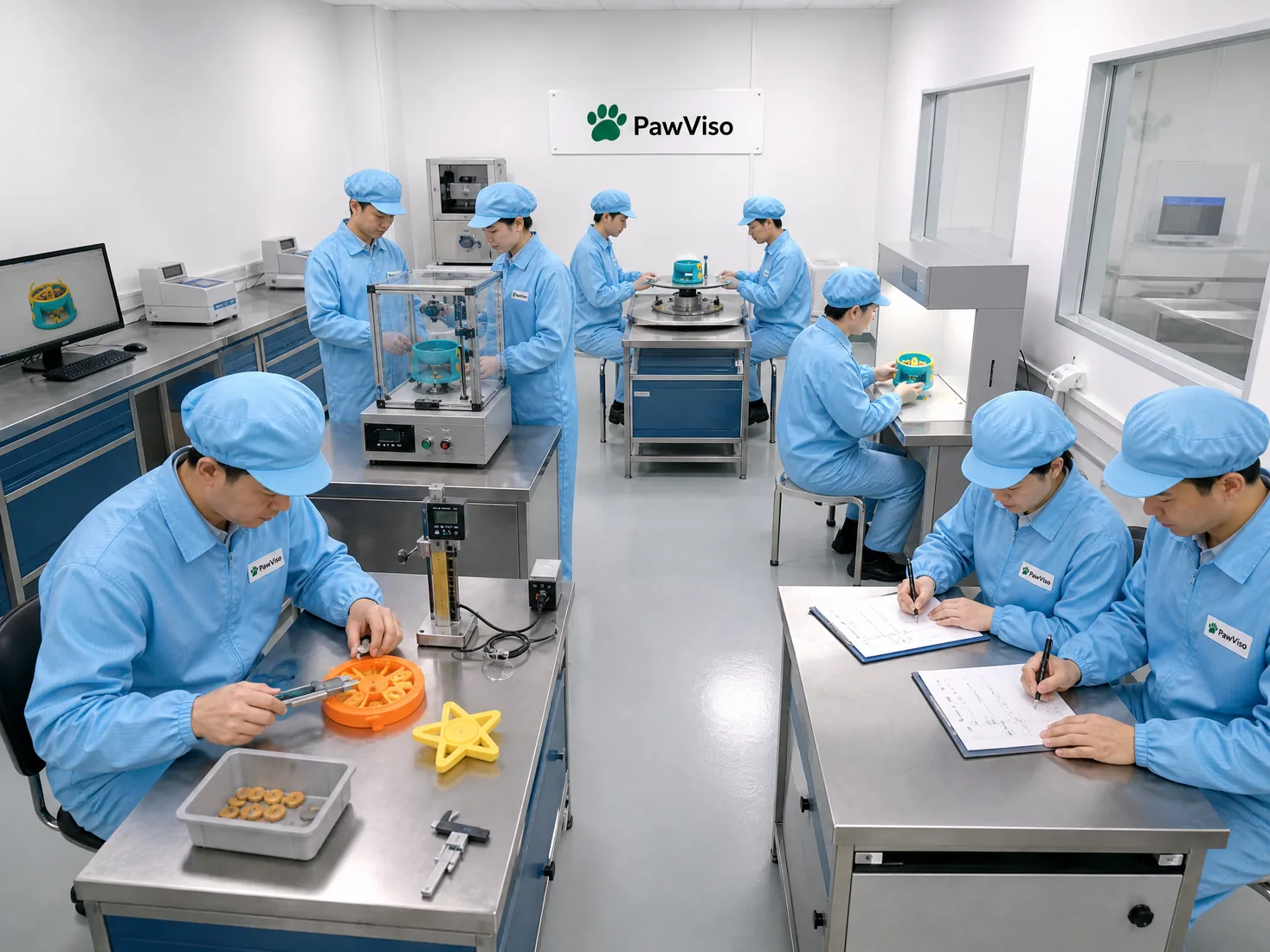
Introduction: What should a pet-product pre-shipment inspection verify?
A pre-shipment inspection should verify that finished goods match the approved product, packaging and quantity requirements before dispatch. It normally combines random sampling, identity and workmanship checks, product-specific functional tests, packaging and barcode verification, carton measurements and a documented release decision.
The inspection must be based on a current purchase order, specification, approved sample, artwork files, packing requirements and defect definitions. A generic checklist cannot determine whether a rotating treat toy moves correctly, a scratch lounge uses the approved board, a grooming item is assembled safely or a travel bottle remains leak-resistant.
AQL is one part of this process. It provides an acceptance-sampling method, but it does not prove that every unit is defect-free, define which defects matter or replace laboratory testing. The buyer must decide which attributes are critical, major or minor and what action follows a failed result.
Why is inspection still necessary after sample approval?
An approved sample is a development reference. A production lot introduces raw-material variation, line setup, tooling wear, multiple operators, subcontracted components, printing, packing and schedule pressure. Even a reliable supplier can produce a lot that differs from the sample if records, component control or instructions are unclear.
Pre-shipment inspection compares a representative production sample with the approved file. It can identify wrong colors, dimensions, materials, accessories, artwork, quantities or packaging before goods leave the source. QIMA describes PSI as an on-site inspection when production is nearing completion, commonly when at least 80% is complete and packing has begun.1
The inspection is not a substitute for controls earlier in production. A new product may also need incoming-material checks, first-article approval or during-production review. PSI is the final verification point at which a buyer can decide whether to release, hold, rework or reinspect the shipment.
When should a pre-shipment inspection take place?
Schedule the inspection when enough finished and packed goods are available for representative sampling, but before final payment or loading removes practical leverage for correction. The exact point depends on the order and contract.
Before the inspector arrives, confirm that:
- the purchase order and SKU list are final;
- the current product specification and golden sample status are clear;
- approved artwork, barcodes and packing instructions are available;
- enough units and cartons are finished for sampling;
- agreed test equipment, accessories and consumables are available;
- all colors, sizes, packaging versions and lots are identifiable;
- the buyer has defined defect categories and reporting requirements.
If only one SKU is ready while others remain incomplete, the inspection may not represent the full order. If packaging is not available, barcode, retail pack and carton checks cannot be completed. An inspection report should record these limitations instead of treating missing evidence as a pass.
How does AQL sampling work for pet products?
ISO 2859-1:2026 defines AQL-indexed acceptance-sampling schemes for lot-by-lot inspection by attributes. The system can use single, double or multiple sampling plans and includes switching between normal, reduced or tightened inspection based on quality history.2
In practice, the buyer identifies the lot, inspection level and AQL policy. The sampling tables determine a code letter, sample size and acceptance/rejection points. The inspector randomly selects units across cartons and records defects by agreed class.
| AQL decision element | What must be defined before inspection |
|---|---|
| Lot | The quantity and configuration treated as one inspection lot |
| Inspection level | The sampling intensity selected for the order and risk |
| Defect class | Critical, major and minor definitions linked to the specification |
| AQL value | The acceptance policy for each class, chosen by the buyer |
| Sample selection | How units are drawn across cartons, colors, sizes and lots |
| Switching rule | Whether repeated performance changes normal, tightened or reduced inspection |
| Release rule | Who may approve, hold, rework, reinspect or waive the result |
QIMA describes AQL as a risk-management tool in which lot size and inspection level determine the sample and defect thresholds, while different defect classes can use different limits.3 Do not copy another buyer’s settings without considering product risk, retailer requirements and tolerance for returns.
Does a passing AQL inspection mean there are no defects?
No. Sampling estimates lot quality from selected units. A passing result means the observed sample meets the agreed acceptance rule; it does not mean every unit is perfect. AQL also does not predict hazards that the checklist fails to test.
For example, a visually acceptable feeder can still use an unapproved material. A correctly printed box can contain a functional product error. Chemical compliance cannot be inferred from appearance. The inspection plan must combine sampling with appropriate records and laboratory evidence.
How should critical, major and minor defects be defined?
Defect severity should reflect user risk, legal or retailer requirements, product function, customer acceptance and the approved specification. Definitions must be written before inspection so the inspector is not asked to make commercial policy on site.
| Defect class | Practical meaning | Illustrative pet-product examples |
|---|---|---|
| Critical | A condition that may create an unacceptable safety or compliance risk | Accessible sharp point, exposed hazardous component, prohibited marking or other agreed zero-tolerance condition |
| Major | A defect likely to cause functional failure, return, rejection or substantial deviation | Mechanism does not operate, bottle leaks, component detaches in the agreed test, wrong barcode, materially wrong dimensions |
| Minor | A limited cosmetic or workmanship issue that does not materially affect function | Small surface mark within an agreed location and limit, slight print variation that remains legible |
The same condition may be classified differently depending on the product. A loose decorative component on a display accessory may be major; a detachable component that creates an identified ingestion or injury risk may be critical. Use photographs, boundary samples and measurable criteria whenever possible.
Avoid vague terms such as “bad finish,” “not strong” or “poor packaging.” Define defect location, size, frequency, test action and acceptance criterion. This improves consistency across inspectors, reorders and suppliers.
Which checks belong in every pet-product inspection?
Every inspection should begin with product identity. Confirm the purchase order, supplier, model, SKU, color, size, lot, product count and packaging version. Compare current production with the approved sample and specification.
Common checks include:
| Inspection area | Typical evidence |
|---|---|
| Quantity and assortment | Finished, packed and total quantities; color/size ratio; pieces per carton |
| Product identity | Model, SKU, color, included parts and accessories |
| Dimensions and weight | Agreed dimensions, unit weight and critical tolerances |
| Workmanship | Molding, edges, seams, joints, fasteners, adhesives, printing and contamination |
| Function | Operation, stability, fit, movement, flow, retention or installation as applicable |
| Material and component match | Visual identity plus approved declarations, records or reports where required |
| Artwork and labeling | Revision, spelling, barcode, origin, warnings, instructions and placement |
| Retail and export packaging | Pack-out, protection, carton quantity, dimensions, weight and shipping marks |
The inspector should photograph the sampled products, test setup, measurements, defects, packaging levels, carton marks and overall production status. A report without traceable images or references is difficult to evaluate remotely.
What functional tests fit different PawViso product formats?
The checklist should translate product application into observable tests. The following matrix provides planning examples, not universal pass criteria. The buyer should confirm methods, duration, force, sample size and acceptance criteria for the actual product.
| Product format | Product-specific checks | Common failure questions |
|---|---|---|
| Treat puzzle or rotating feeder | Stability, movement, lid or component retention, treat path, accessible edges, cleaning access | Does the mechanism jam, tip or release a part during agreed use? |
| Multi-window snack feeder | Window operation, opening consistency, assembly, base stability, residue access | Are openings consistent and can the unit be cleaned as intended? |
| Cat scratch lounge | Overall dimensions, board fit, edge finish, adhesive or staple control, board density consistency, dust and pack flatness | Does the structure deform, expose a fastener or arrive damaged? |
| Feather or tumbler teaser | Balance, return movement, rod/tether connection, attachment security, edge finish | Do play components detach or fail under the agreed pull/cycle test? |
| Grooming clipper or tool | Body and accessory count, guard/blade attachment, switch and operating function if applicable, edge finish, instructions | Is the tool complete, stable and consistent with the approved model? |
| Wall grooming brush | Bristle retention, body finish, mounting parts, adhesive/fastener kit, installation preparation and instructions | Can it be installed correctly and do bristles remain secured? |
| Cotton tug toy | Length, weight, knot or seam security, fiber condition, hardware and agreed pull test | Does the construction loosen, shed excessively or differ from the sample? |
| Travel water bottle | Valve, seal, cap, flow, leakage position, volume marking if applicable and pack protection | Does it leak, fail to dispense or arrive with an incorrect seal? |
For products involving electricity, batteries, food contact or market-specific claims, the inspection should verify the approved configuration and available records but should not replace accredited laboratory assessment. Testing-industry sources describe custom bite-and-pull or fatigue methods for dog toys, illustrating why real-use forces may need a dedicated fixture and method.4
How should factory testing appear in the inspection file?
Factory testing records should identify the SKU, lot, date, method, equipment, sample quantity, result and responsible person. The inspector can verify that required records exist and may repeat selected checks on sampled units.
If the buyer requires a cycle test that takes several hours or a conditioning step that cannot be completed during PSI, perform it earlier under a documented protocol. The PSI can then verify the report and conduct a shorter confirmation check where appropriate.
Mid-article CTA — Ask for a Product Inspection Checklist
Send PawViso the product category, target market, approved sample status, order quantity and packaging route. We can help organize the product, packaging and shipment questions that should be confirmed before inspection. Contact info@PawViso.com.
How should retail packaging and barcodes be inspected?
Packaging inspection should compare the current production file with the physical pack. Verify structure, material, print quality, color, coating, die cut, window, hanger, seal, label and insert. Confirm that the correct product and accessories are inside and oriented as approved.
Review all text, symbols and data: product name, model or SKU, quantity, warnings, instructions, responsible party, country of origin, barcode and artwork revision. Scan barcodes from representative units and confirm the decoded number against the buyer’s master data.
GS1 distinguishes consumer units, inner packs, cases and pallets as separate packaging levels that support ordering, scanning and inventory control.5 The inspection should therefore check identifiers and quantities at the correct level. A retail UPC or EAN does not replace a case code or logistics label when the buyer requires one.
For US-bound products, 19 CFR Part 134 generally requires the English country of origin to appear conspicuously, legibly, indelibly and as permanently as the article or permitted container allows, subject to exceptions.6 The importer should define the approved location and wording before inspection.
How should cartons and transport protection be evaluated?
Confirm export-carton construction, dimensions, gross and net weight, pieces per carton, assortment, sealing method, shipping marks and palletization instructions. Open sampled cartons across the lot to verify inner protection and pack consistency.
Carton tests should match the distribution route. ISTA distinguishes screening methods from general-simulation procedures and lists different procedures for parcel delivery, distribution-center-to-retail, European retail and international direct-import routes.7 A simple factory drop check may support routine control, but it is not automatically equivalent to a named ISTA laboratory procedure.
Record crushing, puncture, moisture, excessive void, abrasion and movement risk. Odd-shaped pet products may need dividers, bags, sleeves or orientation marks. A retail pack that looks attractive on a shelf may still need an outer carton designed for stacked export and downstream parcel handling.
What should a container-loading check record?
A container-loading check is separate from PSI. It focuses on the correct goods, container condition and loading evidence. QIMA notes that it can include quantity, visible quality, carton and shipping marks, container cleanliness and damage, stacking, restraint, loading method and seal information.8
Record container number, seal number, container interior condition, dryness and cleanliness, carton count, loading sequence, damaged cartons, pallet or loose-load pattern, use of dunnage or restraint and final door closure. For wood packaging, the importer and logistics provider should confirm applicable phytosanitary requirements.
Do not use loading control as a last-minute substitute for full product testing. Once loading begins, there is limited time and access for detailed functional inspection or rework.
What should happen when an inspection fails?
A failed inspection is a decision point, not an automatic instruction to ship or cancel. First, identify whether failure relates to a critical condition, sample defect count, specification mismatch, incomplete production, missing test or packaging error.
The supplier should quarantine affected goods, investigate the root cause and propose corrective action. The buyer should decide whether the lot requires sorting, rework, replacement, additional testing, a revised delivery schedule or rejection. A concession or waiver should be documented with the exact condition, quantity, commercial impact and authorizing person.
After correction, reinspection should use an agreed scope. Do not inspect only the repaired units if the root cause may affect the wider lot. The report should connect the original defect, corrective action and reinspection evidence.
What belongs in the final inspection report and release record?
A useful report enables a remote decision without relying on verbal assurances. It should include:
- order, factory, product, SKU, lot and inspection date;
- production and packing completion status;
- sampling plan and sampled quantity;
- defect list by class with photographs and counts;
- product identity, dimensions, weight and functional results;
- packaging, barcode, carton and shipping-mark findings;
- required document and factory-test record status;
- limitations, deviations and unperformed tests;
- result against the buyer’s acceptance rule.
The buyer’s release record should state who reviewed the report and whether the order is approved, conditionally approved, held, rejected or scheduled for reinspection. Payment and shipment actions should follow the contract and documented decision.
Frequently asked questions
What AQL should be used for pet products?
There is no universal value. The buyer should set AQL and defect classes based on product risk, retailer requirements, supplier history and tolerance for defects. Critical conditions often follow a zero-acceptance policy, but the complete sampling and release plan should be approved by the buyer or quality professional.
Does passing AQL mean the shipment is defect-free?
No. It means the sampled units meet the agreed acceptance rule. Unsampled units may still contain defects, and untested attributes remain unknown.
How many units should be inspected?
The sample size depends on lot size, inspection level and the selected ISO 2859-1 sampling plan. The inspector should also distribute samples across cartons, variants and identifiable production lots.
Can the factory perform its own pre-shipment inspection?
Factory final inspection is an important control. A buyer may additionally use an independent third party when objective verification, retailer policy, risk or lack of on-site access justifies it. The contract should define who performs each step and who makes the release decision.
What is the difference between PSI and laboratory testing?
PSI reviews sampled finished goods against the specification through visual, dimensional, functional and packaging checks. Laboratory testing uses defined methods and equipment to evaluate chemical, mechanical, electrical or other regulated properties. One does not automatically replace the other.1
Should every reorder receive the same inspection?
Use a risk-based program. A stable product and supplier may justify adjusted inspection under an approved switching policy, while a new material, component, factory, process, artwork or recurring defect may justify tighter control. ISO 2859-1:2026 includes switching concepts for quality performance over time.2
Conclusion
A pet-product pre-shipment inspection is effective only when the buyer defines what “correct” means. Provide the current product and packaging file, use a sampling plan appropriate to the lot, classify defects before inspection and translate each product application into observable functional checks.
Combine PSI with earlier factory testing, required laboratory reports and a separate loading record where appropriate. The result should be a documented shipment-release decision—not a collection of photographs without acceptance criteria.
Final CTA — Send Your Requirements
Planning an order of interactive feeding, cat play and scratch, grooming, dog play or travel products? Share the SKUs, market, expected quantity, packaging version and inspection expectations with PawViso. Email info@PawViso.com to request a catalogue or discuss a product-specific buying brief.
This article provides general B2B quality-control information, not legal, regulatory or product-safety advice. The responsible buyer, importer and qualified testing partners should approve the actual inspection and compliance program.
Related PawViso resources
- Continue with How to Create a Custom Pet Toy Sampling Plan. Use this pet-toy guide to structure approvals, samples and evidence.
- Browse the PawViso product catalogue to identify product formats for a sourcing brief.
- Follow the PawViso sourcing process and review the B2B buyer FAQ before sharing project requirements.
External reference
For independent shipping-term and handover context, review International Chamber of Commerce Incoterms® 2020 overview. Confirm the requirements that apply to the selected product, target market and order.
References
- 1Pre-Shipment Inspection — QIMA
- 2ISO 2859-1:2026 Sampling procedures for inspection by attributes — ISO
- 3Acceptable Quality Limit (AQL) — QIMA
- 4Safety in Dog Toys — Intertek
- 5Packaging Level Definitions — GS1 US
- 619 CFR Part 134 — Country of Origin Marking
- 7Test Procedures — International Safe Transit Association
- 8Container Loading Inspections for Product Protection — QIMA