
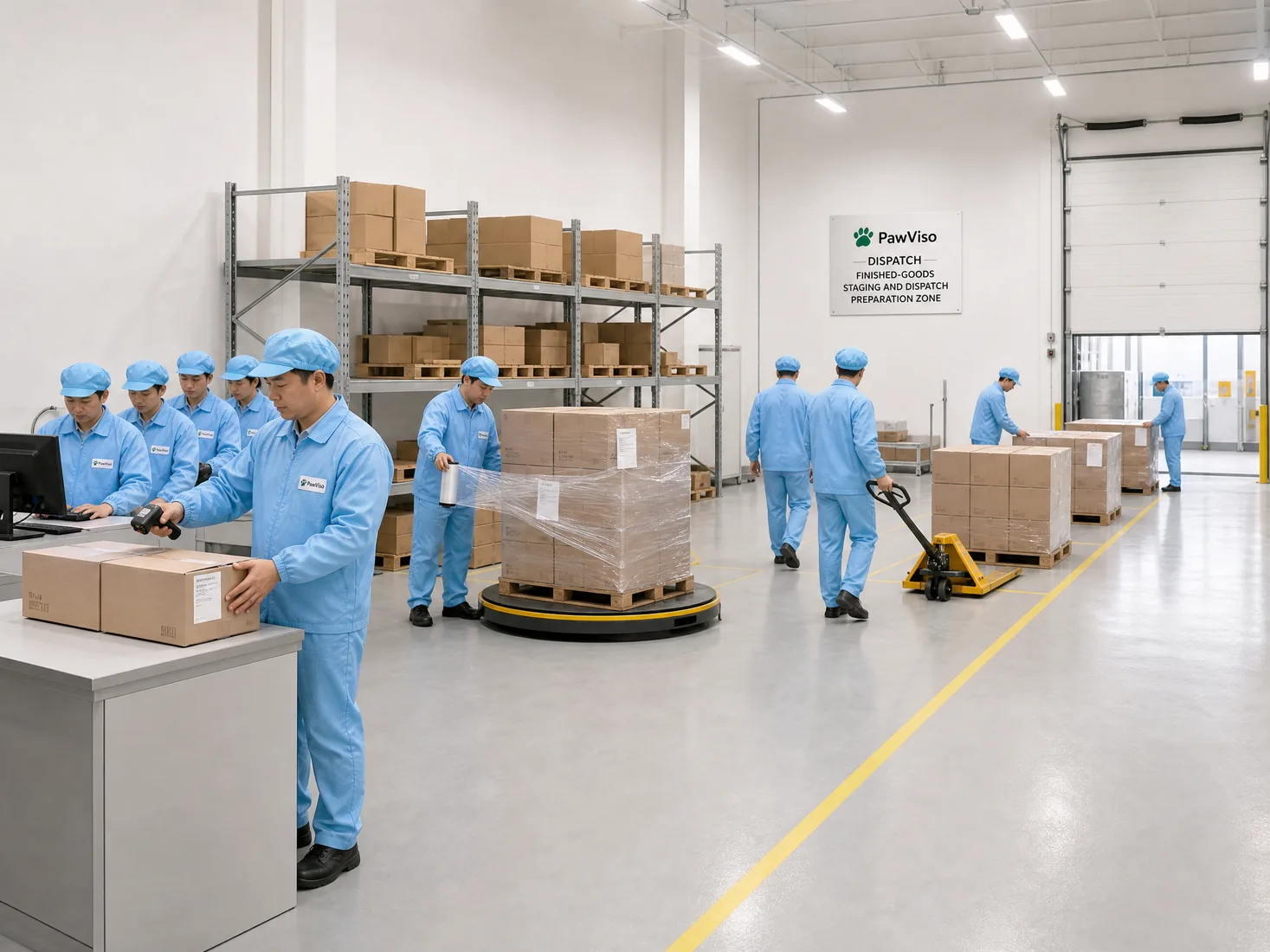
Efficient pet product sample shipping is a repeatable process that clarifies expectations, reduces lead-time risk and avoids disputes before production. For buyers and our factory procurement teams, the aim is simple: define what must arrive, what will be checked, who pays which costs, and how a successful sample moves into production. This guide gives direct actions for buyers, the supplier inputs you should request, and the records both sides should keep at each step.
We write from a Chinese factory and procurement-partner perspective. The instructions cover how to prepare a clear sample request, identify and label samples, pack and photograph them, collect and attach documents, manage shipping details and receipt checks, document review feedback, and when to release tooling or move to production. The advice separates decisions that a buyer must make from the supplier tasks that follow, and provides tradeoffs and practical next steps for each stage.
Module 1 — Define sample scope and objectives
Direct answer: State the exact purpose of each sample in the request: approval for form/fit/function, tooling confirmation, packaging sign-off, regulatory testing, or a sales/marketing prototype. List the SKUs or variant attributes that matter (size, color, material, accessory sets) and the acceptance gates that will determine approval. Clarify whether each sample must be production-intent (made on final tooling/molding) or pre-production (hand-finished prototype).
Explain and next steps: A clear scope avoids repeated cycles. As buyer, provide a one-line objective per sample (e.g., “approve final zipper attachment and play-cord stress for Dog Harness SKU H-204 — production-intent”). Suppliers should return a scope acknowledgement in writing that lists what will be produced and the limitations (e.g., prototype materials, non-final hardware). Record this acknowledgement in your sample folder and set a calendar reminder for review deadlines.
Roles and quick table: assign responsibilities in advance and record decision ownership. Use the table below to make responsibilities explicit and share it in your purchase order or sample request.
| Role | Buyer actions | Supplier inputs |
|---|---|---|
| Sample requester | Provide SKU list, objectives, and visual references | Confirm feasibility and lead time |
| Technical contact | Define acceptance gates and measurements | Provide sample BOM and material notes |
| Logistics coordinator | Specify delivery address and carrier preferences | Provide packing list, weight, and dimensions |
| Compliance/reviewer | Identify required tests or claims to prove | Confirm sample testability and limits |
Practical tradeoffs: Production-intent samples are more predictive but costlier and slower. Pre-production samples can accelerate visual approval but may hide issues that surface only under production processes. Decide which samples require a higher evidentiary standard and budget both cost and time accordingly.
Module 2 — Sample identification and SKU mapping
Direct answer: Insist that every sample is physically labeled with the buyer’s SKU, the supplier sample ID, and a simple description (color, size). Include a short master record that maps buyer SKU to supplier internal code, material batch, and tooling number. This mapping must be captured in a single-line spreadsheet row per sample to avoid mistaken acceptance.
Explain and next steps: Buyers should provide a SKU master file or simple list with attributes and expected GTIN or barcode master data if already assigned. Including GTIN or product identifiers reduces confusion between similar items and supports inventory and invoicing downstream 2. Suppliers should return a sample label mock-up (photo or PDF) and a copy of the mapping spreadsheet for confirmation.
Management system note and verification: Distinguish sample documentation and SKU conformity checks from broader quality management system claims — the factory’s sample mapping and inspection records are operational controls but are not a substitute for formal quality management certification or system audits 1. For buyers, require documented sample mapping as a minimum control, and request additional system evidence only when you need supplier process governance rather than a single-sample decision.
Record keeping: Maintain a single folder (cloud storage or shared drive) per order containing the SKU mapping, sample photos, packing list and the agreed acceptance gates. This single source of truth prevents later disputes about which sample version was approved.
Module 3 — Packaging: protect the sample and show production intent
Direct answer: Define packaging requirements in the sample request: inner packaging for each piece, required labels, and the outer pack-out for transport. For production-intent samples, request the intended retail hangers, cartons, polybags, or printed sleeves. For transit-critical items, specify cushioning and whether the sample should be packed to the final pack-out to validate handling and presentation.
Explain and next steps: Suppliers should supply a pack-out plan and photos of the sample in its final or proposed pack. If you require transit-validation, state it up front; the supplier can either follow your requested pack-out or propose alternatives for approval. Where transit performance matters, reference recognized test procedures rather than ad-hoc claims — for example, if you will later require transport tolerance testing, flag the expectation so the supplier can produce samples packed as they would be for sale 5.
Sample pack-out checklist table: use a compact table in the request to make specifications unambiguous.
| Pack-out item | Buyer requirement | Supplier confirmation |
|---|---|---|
| Inner bag | e.g., polybag with header card | Supplier confirms material and sealing method |
| Carton | dimensions, print, design approval | Supplier provides sample carton photo |
| Cushioning | foam, void-fill, or corrugate | Supplier confirms supplier-sourced material |
| Labeling | SKU label on outer carton | Supplier will attach sample label and send photo |
| Palletization | if applicable | Supplier specifies pallet type and unit count |
Tradeoffs: Final retail packaging on a sample increases cost and time but exposes packaging fit issues, labeling errors and retail presentation problems early. If you accept visual-only approval initially, indicate that functional packaging checks will be re-run on the production pre-shipment sample.
Module 4 — Photos and visual records: what to require, what to trust
Direct answer: Require a standard set of photos and one short video per sample: front, back, detail close-ups (seams, fasteners, prints), interior construction, and a scale reference (ruler or coin). Ask suppliers to include photos of the sample against a neutral background and of the label/packaging and packing list. For important attachments, request short videos demonstrating a specific function (e.g., buckle clip close/open) with an annotated caption.
Explain and next steps: Provide a photo checklist in your sample request so the supplier knows which shots are mandatory. Directly ask for original, high-resolution files and include a naming convention that matches your SKU mapping. Supplier photos are a good first pass but do not replace an in-person inspection when critical dimensions, materials or safety claims are at stake. Keep photographic records in the sample folder and link them to the acceptance gates.
Supplier photo protocols: We recommend that suppliers timestamp photos and include a photo of the packing list next to the sample to prove the photo corresponds to the shipped unit. If you require a photo of the sample weight on a scale or material swatch cross-section, specify these items explicitly.
Evidence considerations: Photos help find cosmetic defects, label errors and incorrect pack-out, but they can miss subtle dimensional or performance differences. Use photos to triage: accept for simple cosmetic approval, or move to an in-person check or independent testing when photos are insufficient.
Module 5 — Documents to include with samples
Direct answer: Require the supplier to include a standard minimal document set with every sample shipment: packing list (with SKU mapping), sample instruction sheet (stating sample purpose), bill of materials for the sample, supplier contact and batch identifiers, and any requested test reports or compliance statements relevant to the sample review. If you plan to run tests on the sample, ask for the sample’s material certificates and any supplier internal test records.
Explain and next steps: Make a document checklist part of your purchase order or sample request. Suppliers should provide both hard copies inside the parcel and PDF versions sent by email before shipment. The packing list must mirror the SKU mapping spreadsheet and show quantities per SKU. Keep the supplier-provided documents in the product folder and log receipt with date and who inspected the parcel.
Document table example: use this table in your request to standardize documents delivered with the sample.
| Document | Buyer needs | Supplier action |
|---|---|---|
| Packing list | Match to SKU mapping | Include signed hard copy + PDF |
| Sample instruction sheet | Defines approval gates | Fill and attach to inside carton |
| BOM (sample) | Material & hardware list | Provide sample BOM version |
| Material certs | For testable materials | Attach electronic certs if available |
| Photos & video | Visual records | Send high-res files before shipping |
Limitations and transparency: When suppliers cannot provide full material certificates for prototype parts (e.g., hand-finished colorways), require an explicit statement describing what is and isn’t final. That transparency reduces later disputes and clarifies what additional evidence will be needed before production.
Module 6 — Shipping details, costs and handover points
Direct answer: As buyer, state preferred shipping method, expected delivery date, and the commercial terms that control cost and risk transfer. Confirm the exact delivery address, receiving hours and any receiving protocols (e.g., pallet jack required). Suppliers must provide weight/dimensions, carrier tracking, and estimated arrival. Make the handover point explicit in the request and the supplier confirmation.
Explain and next steps: Specify the trade term or handover condition in your order and sample request so both sides understand when responsibility passes for loss or damage 6. Suppliers should confirm they will book the carrier you prefer or propose alternatives with an explanation of cost and lead time. Keep tracking details in the sample folder and log the carrier, AWB/BL number and ETD/ETA.
Quick carrier decision table: use this to choose based on urgency and cost.
| Priority | Mode | Typical use |
|---|---|---|
| High | Express courier (air) | Urgent visual or small functional samples |
| Medium | Air freight (consolidated) | Larger packed samples, moderate urgency |
| Low | Ocean LCL/FCL | Heavy pack-outs not time-sensitive |
Handover and responsibilities: Clarify packing and labeling responsibilities and whether the supplier arranges internal export or you will provide a forwarder. Avoid vague instructions — a clear handover term prevents disagreements about who pays for re-ships if a parcel is damaged or misdirected.
**Mid-article CTA — If you want a templated sample request checklist and label mock-up we provide to our sourcing clients, email your project brief and target SKUs and we will send a customizable Word/PDF template.
Module 7 — Receipt check: immediate actions on arrival
Direct answer: Upon receipt, inspect the parcel for external damage, cross-check the packing list to the SKU mapping, and verify sample count and labels. Photograph the unopened parcel if damage is visible, then open and photograph the inner pack-out and sample. Log an arrival record including who checked the sample, the date/time, and a short pass/fail at first glance.
Explain and next steps: Use a receipt checklist and require the recipient to capture photos of damaged packaging before opening — this provides evidence for claims with the carrier and for supplier follow-up. If any item is missing or obviously incorrect, notify the supplier within your agreed notification window with the photos and arrival log. For cosmetics-only samples, a visual pass may be sufficient; for any dimensional or functional sample, proceed immediately to stepwise inspection or testing.
Inspection gates table: define the gates that will determine sample acceptance and next actions.
| Receipt gate | What to check | Action if fail |
|---|---|---|
| Parcel integrity | Outer damage, water, crushing | Photograph + notify supplier |
| Documentation | Packing list matches SKU mapping | Supplier clarification required |
| Quantity & labels | Correct SKU and count | Hold for supplier action |
| Visual defects | Obvious mis-color, prints | Record and request replacement if needed |
| Function/dimensions | Measured per spec | Proceed to technical review or reject |
Record retention: Save all photos, the arrival log and any email exchanges as a single bundle. This bundle becomes the authoritative record of what the buyer actually received and supports decisions about replacement samples, payment adjustments, or proceeding to production.
Module 8 — Technical review, measurements and test planning
Direct answer: For functional approval, specify a concise measurement and test protocol for the sample review: critical dimensions and tolerances, material checks, and any simple in-house tests you will run. Record the exact methods used and the instrument calibrations or lab used for testing. If you require third-party testing later, identify the expected tests now to ensure the sample is appropriate for lab submission.
Explain and next steps: Provide a short measurement sheet tied to the SKU mapping. Suppliers can provide the sample’s BOM and suggest the best measurement points. For consistency, define tolerances in mm or percent and state measurement tools and the number of samples to be measured. If you plan to submit the sample to an external lab, inform the supplier so they can provide chain-of-custody documentation and material source information.
Testing and transit note: If sample packaging or transport performance is within your scope, request that the sample be packed as it would for sale and note that transit performance may be checked later with standardized procedures 5. Decide whether you will run in-house checks or use an external lab and set the logistics for chain-of-custody and who pays for testing.
Practical tradeoffs: Detailed technical checks reduce later surprises but add time. Prioritize which dimensions or tests matter to the buyer’s risk profile — for example, a dimensional critical fit might be non-negotiable while a surface finish detail may be deferred until production pre-shipment checks.
Module 9 — Review feedback, claims and revision cycles
Direct answer: Provide structured feedback within a set timeframe, using a templated review form that maps to the acceptance gates. When making claims about defect categories (e.g., “loose stitching” or “color out of tolerance”) define the evidence needed for acceptance of corrective action: photos, re-made sample, or a confirmed process change. Avoid vague language and state the requested remedy (e.g., re-sample within X days, provide corrective action plan, or accept conditional release).
Explain and next steps: Supply clear pass/fail decisions and required evidence. If you require the supplier to correct and re-sample, define acceptable root-cause documentation and what verification will be used. Be explicit about whether a re-sample must be production-intent or if a pre-production trial is acceptable. When feedback involves marketing claims or labeling claims, remind all parties that any claims require documented substantiation and that the buyer controls claim language until market clearance is confirmed 4.
Buyer/importer market confirmation: Some feedback may require buyer confirmation of market-acceptability or regulatory comparability. Buyers should secure any market-specific confirmations early and document them; regulatory or market suitability confirmation is a buyer/importer responsibility and must be recorded in the decision file 3.
Revision cycle management: Limit rounds of re-sample cycles by escalating thresholds: e.g., allow two cosmetic re-samples by the supplier without tooling change, then require a documented corrective action plan or a tooling iteration. Document each feedback loop and link it to the sample mapping row so the history remains traceable.
Module 10 — Ownership, sample retention and reorder decisions
Direct answer: Decide and document who owns the sample after review and where retained samples will be stored. For items used for testing, clarify whether the lab retains the sample or returns it. Set retention times for approved samples and decide whether to store a master approved sample as the golden reference for future production batches.
Explain and next steps: Specify ownership and retention in the sample request and record the agreement in the sample folder. If the buyer retains the approved sample, provide the supplier with the serial or sample ID for tooling and production reference. If the supplier keeps the sample, require high-resolution photos and a formal signed confirmation that the supplier will not change tooling or materials without buyer approval.
Sample gate and reorder decision table: use this table to formalize the post-approval path.
| Gate outcome | Ownership | Next action |
|---|---|---|
| Approved | Buyer retains golden sample | Release tooling or production instruction |
| Approved with conditions | Supplier retains with buyer-specified constraints | Supplier submits CAP and re-sample timeline |
| Rejected | Supplier retains (if return requested) or buyer returns at supplier cost | Rework or cancel order |
| For testing | Lab retains chain-of-custody | Test report linked to sample ID |
Inventory and reorders: If the sample will function as the template for reorder approvals, tie the sample ID and all documents to the production order. Keep a recorded decision that lists who can sign off on future minor changes (e.g., color shade tolerances) to avoid unnecessary re-sampling for trivial variations.
Module 11 — Transition to production and first-batch checks
Direct answer: Move to production only after the buyer issues a formal release that references the approved sample ID, the production tooling or process version, and any corrective actions. Require the supplier to submit a pre-production validation checklist and a plan for first-batch checks (FFI or first-article inspection) including who performs them and what measurements are mandatory.
Explain and next steps: The production release should be a signed document listing the approved sample, documents that accompany production (BOM, work instructions), and the first-batch inspection schedule. Suppliers should provide a timeline for first-batch delivery and the method of inspection (internal QC, third-party, or buyer inspection on arrival). If first-batch inspection fails, the supplier must provide a corrective action plan before further production.
Inspection and pack-out controls: Confirm whether the first-batch will be packed to final retail pack-out and whether you will sample from the first-batch for laboratory or performance testing. Align first-batch acceptance criteria to the sample acceptance gates and ensure the inspection report references the sample ID and all measurement tolerances.
Ownership of evidence and handover: When production begins, maintain the sample folder as the contractual reference for tolerances, materials and labels. If the buyer permits minor deviations controlled by a management system or routine QC checks, document the allowable change matrix and who can sign for those changes to avoid uncontrolled drift in production quality 1.
Frequently asked questions
Q: Who pays for sample shipping and duties? A: State this clearly in the sample request. Common approaches are buyer-paid express for urgent visual samples, or supplier-paid when samples are routine R&D and used for multiple buyers. Always include the agreed commercial term in writing 6.
Q: How many samples should I request for review? A: Request at least one for visual approval and an additional unit if you will run tests or destructive checks. If you expect variation, ask for three samples from different production runs or material batches to assess consistency.
Q: What if the supplier cannot provide material certificates for a prototype? A: Require an explicit statement from the supplier explaining why certificates are not available and what the supplier will do before production (e.g., source certified materials and provide certificates prior to production shipment). Keep this statement in the sample folder and link it to the sample ID.
Q: Can photos replace an in-person inspection? A: Photos are acceptable for preliminary visual checks but are not sufficient when dimensional, functional, or safety claims are critical. Use photos as triage; plan an in-person or independent lab check when evidence must be conclusive.
Q: How should I track sample versions and approvals over long projects? A: Use a single spreadsheet or PLM entry keyed to the buyer SKU and supplier sample ID. Record dates, approver names, and links to all evidence (photos, packing list, test reports). This traceability reduces confusion during production and helps with warranty or returns management.
Conclusion
This guide describes a practical, stepwise approach to managing pet product sample shipping from request to production. Buyers should lead with precise instructions (scope, SKU mapping, pack-out, documents, acceptance gates), and suppliers should supply matching confirmations, photos, packing lists and sample IDs. Maintain a single foldered record for each sample and require explicit ownership and retention decisions before tooling release or production. Clear decisions, documented evidence and agreed handover terms reduce re-sampling cycles and speed time-to-market.
requirements need project-specific buyer/importer confirmation
Related PawViso resources
- Continue with How to Build a Private Label Pet Product Line. Use this guide to connect customization, packaging and MOQ decisions.
- Browse the PawViso product catalogue to identify product formats for a sourcing brief.
- Follow the PawViso sourcing process and review the B2B buyer FAQ before sharing project requirements.
External reference
For independent shipping-term and handover context, review International Chamber of Commerce Incoterms® 2020 overview. Confirm the requirements that apply to the selected product, target market and order.
References
- 1ISO 9001:2015 Quality Management Systems — Requirements
- 2Global Trade Item Number (GTIN) — GS1
- 3Regulation (EU) 2023/988 on General Product Safety
- 4Green Guides — Federal Trade Commission
- 5ISTA Test Procedures
- 6Incoterms® 2020 — International Chamber of Commerce
**Final CTA —
If you would like our sample-request template, pack-out checklist or a sample-folder spreadsheet customized to your SKUs, contact our procurement team.
Email: info@PawViso.com
WhatsApp: +86 186 8106 4480 — https://wa.me/8618681064480