
Introduction: What is the safest way to source interactive pet products from China?
The safest approach is to treat sourcing as a controlled product-development project, not a search for the lowest unit price. A buyer should define the animal, use scenario, product function, materials, packaging, target market, quantity and required evidence before comparing suppliers. Samples should then be checked against a written protocol, while the supplier is evaluated through records, process controls and change-management evidence.
This method matters because “interactive pet products” can include treat puzzles, slow feeders, rotating toys, scratch-and-play formats, wall-mounted grooming items and other products with very different failure modes. A detachable cap, sharp molding edge, unstable base, loose fastener, weak adhesive or hard-to-clean cavity may create a different commercial and safety risk depending on how the product is used.
There is no single certificate that proves every pet product suitable for every market. The American Pet Products Association notes that few US laws apply solely to pet toys, while retailer, chemical, labeling and general consumer-product requirements may still apply.1 The buyer must therefore build a product- and market-specific requirements file rather than ask only, “Do you have a pet toy certificate?”
Why is interactive pet-product sourcing different from buying a standard accessory?
Interactive products combine animal behavior, repeated force, moving parts, food contact or treat exposure, cleaning and retail presentation. The intended product application changes what must be reviewed.
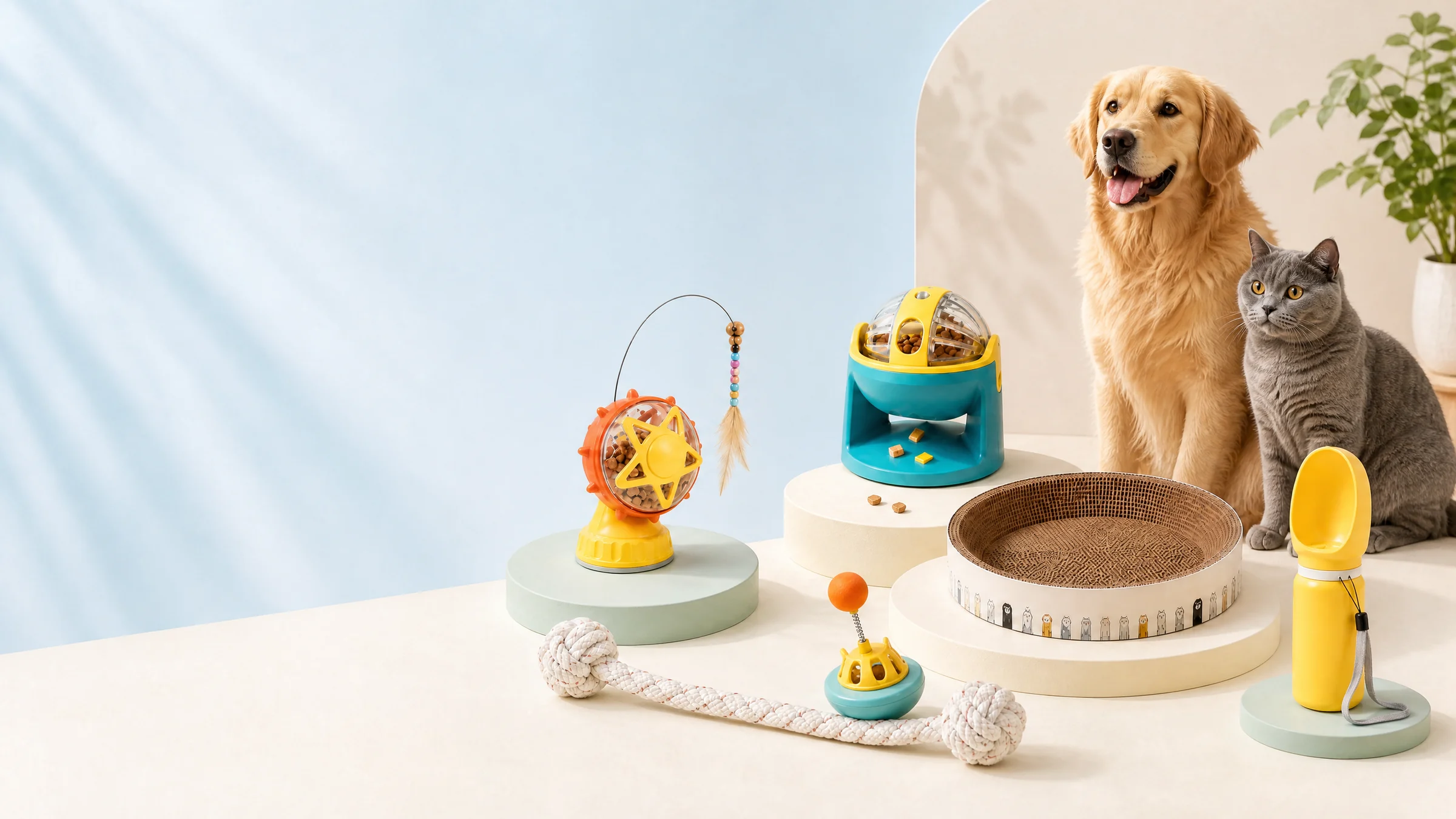
A slow feeder may require attention to stability, cavity access, cleanability and food-contact material documentation. A rotating treat puzzle may add fasteners, lids and moving interfaces. A cat scratch lounge depends on board density, edge finishing, dust control and structural consistency. A wall-mounted grooming brush requires the mounting method, adhesive or fastener system, bristle retention and installation preparation to be defined.
The first sourcing question is therefore not “What is your best price?” It is:
What must this product consistently do, for which animal and sales channel, and what evidence will show that the production unit matches the approved sample?
That question creates a usable buying specification. Without it, two suppliers may quote products that look similar in a photograph but differ in resin grade, wall thickness, assembly method, component retention, packaging protection or inspection scope.
What should be included in the initial product brief?
A useful brief gives the supplier enough information to identify the correct product route and disclose what still needs confirmation. It should separate requirements from preferences so that the quotation does not hide unapproved assumptions.
| Brief field | What the buyer should state | Why it matters |
|---|---|---|
| Product and application | Product type, target animal, approximate pet size, intended interaction and supervision statement | Defines foreseeable use and functional checks |
| Product configuration | Dimensions, weight range, moving parts, detachable components and required accessories | Prevents visually similar but technically different quotations |
| Materials | Known material family, color, surface finish, food-contact or textile components, restricted-substance requirements | Supports material documentation and test planning |
| Target market | Country, retailer, marketplace and any buyer-specific specification | Determines which legal and commercial requirements must be reviewed |
| Quantity | Estimated quantity per SKU, color and packaging version | Helps the supplier explain MOQ and price breaks accurately |
| Branding | Logo method, label, color standard and artwork status | Separates simple marking from process or tooling changes |
| Packaging | Retail format, inner pack, export carton, barcode owner and distribution route | Connects shelf presentation with shipment protection |
| Evidence | Sample checks, factory testing, lab reports, inspection and document expectations | Makes quality scope comparable across proposals |
Avoid requesting “the same as the picture.” Provide a dimensioned reference, annotated image or physical benchmark and identify which features are critical. If a range includes several colors or related SKUs, state whether components and packaging should be shared. This helps the supplier explain whether one sample or test report can reasonably represent the whole family.
How should buyers identify foreseeable product risks?
Start with the complete use cycle: unpacking, installation preparation, normal interaction, cleaning, storage and disposal. Then ask how the product might fail at each stage.
For hard plastic interactive products, review molding edges, cracks, thin sections, trapped dirt, loose lids, unstable bases and components that may detach during repeated manipulation. For textile or rope products, examine seam construction, knot security, fiber shedding, hardware attachment and drying. For cardboard scratch products, check board consistency, exposed staples or adhesives, edge finishing, dust and moisture protection. For grooming tools, examine bristle or blade retention, pinch points, battery access where relevant and the clarity of cleaning instructions.
Testing-industry guidance commonly highlights detachable parts, seam or joint weakness, sharp edges, brittle failure and fragmentation as important pet-toy hazards.2 Intertek has also described custom “bite and pull” fixtures and fatigue-to-failure approaches designed to imitate chewing and tearing where a universal method is unavailable.3 These examples do not create one mandatory protocol. They show why the buyer should define a repeatable method that reflects the product’s intended use.
How should mechanical checks be written?
A check should state the sample condition, action, duration or force, and pass criterion. “Check durability” is too vague. A stronger instruction might require the inspector to operate a rotating mechanism for an agreed number of cycles, apply a defined pull to a detachable component, inspect edges after a drop sequence, or verify that fasteners remain secure after repeated assembly.
The final method should be agreed with a qualified laboratory or inspection provider where safety or compliance decisions are involved. Children’s-toy methods may offer useful hazard concepts, but they are not automatically mandatory for pet toys. CPSC guidance identifies ASTM F963 as a standard for products designed, manufactured or marketed as playthings for children; its legal scope should not be misrepresented as a universal pet-product requirement.4
How should chemical and material risks be managed?
Ask for a component-level bill of materials or material declaration that identifies the major resin, rubber, textile, coating, adhesive, metal and colorant systems. A vague statement such as “eco-friendly material” is not enough to define a test plan.
For EU-bound goods, REACH is the main chemical-risk framework and assigns industry responsibility for risk management and safety information.5 The buyer or importer should identify current restrictions and information duties applicable to the product’s components. For other markets, confirm federal, state, retailer and marketplace requirements. Do not assume that one historic report covers a new color, new supplier, new coating or changed component.
How should materials be compared during sample development?
Material selection is a balance of product application, processing, appearance, cleaning, odor, expected force and target price. “ABS,” “PP,” “TPE,” “cotton” or “cardboard” identifies only a broad family, not the complete performance specification.
Compare samples using a controlled matrix:
| Evaluation area | Practical questions |
|---|---|
| Identity | Is the declared material supported by supplier records or test evidence? |
| Physical feel | Is flexibility, hardness, board density or textile hand consistent with the target? |
| Construction | Are wall thickness, ribs, seams, joints, fasteners and adhesives suitable for the design? |
| Surface quality | Are there burrs, flash, rough edges, color inconsistency, odor or contamination? |
| Use performance | Does the material perform after repeated movement, pulling, loading, scratching or cleaning? |
| Change risk | Which raw-material source, formulation, color masterbatch or process changes require reapproval? |
Record the accepted sample’s measurable characteristics and photographs. When possible, retain a signed or sealed reference sample for the buyer and supplier. The goal is not to create an unrealistic laboratory specification for every detail. It is to make critical characteristics clear enough that production and shipment inspection can detect a meaningful change.
How should buyers test samples before a purchase order?
Sample review should follow a staged process rather than a single unboxing impression.
First, confirm identity: model, dimensions, unit weight, color, material declaration, accessories and packaging components. Second, perform visual and workmanship checks under consistent lighting. Third, run functional checks that simulate normal product application. Fourth, conduct reasonable abuse, cleaning and storage checks. Fifth, review retail packaging and export protection. Finally, document deviations and decide whether the sample is approved, conditionally approved or rejected.
For an interactive feeder, the protocol might include base stability, movement of each feature, food or treat release, accessible edges, component retention and cleaning access. For a scratch lounge, it might include overall dimensions, board fit, edge condition, dust, load behavior and pack-out. For a wall grooming brush, it might include bristle retention, body finish, mounting preparation, adhesive or fastener instructions and removal risk.
What is factory testing, and what requires a laboratory?
Factory testing can include dimension, weight, assembly, function, cycle, pull, drop, visual and packaging checks when suitable equipment and written methods are available. It helps control production against the approved specification.
Laboratory testing is different. It may be necessary for chemical analysis, food-contact evaluation, electrical safety or other regulated and retailer-specified requirements. A pre-shipment inspection also serves a different purpose: it samples finished production for conformity and does not replace laboratory testing. Keep these three evidence types separate in the project file.
Mid-article CTA — Send Your Requirements
Preparing an interactive pet-product RFQ? Send PawViso the product category, target market, estimated quantity, preferred material or benchmark, packaging direction and required tests. We can organize the questions that still need project confirmation before a quotation is compared. Contact info@PawViso.com.
How can a buyer evaluate a pet-product supplier?
Supplier evaluation should confirm whether the organization can control the product you intend to buy. A business license, catalogue and certificate may be useful starting points, but they do not demonstrate that the quoted process, subcontractors and inspection records match your project.
Ask the supplier to explain the manufacturing route: which steps are completed at the quoted site, which components are purchased, which operations are subcontracted and who approves changes. Review sample-control, incoming inspection, in-process inspection, final inspection, calibration, nonconformance and corrective-action records. If tooling or color matching is involved, clarify ownership, maintenance and change approval.
ISO describes ISO 9001:2015 as a general quality-management-system standard covering documented processes, customer requirements, operational control, performance evaluation and continual improvement.6 Certification can add confidence when valid and relevant, but the buyer should still review working evidence. A certificate does not replace a product specification or prove that the sample and production lot are identical.
Useful verification questions include:
- Who controls the bill of materials, drawings, artwork and approved sample?
- How are purchased components identified and inspected?
- What triggers first-article or pilot-run approval?
- How are nonconforming units separated and recorded?
- How are process, material and subcontractor changes communicated?
- Which tests are performed during production, and where are the records stored?
- Can final inspection trace findings to the purchase order, SKU and production lot?
Answers should be specific and supported by records. If the project is high risk or strategically important, consider an independent factory audit or process audit focused on the actual product route.
How should quotations be compared beyond unit price?
Normalize each quotation before deciding. A lower price may exclude logo setup, color matching, sample fees, packaging, inserts, barcode labels, lab testing, inspection, tooling, spare parts, export cartons or delivery to the chosen port.
| Quotation area | Required comparison point |
|---|---|
| Product scope | Exact model, dimensions, materials, color and included accessories |
| Commercial scope | MOQ per SKU/color, price breaks, currency, Incoterm and payment stages |
| Development | Sample type, number of rounds, setup or tooling fees and refund conditions |
| Packaging | Retail unit, inner pack, case quantity, carton specification and artwork work |
| Quality | Approved sample, factory tests, laboratory tests, PSI and reinspection responsibility |
| Timing | Approval dependencies, production window and shipment-readiness definition |
| Change control | Notice and reapproval requirements for material, component or process changes |
Ask suppliers to identify exclusions and assumptions in writing. Compare total landed and quality-control scope, not only the ex-factory unit price.
What must be approved before mass production starts?
Production should begin from a controlled approval pack. At minimum, it should contain the purchase order, product specification, bill of materials or material declaration, approved colors, dimensioned artwork, packaging hierarchy, barcode data, test plan, defect classification, golden sample status and required documents.
If any item is open, record the owner and approval deadline. “Proceed and confirm later” is particularly risky for printed packaging, colors, custom components and test scope because rework may be costly or impossible after production.
The approval pack also becomes the basis for shipment inspection. If the inspector does not receive the current files, even a well-executed inspection cannot confirm the correct requirement.
Frequently asked questions
How do I find a reliable pet-product supplier in China?
Start with a complete RFQ, compare like-for-like proposals, verify the legal entity and manufacturing route, review samples against a written protocol, and examine working quality records. Use an independent audit or inspection where the project risk justifies it.
What tests should an interactive pet product undergo?
The test plan should reflect materials, moving parts, detachable components, target animal, intended interaction, cleaning, packaging and destination-market requirements. Typical categories include dimensions, function, cycle, pull, drop, edge, component retention, cleanability and risk-based chemical testing. Confirm the final method with the responsible importer, retailer or qualified laboratory.
Are EN 71, ASTM F963 or CE marking automatically required for pet toys?
No universal answer applies. ASTM F963 is a children’s-toy standard in the US context, while CE marking applies only when relevant EU legislation requires it. Some retailers use selected children’s-toy methods as purchasing specifications for pet products. Confirm the actual product, market and sales-channel requirements before testing or marking.1 4
How many samples should I approve?
The number depends on product complexity, colors, materials, tooling and family similarity. Approve enough samples to represent every meaningful configuration, and record which variants are covered. A new material, coating, component or process may require additional approval even if the product name is unchanged.
Should I choose a stock product or a custom design?
Choose the simplest route that creates useful differentiation. A stock or semi-custom product may reduce development complexity; a custom structure may be justified when function, fit, material, packaging or exclusivity is central to the commercial offer. The written scope matters more than the label “OEM” or “ODM.”
Can one test report cover several colors or models?
Only when the laboratory, importer and applicable requirement accept the product-family rationale and the tested samples represent the relevant materials and risk. Do not assume coverage. Confirm it before sample submission and retain the documented decision.
Conclusion
Sourcing interactive pet products from China is most reliable when the buyer controls the information flow. Define the application, map foreseeable failures, document materials, test representative samples, verify the supplier’s process, normalize quotations and release production only from an approved specification pack.
This approach does not eliminate commercial risk, but it replaces vague claims with evidence that can be checked again during factory testing and shipment inspection. It also makes supplier conversations faster because open questions are visible before price and timing are treated as final.
Final CTA — Ask for the PawViso Product Catalogue
Tell PawViso which categories you are planning—interactive feeding, cat play and scratch, grooming, dog play or travel—and include your market, expected quantity, packaging direction and target launch window. Email info@PawViso.com to request the catalogue or send a product brief for project-specific discussion.
This article provides general B2B sourcing information, not legal, regulatory or veterinary advice. Product requirements must be confirmed for the actual SKU, intended use, destination market and sales channel.
Related PawViso resources
- Continue with How to Create a Custom Pet Toy Sampling Plan. Use this pet-toy guide to structure approvals, samples and evidence.
- Browse the PawViso product catalogue to identify product formats for a sourcing brief.
- Follow the PawViso sourcing process and review the B2B buyer FAQ before sharing project requirements.
External reference
For independent quality-management system context, review ISO 9001 quality-management systems overview. Confirm the requirements that apply to the selected product, target market and order.