
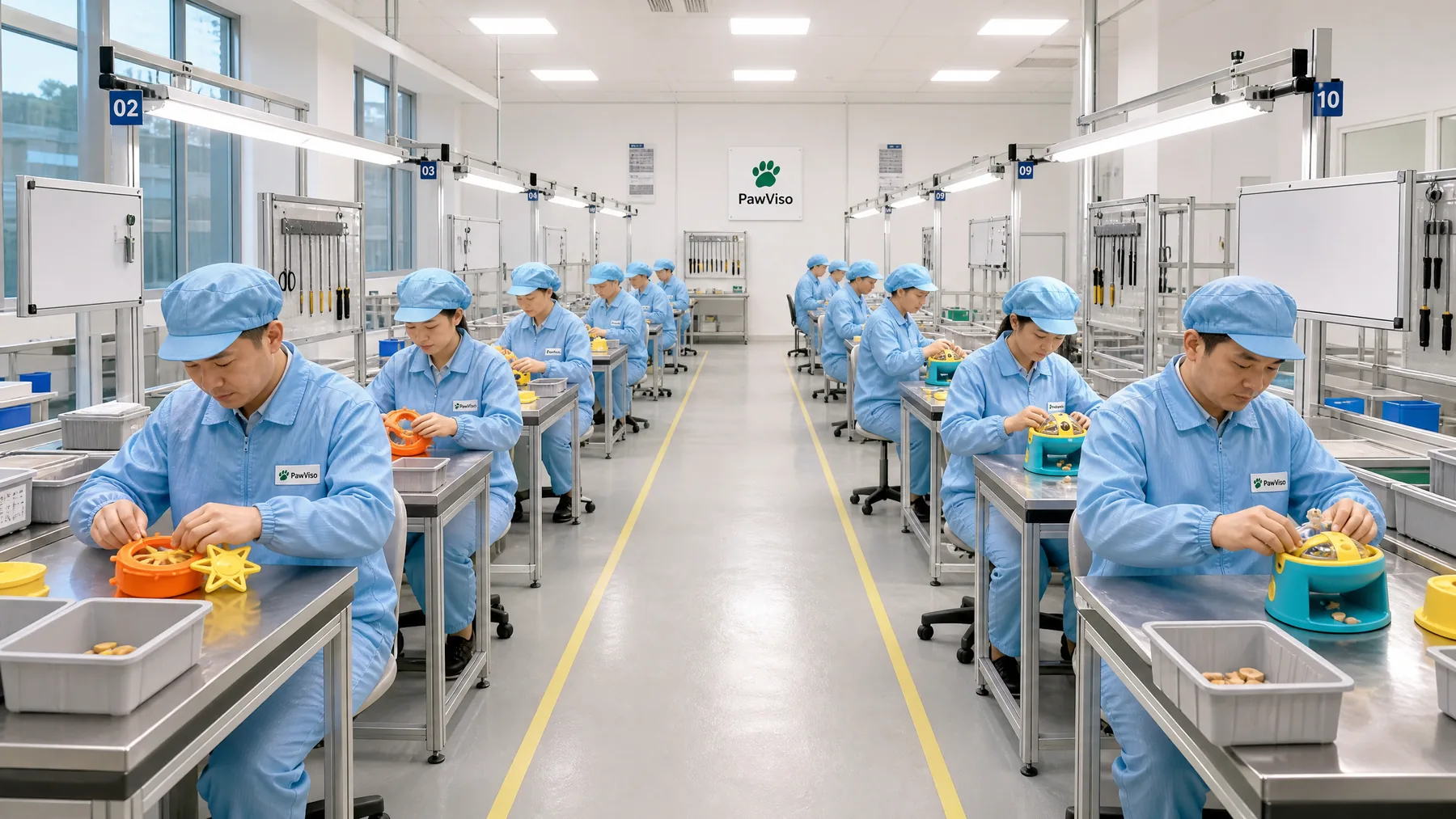
Module 1 — Buyer intent and decision boundary
Purpose and intent
- Define why you are running a pet product remote factory review: supplier selection, initial capability screening, pre-production verification, corrective-action verification, or periodic surveillance. Keep the intent narrow and documented before any live video. That intent sets what evidence you will accept and what you will reserve for in-person or third-party inspection.
- A remote review is a tool for observation and confirmation of supplier capability evidence; it is not a substitute for contract, destination-market testing, or buyer/importer confirmation of final product, claim, testing, documentation, contract and destination-market decisions.
Decide the decision boundary
- For each engagement, state the decision outcomes you expect the review to support. Typical boundaries:
- Go/no-go for pilot order (low risk)
- Release to full production subject to lab/test results (conditional)
- Verify corrective actions from an audit (verification)
- Document packaging/labeling for freight and customs (evidence only)
- Record explicitly what the review will not decide: e.g., final product acceptance, full compliance with destination-market safety rules, or achievability of performance targets. This prevents assumption creep.
Risk-based prioritization
- Prioritize what to see based on product risk (mechanical failure, entanglement, chemical exposure) and business risk (brand exposure, retailer requirements). Use a short risk table in procurement files to justify the level of remote scrutiny.
Participant roles and required sign-offs
- Identify who in your team will make the final decisions and who will be observers. Define an escalation path: observational notes go to a sourcing manager; technical questions go to R&D; legal flags go to compliance; final acceptance is the buyer/importer’s responsibility.
Document control
- Use a single, dated scope document that accompanies all scheduling invites and links. This document should say what will be recorded (still images, video segments), who can view recordings, retention period, and how follow-up questions will be logged.
Module 2 — Scope, roles and evidence
Define scope clearly
- Scope defines which facilities, lines, and processes will be shown. For example: “Show assembly line A producing leash models 101–104; show packaging line B during shift 2; show incoming inspection area; show raw-material storage.” Keep scope limited to what supports your decision boundary.
- Distinguish pet-product guidance from other product classes: safety and test regimes that apply to children's toys or medical devices may differ and do not automatically apply to a pet product; consult category-specific standards and regulatory specialists before assuming cross-application 2.
Roles during a live session
- Host (supplier): controls camera movement, answers questions, and obtains internal approvals for showing restricted areas.
- Moderator (buyer): manages the sequence of topics in the scope document, holds the supplier to time allocations, and logs questions.
- Technical witnesses: product engineer or quality lead who can interpret what is shown and note exceptions.
- Observer list: limit the number and publish it in advance.
Types of supplier capability evidence you can collect remotely
- Visual confirmation of line geometry, tooling presence, labeling content, and packing configuration.
- Live demonstrations of sample handling, basic measurement using visible gauges, and employee practices.
- Documentary evidence shown on camera: batch records, calibration stickers, certificates (view-only). Insist on time-stamped digital copies to be shared after the session.
What a factory video review can document vs what it cannot
- Table: video review capabilities (concise decision aid)
| What a factory video review can document (useful) | What it cannot establish (requires follow-up) |
|---|---|
| Visual configuration of production lines and tooling | Full verification of process capability (Cp/Cpk) |
| Presence of labels, markings, and packaging layout | Authenticity of certificates or lab reports without originals |
| Observed operator technique and training signage | Continuous compliance or long-term behavior changes |
| Existence of inspection stations and basic gauges | Full traceability back to raw-material batch without records |
| Surface finish and visible defects on samples | Sub-surface defects, chemical composition, or microstructure |
Evidence hierarchy
- Assign evidence levels for each item: Visual (video/picture), Documented (records shown), Managed (SOPs with signatures), Verified (third-party test or buyer inspection). Use this hierarchy to decide what additional verification is required before contracting.
Hypothetical-scenario table (illustrative)
- Use a short table to map a typical scope to evidence expected. Label as illustrative.
| Scope item | Expected supplier capability evidence (illustrative) |
|---|---|
| Assembly line layout | Live walk-through video; fixed-camera overview; annotated floor plan |
| Packaging labels | Live close-up of label content; sample pack scanned and sent afterward |
| Inspection gauges | On-camera demonstration and subsequent photo of gauge certificate |
Module 3 — Product and data control points
Key control points to cover
- Incoming material storage, raw-material identification, inventory segregation.
- Cutting/casting/injection points that produce parts critical to safety.
- Assembly/join methods and any adhesives or fasteners that affect performance.
- Final inspection and packing stages where labels, instructions, and safety warnings are applied.
Trade-item identification and traceability
- If GTIN or trade-item identifiers are part of your supply chain controls, require the supplier to show the master label and digital records for trade-item identification; include GTIN context where applicable 3. Ensure that any GTINs or identifiers shown are consistent with your purchase orders and packaging specifications.
Data capture and record quality
- Request to view records on camera but also insist on receiving certified digital copies immediately after the review. Records to request: lot numbers, inspection checklists, calibration certificates, and production start/stop times. Avoid relying solely on camera: resolved records must be verifiable and timestamped.
Data security and IP protection
- Limit recorded content to what is necessary. Use redaction for proprietary tooling or processes if the supplier requires it; include a non-disclosure agreement clause in the pre-review paperwork. Define retention and destruction policies for recordings.
Sample handling and chain of custody
- For samples shown on camera, deploy a short chain-of-custody script: supplier displays sealed sample, opens it on camera, shows packaging, measures, and signs a simple on-camera declaration of origin and batch. Then request the supplier to ship a sealed sample with the same batch number for buyer verification.
Table: Decision checklist for data you'll accept remotely
| Data type | Accept via video? | Minimum follow-up required |
|---|---|---|
| Visual label/packaging layout | Yes | Photo files + final packaging spec |
| Master batch record | Show on camera | Certified digital copy with signatures |
| Calibration certificate | Show on camera | Original PDF or copy with traceable stamp |
| Chemical composition | No (not reliably) | Independent lab report with chain-of-custody |
Module 4 — Supplier communication and approvals
Pre-review preparation checklist
- Send a clear invitation with scope, roles, expected evidence, time zones, and required attendees 7–10 days in advance. Attach a one-page agenda and the decision boundary document. Ask supplier to confirm they can produce the requested evidence and to list any items they cannot show.
Scripted walkthrough and timebox
- Use a scripted walkthrough tied to the scope document. Break the session into 10–15 minute blocks per control point. Enforce timeboxes and note any deviations immediately.
Approvals required during the session
- Where supplier internal approvals are necessary to show certain areas, agree on a process: the supplier will pause, obtain sign-off, and resume. Log the approval time and name on camera.
Question-led follow-up record
- For each observation create a follow-up record with: timestamp, observer, exact question, supplier response, required evidence to close, due date, and acceptance criteria. This structure makes the session actionable and auditable.
Example follow-up record (concise table format)
| Timestamp | Observation | Question | Supplier response | Evidence required to close | Due |
|---|---|---|---|---|---|
| 00:12:30 | Incoming storage bins unlabeled | Confirm lot ID method | Supplier says labels applied after inspection | Photos + batch list | 3 days |
Communication etiquette and restrictions
- Avoid speculative language; stick to facts. If the moderator asks for a repeat shot, keep it short. Do not interpret observed items on camera as final compliance; use them to form clear follow-ups.
Module 5 — Sample, packaging and operational checks
What to check on samples shown by video
- Visual appearance against your spec: color, seams, stitch quality, obvious defects.
- Functional checks the supplier can demonstrate on-camera: fit checks, moving parts (basic), and assembly steps.
- Simple measurements using visible rulers or calipers; record the tool and calibration label on camera.
Sample shipment and verification
- After the remote session, require that a sealed sample from the production batch be shipped to a nominated lab or to your staging address. The sample must include the batch ID shown during the session and a signed declaration linking the sample to the camera-demonstrated lot.
Packaging and labeling checks
- Confirm packaging suffices for transit and retail display. Check that retail-facing labels match the spec and include required data elements for your destination market.
- If you rely on the live session for packaging confirmation, request high-resolution photos and the final dielines. Do not accept verbal confirmation as final.
Table: Packaging evidence and buyer decision guide
| Packaging element | Accept if seen on video? | Follow-up required before production |
|---|---|---|
| Retail label text and language | Yes (close-up) | Final PDF dieline + proof print |
| Inner protective materials | Yes (visibility) | Sample shipment to confirm protection |
| Shipping marks and palletization | Yes | Written packing list and pallet photo |
| Barcode/GTIN placement | Yes (clear) | Confirm GTIN registration and print quality 3 |
Operational checks to request
- Operator skill demonstration: have an operator assemble a unit, narrate the steps, and show the SOP binder. Note operator name and date.
- Inspection routine demo: show an inspector performing a pass/fail decision with a documented checklist, and show where records are filed.
- Change-control practice: ask how a small product change is documented and approved, and request to see an example change record.
Chain of custody for instructions and inserts
- Ask the supplier to show a pre-production proof of any instruction insert and to confirm the file version that will be used. Reserve final approval until you have the actual print sample and buyer confirmation.
Module 6 — Quality controls and exception decisions
What to observe for quality controls
- Inspection stations and their tooling, presence of visual inspection aids, sampling plan postings, and corrective-action log. Ask to see how nonconforming items are segregated and labeled.
Sampling and acceptance criteria
- Document the supplier’s sampling plan and acceptance criteria. If it is statistical, request to see the plan’s written parameters and any historical sample records. Remember that viewing the plan is different from verifying its consistent execution over time.
Link to quality-system context
- Frame remote findings within recognized quality-system thinking: treat observations as inputs into your supplier control plan and corrective-action processes rather than as standalone compliance conclusions 1.
Nonconformance and exception handling
- Test a live scenario: ask the supplier to show a recent nonconformance record and the steps taken. Confirm the person responsible and how the disposition was decided. Record the timestamps and request supporting evidence.
Decision rules for exceptions
- Predefine exception thresholds for remote review outcomes. Examples:
- Minor discrepancy: require corrective action and photographic evidence within 7 days.
- Major discrepancy affecting safety: halt further orders until in-person audit or third-party verification.
- Documentation gaps: hold shipments until certified documents are received.
Table: Exception decision matrix (concise)
| Observation severity | Typical buyer action | Evidence required to reopen |
|---|---|---|
| Informational (no impact) | Note in file | No closure evidence needed |
| Minor (non-safety) | Correction plan + photos | Photos + updated SOP |
| Major (safety or traceability) | Suspend shipments | Third-party verification or in-person audit |
Audits vs video review
- Use remote review to discover where an in-person audit or lab test is required. Do not treat the remote review as a full audit substitute. Reserve final audit and conformance confirmation to on-site or accredited third-party inspection where required.
Module 7 — Commercial and change-control tradeoffs
Commercial decisions that hinge on remote evidence
- Pricing, MOQ, and lead-time negotiations often depend on supplier capability evidence, but decisions should be conditional. Use remote evidence to open negotiation floors, not to finalize contractual obligations without additional verification.
Change-control tradeoffs
- For private-label decisions, small changes (packaging color, label wording) may be approved with remote visual confirmation plus a buyer-sent proof. Larger changes (material changes, structural design) should trigger a documented change-control process that may require sample evaluation and testing.
Environmental and marketing claims
- If the supplier makes environmental marketing claims about materials or processes, require documentary proof and third-party verification where claims will be used in marketing. Evidence-backed environmental marketing claims should be supported by documentation such as supplier declarations, certification, or test reports before any claim is accepted 4.
Allocation of cost, risk and responsibilities
- Explicitly document who pays for follow-up verification, third-party tests, rework, or detention if nonconformities are found. These allocations should be negotiated and captured in contract terms; do not assume remote review observations settle these obligations 5.
Table: Commercial decision guide (illustrative)
| Decision type | Use remote evidence to | Require additional proof |
|---|---|---|
| Price confirmation | Start negotiation | Sample verification + contract clause |
| Release to production | Conditional release | Lab test results + packaging proof |
| Accept design change | Preliminary approval | Production samples + updated docs |
Change approval workflow
- Define a simple workflow: Request → Supplier submits change record → Remote review (if needed) → Buyer conditionally approves → Sample and test verification → Final approval. Timebox each step to prevent indefinite delays.
Module 8 — Logistics, handover and record retention
Logistics checks in a remote review
- Confirm packing density, palletization method, pallet labels, and stacking patterns to ensure compliance with freight requirements. Ask the supplier to stage a mock pallet and show it on camera.
Handover documentation
- Standardize the handover packet to include: final packing list, commercial invoice draft, origin certificate (if required), pallet diagram, master carton photos, and any special handling instructions. Require the supplier to confirm that the on-camera packaging matches the packet to be used in shipments.
Customs and import-file readiness
- Verify that markings and invoice descriptions match your purchase-orders and destination-market requirements. Do not rely solely on the factory video—obtain the digital files and, where necessary, a copy of the supplier’s export documentation before shipment.
Record retention and access
- Define how long you will retain video recordings and related documents and who will have access. Keep follow-up records, closure evidence, and the final handover packet in a secure procurement folder and index them by supplier and batch.
Table: Minimum handover packet checklist
| Document | Accept via video? | Buyer requirement |
|---|---|---|
| Packing list | Show on camera | Signed digital copy before shipment |
| Invoice draft | Show on camera | Final signed invoice before release |
| Pallet diagram | Show on camera | Photo of actual pallet used |
| Certificate of origin | Show on camera | Original copy with signature |
Chain-of-evidence for logistics claims
- If a supplier claims certain handling or shipping performance, collect demonstrable evidence: photos, seals, timestamps and, if relevant, carrier confirmation. Reserve rights to condition acceptance on post-shipment verification.
Module 9 — Buyer implementation plan
Roles and responsibilities
- Assign a review lead who coordinates scheduling, agenda, and follow-up. Assign a technical reviewer for product-specific questions and a compliance reviewer for documentation and legal flags.
Calendar and cadence
- Define an implementation cadence: initial remote capability review before first production run; conditional reviews before each SKU ramp; ad-hoc reviews for corrective actions. Document the cadence in your supplier file.
Follow-up closure criteria
- For each follow-up item created during the review, define clear acceptance criteria, evidence type, and a deadline. Only the buyer/importer may confirm closure and final acceptance of product, claim, testing, documentation, contract and destination-market decisions.
Template: Follow-up log (concise and actionable)
| ID | Observed issue | Assigned to | Evidence required | Due date | Status |
|---|---|---|---|---|---|
| F-001 | Label mismatch on sample | Supplier QA | High-res image + corrected dieline | 5 days | Open |
Training and internal alignment
- Train your sourcing and technical teams on the evidence hierarchy and the follow-up process so they uniformly interpret what can be accepted from a remote review.
Contract and procurement steps
- Link remote-review outcomes to procurement actions: conditional POs, hold-release clauses, or milestone payments. Explicitly document who bears the cost of additional verification, third-party tests, or rework in the contract terms to avoid later disputes 5.
Pilot project example (illustrative)
- Run a small pilot order with the supplier after the remote review. Use the pilot to validate that the observations from the video review hold in shipment and that the supplier can meet logistics and documentation commitments. Label this example as illustrative.
Record keeping and audit trail
- Keep an auditable trail: invitation and scope, recording of the session, follow-up log, closure evidence, and final buyer sign-off. Organize files by supplier, SKU, and batch for traceability.
Module 10 — Frequently asked questions
Q1: Can a factory video review replace an on-site audit?
A1: No. A factory video review is a valuable remote supplier assessment tool that provides visual and documentary evidence of certain capabilities, but it cannot replace an on-site audit for full verification of systems, long-term behavioral consistency, or tests requiring physical sampling and lab methods. Use the remote review to prioritize in-person audits and to create a follow-up plan.
Q2: What exact evidence should I insist the supplier sends after the video review?
A2: Insist on time-stamped digital copies of any documents shown on camera (batch records, calibration certificates, final dielines), high-resolution photos of labels and packaging, a sealed production sample from the lot demonstrated on camera, and a signed change or nonconformance record when relevant. Define acceptance criteria and who in your organization will confirm receipt.
Q3: How do I handle supplier pushback on showing proprietary tooling?
A3: Respect supplier IP concerns. Allow redaction or partial views for proprietary tooling, but balance that with evidence needs. Require alternative evidence such as process approvals, calibrated fixtures, or third-party attestations. Document any restricted views and treat those areas as unresolved until adequate non-visual evidence is provided.
Q4: What should be in a follow-up record to make it actionable?
A4: Each follow-up record should include: a unique ID, the exact timestamp and topic, a clear question, the supplier’s recorded response, the specific evidence required to close the item, who is responsible on both sides, and a deadline. The buyer must confirm closure in writing when the evidence meets the acceptance criteria.
Module 11 — Conclusion and buyer action plan
Summary of best practices
- Begin with a tight scope and decision boundary. Use a scripted, timeboxed walkthrough and a question-led follow-up record to convert observations into verifiable actions. Treat remote observation as one evidence stream and demand certifiable documents, sealed samples, or third-party tests for final decisions.
Immediate buyer checklist (actionable)
- Before the next review:
- Define your decision boundary and scope document.
- Identify participants and schedule a 60–90 minute timeboxed session.
- Share the evidence hierarchy and follow-up template with the supplier.
- Require sealed sample shipment and digital record delivery within a defined timeframe.
- Assign a follow-up lead and set closure criteria for each item.
Final caveat
- Remote supplier assessment, including a factory video review, is a structured and cost-effective way to gather supplier capability evidence and to focus in-person work where it matters most. However, buyer/importer confirmation is required for final product, claim, testing, documentation, contract and destination-market decisions. Maintain a disciplined follow-up process and document every decision point.
Appendix: quick-reference tables (summary)
| Use case | Best remote evidence | Required follow-up |
|---|---|---|
| Packaging confirmation | Close-up video + dieline | Proof print + sealed sample |
| Operator competence | Live demo + SOP view | Regular sampling or on-site audit |
| Traceability | On-camera records | Certified digital batch records |
| Environmental claim | Supplier documentation | Third-party verification 4 |
| Follow-up priority | Timeline example (buyer-defined) |
|---|---|
| Critical safety or traceability gap | 48–72 hours |
| Documentation compliance | 3–7 days |
| Minor visual discrepancies | 7–14 days |
Use this guide to make your pet product remote factory reviews consistent, auditable, and actionable.
Final CTA — Prepare a focused supplier evaluation brief with PawViso.
Share the intended product or process scope, target channel, evidence already available, packaging direction and order structure for a practical B2B discussion.
Email: info@PawViso.com
WhatsApp: +86 186 8106 4480
Related PawViso resources
- Continue with How to Audit a Pet Product Supplier Before Ordering for a related buyer-controlled sourcing route.
- Browse the PawViso product catalogue to identify relevant product formats for an enquiry.
- Follow the PawViso sourcing process and review the B2B buyer FAQ before sharing project requirements.
External reference
For product identification and supply-chain data context, review GS1 guidance on Global Trade Item Numbers (GTINs). Confirm the product- and channel-specific records required for the selected SKU.