
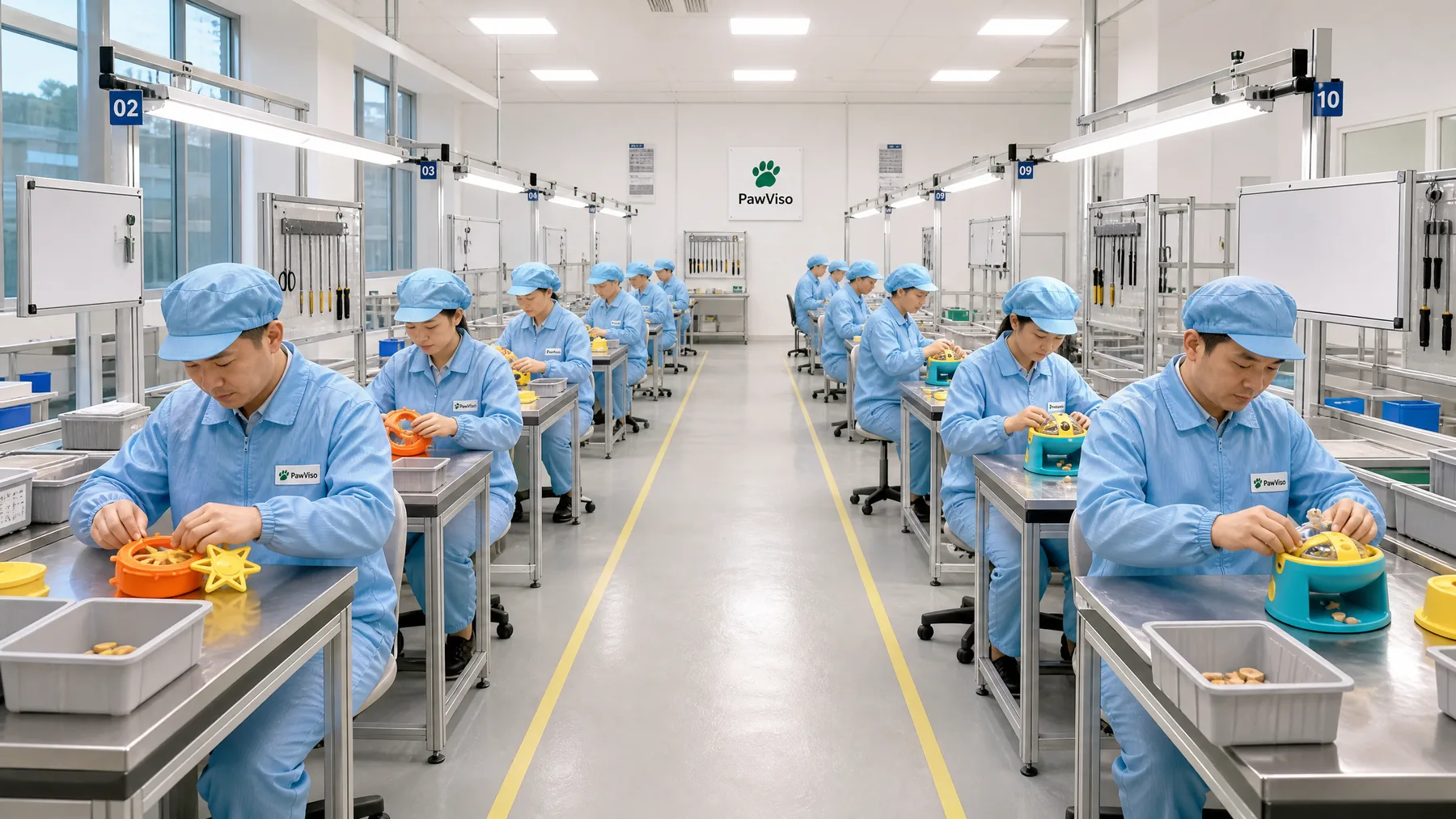
A pre-order supplier audit is not a tour, a certificate collection exercise, or a way to negotiate a lower unit price. It is a buyer-led decision process that asks one practical question: can this named counterparty make, control, document, and deliver the exact SKU you intend to buy? For pet accessories, toys, grooming items, travel products, beds, and private-label ranges, the answer rests on a connected chain of evidence. The legal entity must be clear, the production route must be visible, the approved sample must match the production intent, and records must allow the parties to identify what happened if the product, packaging, or claim later changes.
From the perspective of a Chinese pet-product factory and procurement partner, the strongest audit is proportionate rather than theatrical. A buyer does not need to inspect every room or demand unrelated documents. The buyer does need to test the proposed order path: the contract party, factory or factories, materials and components, quality checkpoints, artwork handoff, packing method, and escalation route. This guide is written for professional buyers building an evidence file before they place or release an order. It does not determine legal, regulatory, veterinary, medical, or product-safety requirements. Those requirements must be confirmed by the buyer/importer for the actual SKU, destination market, and sales channel.
Module 1 — Decide Whether the Supplier Merits an Audit
Decide whether to audit before investing in extensive due diligence. Start by setting a pass-or-pause threshold based on the intended order, not on catalogue appeal. A straightforward repeat purchase from a known, controlled source may require a lighter verification. A new private-label toy, an item with several materials or moving parts, a marketplace launch, a first order with a new legal entity, or a programme involving more than one production site normally warrants deeper review. The aim is not to label a supplier as universally good or bad. It is to decide whether the evidence burden matches the buying risk you are prepared to accept.
Write an audit brief before the first call. State the SKU family, target market, sales channel, expected product role, proposed branding, packaging level, buyer contacts, and the decision date. Add the questions that could stop the order: who will contract, where final assembly occurs, whether third parties are involved, which records exist, and what must be approved before payment or shipment. A process approach and customer focus are among the quality-management principles described by ISO; for a buyer, that translates into auditing the order process rather than judging a presentation in isolation.1
| Buying situation | Audit emphasis | Evidence that should exist before the next stage | Buyer decision |
|---|---|---|---|
| Existing SKU with a new supplier | Identity, comparable sample, production route | Legal entity details, model-specific quotation, route map, sample plan | Continue to sample or pause |
| New private-label SKU | Specification ownership, artwork, change control | Buyer brief, draft specification, artwork workflow, approval gates | Continue only after owners are named |
| Multi-component product | Component control and assembly verification | Bill of materials, component list, assembly sequence, inspection points | Audit the critical route before order release |
| Mixed assortment | SKU-level evidence and packing discipline | Matrix linking each SKU to records, labels, sample status, cartons | Split, phase, or hold the assortment |
Module 2 — Verify the Legal Entity and Contracting Route
Approve the counterparty only when the legal entity, payment route, and performance route are coherent. Ask for the full registered legal name in Chinese and English where available, registration identifier, registered address, authorized signatory, bank beneficiary name, and the entity proposed on the quotation, purchase order, invoice, and export documents. Compare the information rather than accepting it in separate messages. A trading company can be an appropriate contracting party, and a factory can use a sales affiliate; the issue is not the business model. The issue is whether the buyer can see which entity is responsible for the commercial promise and who can authorize corrective action.
Document mismatches as questions, not accusations. For example, a quotation from one company, payment request from another, and factory visit hosted by a third may be explainable through a group structure or service arrangement. Ask for the role of each entity, the contractual link, and the party that owns the tooling, sample, artwork files, and production release. Do not assume that a company’s website, export history, certificate, or social-media account proves that it will be your contracting or manufacturing party. The buyer should approve the route in writing before issuing a purchase order.
| Entity or party | Buyer should confirm | Evidence to request | Audit consequence if unclear |
|---|---|---|---|
| Contracting seller | Who accepts the purchase order and performance obligations | Quotation header, company registration details, authorized signature | Hold order issuance |
| Manufacturing site | Where the relevant work is actually performed | Site address, process description, audit access confirmation | Plan site or remote verification |
| Payment beneficiary | Who receives funds and why | Bank details matching the commercial route | Pause payment authorization |
| Export or logistics party | Who prepares the shipment documentation | Written role allocation and shipment-contact details | Confirm before booking or document release |
| Brand owner or buyer | Who approves claims, artwork, GTINs, and revisions | Brand authorization and approval matrix | Prevent unauthorized label changes |
Module 3 — Map the Manufacturing Route Before Visiting
Audit the route that produces the proposed SKU, not the most polished facility in a group. A factory visit, remote walkthrough, or third-party audit should follow a simple material-to-carton map. Identify where incoming materials arrive, where components are made or sourced, where assembly and finishing occur, where inspection takes place, where labels are applied, and where cartons are sealed. For a sewn bed, that could include fabric receipt, cutting, sewing, filling, trimming, inspection, and packing. For an injection-moulded accessory, it may include material receipt, moulding, secondary assembly, surface treatment if used, inspection, and packing. The exact route matters more than the generic category of “factory.”
Ask the host to distinguish operations performed on site from operations that are purchased or outsourced. A buyer should see the current route for the quoted construction, including ordinary components such as straps, hardware, printed inserts, or cartons where they affect the finished SKU. This does not mean that every upstream supplier must be audited. It means the factory should be able to state what it controls, what it receives, and where it relies on another party. If the product depends on a process that cannot be shown or explained, classify that as an open point rather than filling the gap with confidence.
Module 4 — Define the SKU Evidence Package
Require an evidence package tied to the model, revision, and intended market before you approve a supplier. Generic catalogues, undated reports, and certificates with no SKU connection may be useful background, but they are not a release file. Build a single index for each proposed item. Give it a buyer SKU, supplier model, revision date or code, and a status: received, reviewed, open, superseded, or approved for the defined purpose. The record should make it easy for a new team member to understand what version was quoted and what information still needs confirmation.
The relevant evidence differs by product and market. At a minimum, ask for a controlled description of the product, component or material information, visual references, packaging and label drafts, sample status, inspection plan, and the route for changes. Where market requirements call for reports, declarations, warnings, risk documentation, or other records, the buyer/importer should define the requested scope for that exact SKU. For consumer products within its scope, the EU General Product Safety Regulation requires manufacturers to prepare technical documentation and keep it up to date; it also makes clear that a person placing a product under its own name or trademark can be treated as the manufacturer.2 That context is a reason to assign documentation ownership early, not a substitute for market-specific assessment.
| Evidence item | What a useful version identifies | Buyer review question | Status to record |
|---|---|---|---|
| Product specification | Model, revision, components, dimensions or other agreed attributes | Is the quoted item defined clearly enough to compare? | Approved, revise, or open |
| Bill of materials or component list | Material/component names and controlled alternatives | Can a substitution be recognized and authorized? | Complete or incomplete |
| Artwork and label draft | SKU, revision, language version, placement, approver | Is it the exact artwork intended for this order? | Approved proof or pending |
| Sample record | Sample code, date, build, deviations, custody | Does the sample represent the intended production version? | Reference, development, or reject |
| Inspection plan | Checkpoints, criteria owner, records produced | Can the supplier show how conformance will be checked? | Accepted or revise |
| Market-document index | Market, SKU, document title, scope, expiry/revision if applicable | Has the buyer confirmed what is required? | Buyer action open or closed |
Module 5 — Test Whether Controls Operate in Practice
Accept process controls only when the supplier can demonstrate how they work on the floor and in records. An audit should test a small number of real control points, not reward impressive terminology. Choose points that could change the order outcome: identification of incoming materials, segregation of nonconforming parts, first-piece or setup confirmation where used, in-process checks, final inspection, artwork release, and carton marking. Ask the operator or quality lead to show the record used, explain who completes it, and identify what happens if a result is unacceptable. A blank form demonstrates intent; a completed, traceable record demonstrates use.
Follow one recent or current lot where practical. Compare the model name, material lot, inspection entry, approved sample reference, packaging artwork, and carton label. The information need not be digitally sophisticated to be useful. A controlled paper record, a spreadsheet, or a system entry can all work if it is legible, attributable, retrievable, and consistent with the production route. Conversely, an elaborate dashboard that cannot connect to the item in front of you is weak audit evidence. Record what you observed, what document supported it, and which point remains unverified.
Mid-article CTA — Request a buyer-led audit brief. Share your product category, intended market, channel, and proposed order route with PawViso at info@PawViso.com. We can help structure the questions and evidence list for a sourcing discussion; all project specifications, market requirements, and commercial commitments remain subject to buyer/importer and supplier confirmation.
Module 6 — Assign Ownership for Specifications and Brand Assets
Do not release a private-label order until each controlled input has one named owner and one approval path. Private label adds a layer of risk because the buyer’s name, trademark, GTIN, claims, and artwork may sit on a product made by another party. Decide who owns the product specification, who may revise it, who supplies final artwork, who approves print proofs, who controls product identifiers, and who decides whether a material or packaging alternative is acceptable. Put the allocation in the purchase documentation or a linked approval matrix rather than leaving it in scattered chat messages.
Identifiers are practical controls, not decorative codes. GS1 describes the Global Trade Item Number as a way for a company to uniquely identify trade items that are priced, ordered, or invoiced in the supply chain.3 If a buyer uses GTINs, establish which party provides or approves them, how the code is tied to a SKU and pack level, and who checks that the printed code matches the approved file. This is not an instruction to obtain or assign an identifier; it is a reminder to avoid ownership ambiguity when an identifier is part of the buyer’s programme.
| Controlled input | Recommended decision owner | Factory or supplier role | Release evidence |
|---|---|---|---|
| Product specification | Buyer product owner | Build to the approved revision and flag conflicts | Dated approval or change record |
| Brand artwork and claims | Buyer brand owner | Use only the released file and proof | Artwork approval and proof reference |
| Product identifier and pack hierarchy | Buyer data or brand owner | Apply the identifier exactly as released | SKU-to-pack mapping and artwork check |
| Packaging structure | Buyer and supplier jointly | Propose build details and execute approved version | Packaging specification or approved sample |
| Material or component alternative | Named buyer approver | Request change before use | Written authorization or hold |
Origin language deserves the same discipline. A corporate location or brand story does not establish a product-origin claim. For unqualified “Made in USA” claims, the U.S. Federal Trade Commission says marketers need a reasonable basis supported by competent and reliable evidence, and that the claim means the product is “all or virtually all” made in the United States.4 Other markets can apply different rules. The buyer should therefore approve any origin statement, its evidence, and the particular market use before it appears on packaging or sales material.
Module 7 — Approve Samples Through Controlled Gates
Use samples as gates, not as informal reassurance. A sample should answer a defined question at each stage: does the concept match the brief, does the proposed build match the approved specification, does the production-intent version match the release criteria, and does the packed unit match the approved presentation? Do not call all of these simply “the sample.” Give every sample a code, date, declared build, and decision. If a development sample contains a different material, assembly route, finish, or packaging from the order intent, record that difference plainly.
The buyer should retain or otherwise preserve the reference that governs the next stage. For a physical reference sample, attach a controlled label and record its location, photographs, model, revision, and known deviations. For a digital artwork proof, retain the final approved file and approval record. A retained sample is useful only if the parties know what it represents. It cannot demonstrate a requirement that was never agreed, and it cannot replace any market-specific test, assessment, or documentation the buyer/importer determines is needed.
| Sample gate | Purpose | Minimum decision record | What must not proceed without closure |
|---|---|---|---|
| Concept sample | Check basic product direction | Buyer comments and visible deviations | Final artwork or production release |
| Engineering or development sample | Check proposed materials and construction | Build list, change log, buyer disposition | Assumption that it equals production |
| Production-intent sample | Confirm the proposed order version | Model/revision, materials, workmanship, packaging status | Order release when critical gaps remain |
| Packaging proof or packed sample | Confirm presentation and data placement | Artwork revision, pack configuration, approver | Printing or mass packing |
| Shipment reference | Support comparison at inspection or receipt | Reference identifier and custody record | Dispute resolution based only on memory |
Module 8 — Audit Packaging, Markings, and Product Data
Treat the packed retail unit and shipping carton as part of the SKU under audit. Product controls can fail at the last metre if the wrong insert, language file, carton quantity, barcode, country statement, or revision is used. Review the packaging hierarchy: the unit pack, any inner pack, master carton, shipping marks, and the files that govern each. Establish which data belong at each level and which party checks them. If the buyer sells through multiple channels, decide whether each channel has a distinct pack or whether a common configuration is being used deliberately.
The buyer/importer must confirm actual SKU requirements for destination-market labelling, warnings, languages, claims, and traceability information. For EU products in scope, the General Product Safety Regulation requires manufacturers to identify products with a type, batch, serial, or other element enabling identification, subject to the regulation’s conditions, and requires traceability information to be available on request for defined periods.2 Use that as a prompt to agree the order’s identification method and record retention, not as a universal label template.
Module 9 — Review Quality Records and Traceability
Approve the supplier’s record system only if it can reconstruct a reasonable product history. At a minimum, the buyer should be able to connect a finished SKU and production period or lot to the approved specification, relevant material or component inputs, inspections performed, disposition of nonconformities, packaging revision, and shipment. The exact depth of traceability should reflect product complexity, buyer risk, and market requirements. Do not demand data that neither party will use; do demand enough linkage to investigate a complaint, check a substitution, or isolate a defined shipment.
Ask for completed examples with sensitive commercial details redacted if necessary. A usable nonconformity record identifies the issue, affected scope, immediate containment, decision owner, corrective action, and effectiveness check where appropriate. Do not confuse the absence of records with the absence of problems. A supplier that can show a controlled deviation and its resolution may provide more decision-useful evidence than one that simply says there have never been issues. Establish who receives records, how long they are retained, and what triggers an escalation to the buyer.
| Record group | Link that makes it useful | Audit test | Buyer follow-up |
|---|---|---|---|
| Incoming material or component record | Supplier lot or receipt linked to the SKU route | Trace a listed input into a current or past lot | Define any critical inputs needing tighter linkage |
| In-process and final inspection | Model, lot/date, criteria, result, inspector | Compare a completed record with the actual item | Clarify criteria and disposition authority |
| Nonconformity and corrective action | Issue, affected scope, containment, outcome | Check whether closure is evidenced rather than verbal | Set recheck or re-sample gate |
| Packaging and artwork release | Artwork revision and pack level | Verify current print matches release | Quarantine or replace obsolete materials |
| Shipment record | SKU, quantity, carton/lot identification, date | Connect cartons to the released order version | Retain in the supplier file |
Module 10 — Challenge Subcontracting and Change Control
Permit subcontracting or changes only when they are disclosed, assessed, and authorized through a defined route. Many practical supply chains use external processes: mould makers, printers, component factories, sewing workshops, electroplating providers, carton suppliers, or laboratories. Subcontracting is not automatically a defect. Undisclosed subcontracting is a risk because it breaks the buyer’s understanding of who controls the product and records. Ask the supplier to identify externally performed critical processes, explain how it qualifies or monitors the provider, and state whether the buyer will be notified before the route changes.
Change control should cover more than a finished-product redesign. A material source, colour batch, adhesive, filling, hardware item, mould, print supplier, factory, inspection criterion, carton construction, or label revision can alter what the buyer is receiving. Agree which changes require prior written approval, which require notice, and which are prohibited without a new sample or documentation review. The audit question is simple: when the order departs from the approved baseline, can the supplier stop, identify, assess, and escalate it before goods are packed?
Module 11 — Release, Hold, or Exit with Decision Gates
Make the supplier decision explicitly: release, conditional release, hold, or exit. A strong audit ends with a short decision record, not a pile of unranked observations. Release is appropriate only when the buyer has the level of evidence it defined for the order. A conditional release is appropriate only when the remaining action has an owner, deadline, consequence, and a clear rule for whether production, payment, or shipment may proceed. A hold means the missing evidence or unresolved discrepancy is material enough that the next commercial step should not occur. Exit means the route no longer justifies further effort.
Separate critical gaps from improvement points. Critical gaps may include an unknown contracting party, an unconfirmed manufacturing route, no controlled order version, an unapproved substitution, missing buyer-owned artwork approval, or no way to associate shipped goods with the agreed SKU. Improvement points might include a clearer record format, more consistent photo documentation, or a more convenient file index. The categories are buyer decisions, not universal rules. Their purpose is to prevent minor observations from masking a gap that could change the order outcome.
Frequently asked questions
Is a supplier certificate enough to approve a pet product supplier?
No. A certificate may provide context about a management system or another defined scope, but it does not by itself verify the legal counterparty, the factory route for the quoted SKU, the sample version, packaging, or the buyer’s market requirements. Ask what the certificate covers, whether it is current, and how it relates to the order. Then use it as one item in an evidence pack, not as the approval decision.
Can a trading company be approved if it does not own the factory?
Yes, if the buyer understands and accepts the route. The trading company may manage communication, consolidation, export, or commercial terms while a named factory manufactures the item. The audit should identify the role of each party, provide access to relevant production evidence, set the escalation route, and align the contract and payment path with that structure. Approval should not depend on a label such as “manufacturer” or “trader” alone.
What is the best way to audit a supplier remotely before the first order?
Use a live, route-based session rather than a generic video tour. Provide the SKU evidence index in advance and ask the supplier to show the declared material route, assembly or finishing area, inspection record, current packaging control, and a completed lot record. Request follow-up photographs or files tied to model and date where needed. Remote evidence has limits, so state which points were observed, which were document-reviewed, and which remain open for later on-site or third-party verification.
Conclusion
A buyer should order from a pet-product supplier only after the order path is visible and evidenced: the entity that contracts, the party or parties that make the SKU, the sample that controls the build, the data and packaging that will be used, the records that can reconstruct a lot, and the authority that governs a change. This approach is practical for a Chinese factory relationship because it focuses the discussion on the product route and buyer decisions instead of broad, unsupported assurances.
Use the eleven modules as a release discipline. Begin with a proportional audit brief, test evidence against the actual SKU, document open points, and make the release decision explicit. A supplier that is transparent about its route, records, limitations, and corrections gives the buyer a better basis for a controlled first order than one that only offers general claims.
Final CTA — Begin with an evidence-led sourcing conversation. Email: info@PawViso.com | WhatsApp: +86 186 8106 4480. Share the product category, destination market, sales channel, and intended order route so the buyer-led audit questions can be scoped before any commitment. All requirements and terms require project-specific confirmation.
Disclaimer: This article provides general B2B sourcing information. Project requirements, including product, documentation, market, commercial, and importer obligations, need buyer/importer confirmation.
Related PawViso resources
- Continue with How to Build a Private Label Pet Product Line. Use this guide to connect customization, packaging and MOQ decisions.
- Browse the PawViso product catalogue to identify product formats for a sourcing brief.
- Follow the PawViso sourcing process and review the B2B buyer FAQ before sharing project requirements.
External reference
For independent product identification and barcode context, review GS1 guidance on Global Trade Item Numbers (GTINs). Confirm the requirements that apply to the selected product, target market and order.