
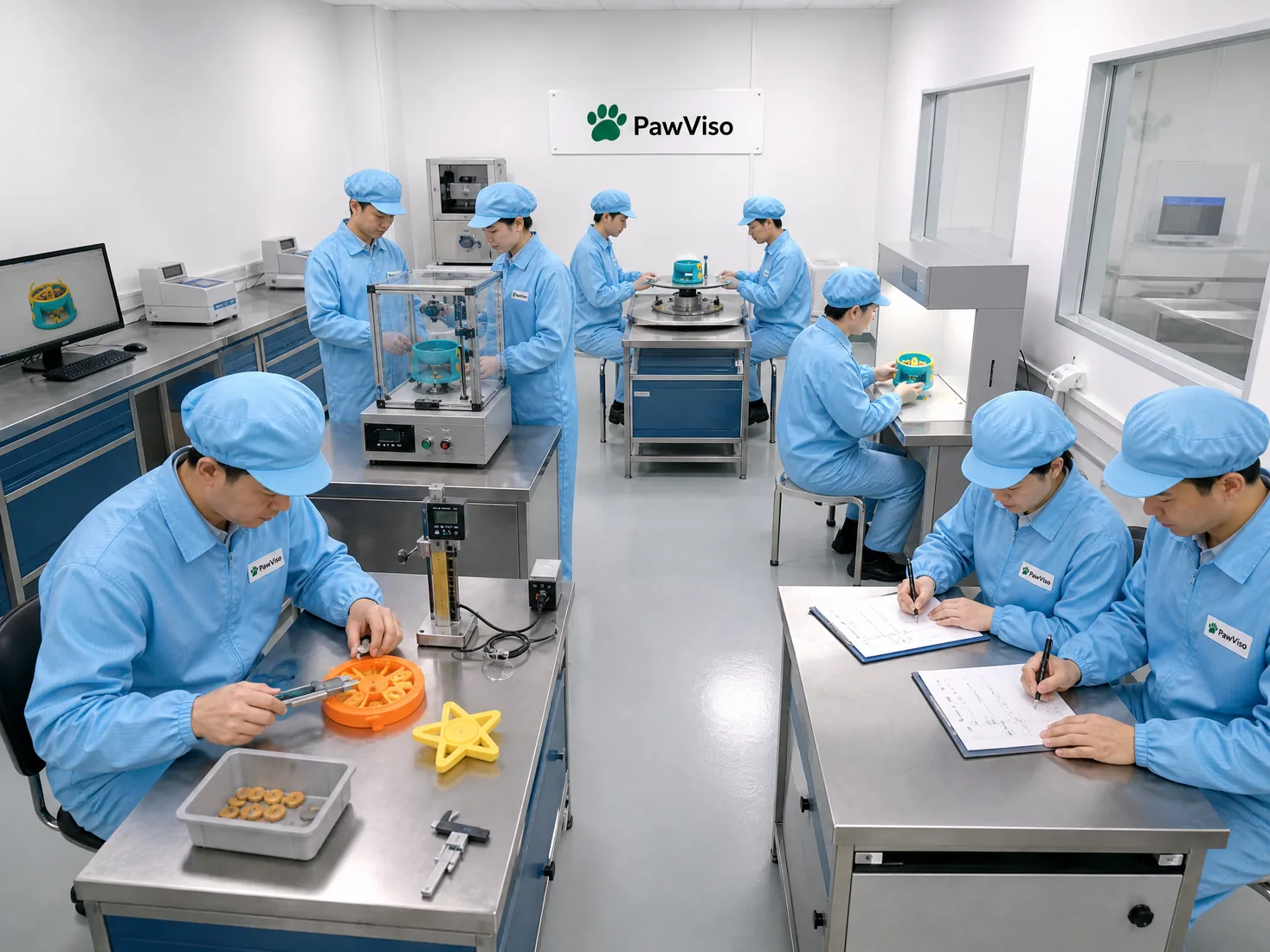
A pet accessory can look unchanged while its production configuration moves. A collar may use a different webbing or buckle source; a plush toy may receive different fill, thread, squeaker, or label; a feeder may have revised resin or carton. These changes affect what the buyer approved, what the factory assembles, and what shipment records can answer later questions.
What should a buyer require? Require a controlled bill of materials (BOM), advance notice of defined changes, a sample or evidence decision, an effective lot or order boundary, and a shipment-release record. This is more useful than “keep quality the same.” It turns expectations into identifiable parts, owners, records, and gates that purchasing, production, and packing teams can use.
This is a sourcing and quality-management framework. It does not assume that PawViso or another supplier holds certifications, operates a particular factory, uses fixed specifications, provides laboratory testing, or has approved a configuration. It is not a promise of legal, product, veterinary, medical, safety, testing, or market compliance. The responsible buyer or importer must confirm actual-SKU requirements before production and shipment.
Module 1 — Decide what configuration you are actually buying
Define the sellable unit as a configuration, not a product name. “Nylon leash,” “rubber pet toy,” and “ceramic bowl” are purchasing categories, not production definitions. List the approved material, construction, hardware, thread, coating, filler, sound component, printing, label, retail pack, inner pack, master carton, and accessories. For each, state the revision, plain-language description, and controlled reference, such as a signed sample, drawing, artwork, swatch, or photograph. The baseline should name important dimensions, appearance points, fit relationships, pack counts, or functions.
In China-based sourcing, replace “Is this the same?” with “Does it match the approved configuration and critical characteristics?” A working zipper, mating buckle, or usable carton can still differ from the selection. Before issuing a purchase order, hold a brief baseline review with buyer, sourcing, factory purchasing, production, quality, and relevant packaging owners. Record the released version so a sales sample, old photo, and unversioned chat attachment do not compete as the standard.
| Configuration tier | Typical pet-product example | Buyer control needed | Useful approval reference |
|---|---|---|---|
| Core product | Harness body, leash webbing, bowl body, toy shell | Identity, construction, fit, stated appearance | Controlled sample and BOM line |
| Functional component | Buckle, D-ring, squeaker, seam, closure, insert | Source, interaction with assembly, defined performance check | Part drawing, sample, comparison record |
| Presentation component | Print, label, hangtag, retail box, carton | Artwork revision, language, barcode, pack-out | Approved artwork and packed sample |
| Consumable or process input | Thread, adhesive, ink, colour masterbatch | Declared identity and agreed change trigger | Approved source or buyer-review requirement |
Module 2 — Decide the BOM depth that matches your assortment
A BOM is the configuration’s working map. Set its depth by product complexity and substitution consequence, not spreadsheet length. A simple item may need a short BOM with packaging lines; a custom harness, interactive toy, travel accessory, or gift-ready assortment normally needs component-level lines. Give each line a part number, revision, parent SKU, approval status, and source status. Identify buyer-supplied or nominated parts and any source switch needing permission. “Metal ring” or “polyester fabric” is too broad.
Distinguish a material declaration from a controlled characteristic. A buyer may request a declared material name, but should separately specify the comparison point: weave appearance, width, thickness, colour reference, logo position, mould mark, or interface dimension. Do not add unverified compositions or thresholds merely to sound technical. Put required documents, samples, or evaluation in an evidence field and identify its review owner. This connects commercial scope, production instructions, and evidence requests without confusion.
| BOM field | Decision the buyer makes | Why it matters at change review |
|---|---|---|
| Part code and revision | What exact version is current? | Separates approved, superseded, and proposed versions. |
| Part description | What is this component in plain production language? | Helps purchasing and inspection identify the right part. |
| Approved source status | Is this source fixed, preapproved, or subject to buyer review? | Makes a source change visible before ordering. |
| Controlled characteristics | Which features are compared? | Prevents a generic “equivalent” judgment. |
| Evidence link | Which sample, drawing, artwork, or record supports it? | Directs reviewers to the applicable reference. |
| Effective boundary | From which order, lot, or date does it apply? | Allows old and new configurations to be separated. |
Module 3 — Decide which changes require written reapproval
Set reapproval triggers before a quotation becomes an order. The supplier must notify the named buyer contact before buying, making, assembling, or packing a changed part. Notice after cartons are complete is an exception report, not change control. Typical triggers are a new material source, changed declared material or construction, colour or finish revision, tooling or dimension adjustment, hardware substitution, revised print or label artwork, pack-out revision, assembly-method change, or a different production location. Treat any “small improvement” as proposed until scoped.
Not every change needs the same response. Classify triggers as no buyer decision, review before production, or reapproval before release, based on the actual SKU and risk. A carton correction may need only an artwork proof; a closure change may need a comparison sample and new control point. Do not ask factory purchasing to interpret “do not change material.” Give it a matrix and escalation route. Log the request number, reason, affected BOM lines, effective date, decision, and closure.
| Proposed change | Buyer decision gate | Evidence or action to request |
|---|---|---|
| New supplier for an existing component | Confirm source status and assess the BOM line | Updated source record and comparison sample when required |
| Material, resin, coating, or adhesive change | Hold use until project requirements are reviewed | Change notice, requested declarations, and sample plan |
| Colour, finish, or logo revision | Compare against approved visual reference | Drawdown, artwork proof, or production-representative sample |
| Tooling, dimension, or assembly revision | Recheck fit and agreed critical characteristics | Revised drawing and first-off comparison |
| Label, barcode, retail pack, or carton revision | Confirm artwork, identity, and pack-out | Revised proof and packed sample when required |
Module 4 — Decide what the quotation is locking and what remains open
A quotation is an early change-control document because it identifies assumptions that may become the supply basis. Request a quote scope linking each SKU to its version, intended pack, artwork stage, included components, and exclusions. This matters when a concept image is incomplete or several variants are being developed. Ask whether the proposal uses an existing component, a buyer-specific component, provisional packaging, or a reference sample. The answer lets the buyer fund development, approve a standard option, or defer a component decision.
Do not convert uncertainty into invented facts. If a source is unapproved, write “source subject to buyer review,” not a guessed factory name. If pack-out is open, record alternatives and the decision owner. Do not let a claim that needs independent support move automatically from marketing draft to product record. The point is to stop commercial assumptions becoming production instructions. Reference the current quote scope, BOM and artwork revisions, and change-control process in the order.
| Quote scope category | Include in the buyer’s review | Common ambiguity to remove |
|---|---|---|
| Product identity | SKU, model or style, version, assortment relationship | Whether a photo represents the exact production build |
| Component scope | Included hardware, insert, print, accessory, and source status | Whether an alternative part is permissible |
| Packaging scope | Retail pack, inner pack, carton, labels, and artwork stage | Whether packaging is merely illustrative |
| Evidence scope | Samples, documents, inspections, or comparisons requested | Who pays for or approves each activity |
| Change scope | Notice period, trigger matrix, approval owner, release rule | Whether verbal approval is sufficient |
Module 5 — Decide how samples will earn approval
A sample is a decision tool, not a ceremonial delivery. Before sending one, state its purpose: concept review, material review, artwork proof, pre-production comparison, packed sample, or retained reference. A concept sample can help choose shape or assortment direction, but it may not represent final materials, tool condition, colour, or packaging. A pre-production sample should be tied to a specific BOM and artwork revision. A packed sample should show the unit as it will be identified and presented. When buyers and suppliers use the same word “sample” for all these stages, an earlier prototype is easily mistaken for a release standard.
Build a concise approval sheet around observable decisions. It should identify the sample ID, date, SKU, BOM revision, artwork revision, purpose, observations, decision, conditions, and approver. Ask the reviewer to choose approved, approved with a documented deviation, rejected, or pending information; avoid informal phrases such as “looks fine.” A documented deviation must specify whether it applies to one lot, one purchase order, or the next revision. Retain the signed or digitally approved reference, and distribute the current version to factory purchasing, production, quality, and the buyer’s inspection contact. If physical retention is needed, agree where the reference is held and how it is marked.
| Sample stage | Buyer question answered | Release status it should not imply |
|---|---|---|
| Concept sample | Is the direction worth developing? | Final component or packaging approval |
| Material or colour sample | Does the proposed input resemble the selected reference? | Approval of all assembled-product characteristics |
| Artwork proof | Is the supplied artwork version correct for review? | Packed-product or market approval |
| Pre-production sample | Does the stated configuration match the production baseline? | Automatic release of all finished goods |
| Packed sample | Does the presented unit match the agreed pack-out? | Assurance for an unreviewed distribution route |
Mid-article CTA — Plan the control points before the order is placed. Share your product brief, target market, assortment logic, component priorities, and approval workflow with PawViso for a project-specific discussion of supplier questions, BOM structure, sample stages, and inspection handoffs. Contact info@PawViso.com.
Module 6 — Decide what traceability question your records must answer
Traceability is not a single barcode or a filing cabinet. It is the ability to connect a finished unit or shipment to the relevant configuration, inputs, process period, and records. First define the question that may arise: “Which cartons used the proposed buckle source?” “Which order used the prior artwork?” or “Which production lots were packed before the carton change?” Then set the smallest record set that can answer it. For many pet-product programs, that means SKU, purchase order, BOM revision, finished-goods lot or packing identifier, production or packing date, relevant component lot where needed, inspection record, and shipment reference.
GS1 describes traceability as tracing an object’s history, application, or location, and identifies origin of materials and parts, processing history, and distribution as relevant contexts.1 Its approach uses standards-based identification and data sharing, but buyers do not need to impose a particular GS1 implementation on every pet-product SKU. What matters in ordinary sourcing is an unbroken relationship between the record fields that the buyer actually needs. Mark the approved change as effective from a named order or lot. Segregate remaining old components, label their status, and prevent an old and new version from being mixed without a buyer decision. Test traceability once before the first changed shipment by asking the factory to retrieve the answer from the records.
Module 7 — Decide where inspections will detect the changed configuration
Inspections should be placed where they can detect the failure mode, not only at the end of production. Incoming checks can compare received components to BOM identity, source status, and visible reference points. In-process checks can examine assembly, orientation, print position, seam presentation, or fit. Final inspection can check finished SKU identity, pack completeness, selected appearance criteria, and the reconciliation of labels or carton marks. Specify what is checked, against which current reference, when the check occurs, who records it, and what happens when the agreed condition is not met. An inspector should see the live BOM and approved sample record, not rely on memory or an old sales image.
When a buyer selects lot-based attribute sampling, ISO 2859-1:2026 provides acceptance sampling schemes indexed by acceptance quality limit for lot-by-lot inspection; it does not select the buyer’s defect definitions, release authority, or product-specific acceptance criteria.2 Therefore, state those items separately in the inspection plan. Include order and SKU, BOM revision, lot identity, inspection stage, sample basis, observations, defect categories if used, photographs, open issues, and disposition. Record a material discrepancy even when the finished appearance seems acceptable. The decision may be to accept a documented deviation, replace the item, obtain more information, or hold the affected scope; the key is that the decision belongs to the named authority.
| Control point | Primary purpose | Record that supports shipment decisions |
|---|---|---|
| Incoming component review | Confirm component identity and status before use | Receiving check and component-lot record |
| First-off or pre-production review | Compare early assembled output to current baseline | Signed comparison or sample-decision sheet |
| In-process verification | Detect configuration drift during assembly or packing | Dated line-check record and escalation note |
| Final inspection | Confirm selected finished-good and pack-out criteria | Inspection report tied to lot and BOM revision |
| Shipment reconciliation | Confirm released order, cartons, and documents align | Release checklist and shipment reference |
Module 8 — Decide how packaging, labels, and claims are controlled
Packaging belongs in the BOM because it identifies, protects, and presents the sellable unit. Separate retail packaging from inner packs, master cartons, inserts, labels, tape, and pallet marks when each can affect the buyer’s decision. Control artwork by file name, revision, and approval date rather than by verbal description. Check the version used at print approval and again in packed-product review. Barcode placement, quantity statements, language, product identity, and retailer-specific marks should be reviewed against the buyer’s provided requirements for the actual SKU. The factory should not infer destination-market text from an earlier order or a product that looks similar.
A package change can also alter a consumer-facing claim. The U.S. Federal Trade Commission says environmental claims for a product or package need competent and reliable scientific evidence, and its Green Guides explain truth-in-advertising principles for such claims.3 Do not approve “eco,” recycled-content, recyclable, or similar wording merely because an alternative carton or material was proposed. Confirm claims and supporting evidence through the responsible buyer or importer for the intended market. Likewise, do not automatically apply children’s-product rules to pet products: the U.S. CPSC defines a children’s product as one designed or intended primarily for children 12 years of age or younger.4 Classification, labelling, and market requirements require confirmation by the responsible buyer or importer for the actual SKU.
| Packaging level | Change-control focus | Buyer approval evidence |
|---|---|---|
| Retail unit | Product identity, artwork, required information, presentation | Approved proof or packed sample |
| Inner pack | Quantity, SKU separation, handling and identification | Pack-out diagram or count check |
| Master carton | Carton marks, assortment, shipping identifiers, closure | Carton artwork and final inspection record |
| Distribution load | Orientation, stability instructions, shipping configuration | Buyer-agreed packing plan where required |
Module 9 — Decide who can approve, stop, and escalate a change
A change process fails when it has many observers but no owner. Name one buyer-side approver with authority to accept, reject, or conditionally release the proposed configuration. Name one supplier-side change-control contact who coordinates purchasing, production, quality, and packing. Add a backup contact and a response path for time-sensitive issues. The supplier should be able to place affected parts, work in process, or finished goods on hold while the buyer decides. The buyer should be able to see the size of the affected scope: which components, work orders, lots, cartons, and shipment date are involved.
Use a short escalation ladder. The first level resolves a routine evidence gap; the next level decides whether production may continue; the final level decides the disposition of affected goods and shipment release. Each escalation should state the proposed change, reason, baseline reference, impact, requested decision, and deadline. Do not let a messaging-app confirmation become a silent permanent revision. After a decision, update the BOM, approval sheet, instructions, and release record together. Review repeated late notifications, unexplained source changes, mismatched revisions, or incomplete records after each cycle. Those patterns often point to a weak handoff between sourcing and factory purchasing rather than to one isolated inspection error.
Module 10 — Decide the evidence needed before shipment release
Shipment release should answer a specific buyer question: “Is this identified scope the approved configuration, or has the buyer accepted the documented exception?” Create a release checklist that connects the purchase order, SKU and quantity, BOM revision, approved change requests, sample-decision status, inspection status, packaging and artwork version, lot or carton identification, and unresolved issues. A checklist does not create product compliance or product safety; it makes the commercial and quality decision visible. The release owner should be able to distinguish “inspected,” “approved,” “approved with a named deviation,” “on hold,” and “not reviewed.”
Destination-market obligations can differ and may require separate confirmation. For example, the European Commission states that the General Product Safety Regulation is intended to ensure only safe products are available on the EU market and provides business-obligation information.5 This does not tell a buyer that a particular pet product is acceptable for a particular market. It is a reason to keep market review separate from factory release and to verify actual-SKU requirements with the responsible buyer or importer. If a material change remains unresolved, hold the affected scope, identify its lots, collect the requested comparison evidence, and obtain a documented disposition before release. Do not relabel an unapproved change as a minor variation simply to meet a vessel cutoff.
| Release condition | What the release owner verifies | Action when evidence is missing |
|---|---|---|
| Configuration match | BOM, sample status, and approved changes agree | Hold or escalate the affected scope |
| Inspection status | Required records are complete and attributable | Request clarification or additional review |
| Packaging identity | Current artwork and pack-out are confirmed | Segregate cartons pending decision |
| Traceability link | Lot or shipment record can be retrieved | Correct records before release decision |
| Exception status | Buyer deviation is written and bounded | Do not treat it as a new baseline |
Module 11 — Decide how reorders stay controlled without restarting everything
A reorder should reuse approved decisions, not reuse assumptions. At reorder review, compare the new purchase order against the last released BOM, artwork, packaging plan, sample decision, source status, and open change log. Ask the factory and sourcing contact to declare whether any supplier, material, tooling, artwork, label, pack-out, process, or production-location change is proposed. A “no changes” confirmation is valuable only when the baseline is identified by revision. If the buyer is intentionally changing a colour, size assortment, artwork, or pack, create a new revision and state exactly what is unchanged. That limits the scope of reapproval and avoids forcing the team to reopen every decision.
Reorders also deserve a performance review. Examine late change notices, repeat defects associated with a component, inspection observations, sample-to-production mismatches, and traceability retrieval gaps. Turn the result into one or two targeted controls, such as an earlier material lock, a clearer carton proof, a source-status field, or a pre-shipment record check. Do not claim that a mature control process guarantees consistent outcomes; it improves the visibility and decision path when variation appears. A disciplined reorder process lets a buyer preserve familiar product identity while still making deliberate choices about new materials, components, packaging, and market requirements.
Frequently asked questions
Can a supplier use an “equivalent” component without asking?
Not unless the buyer’s controlled documents expressly allow that path. “Equivalent” is a commercial judgment only after the buyer compares the proposed part with the approved source status and controlled characteristics. A component can assemble correctly yet differ in appearance, packaging interface, declared material, or evidence requirement. Require advance notice, identify the impacted BOM line, and decide whether the comparison needs a sample, updated document, or inspection control.
Does every colour change require a full pre-production sample?
No. The right evidence depends on what has changed and what the buyer needs to decide. A colour change may be reviewed through a swatch, drawdown, artwork proof, or production-representative sample, depending on the component and sales presentation. The buyer should state the comparison reference, lighting or image conditions if relevant, decision owner, and the effective order or lot. Do not use an informal phone image as the only record unless the buyer has deliberately accepted that method.
Is a factory inspection report enough for traceability?
Usually not by itself. An inspection report can show what was checked on a stated date and lot, but it may not link the goods to the BOM revision, approved change request, component source, packing identifier, and shipment. Build those fields into the release record. The needed level of detail can be modest for a simple item and more granular for a multi-component or custom assortment; it should always answer the buyer’s intended retrieval question.
What should happen if an unapproved change is found near shipment?
Place the clearly identified affected materials, work in process, or finished goods on hold. Establish which orders or lots may be involved, preserve the current records, compare the changed item to the baseline, and send the named buyer approver a concise decision request. The buyer may request more evidence, accept a bounded deviation, require correction, or reject the scope. Shipment timing is a business pressure, not evidence that the configuration was approved.
Do packaging updates need the same control as product materials?
They need control appropriate to their role. A revised carton can affect product identity, count, artwork, barcode, consumer claims, retailer instructions, and distribution handling even when the pet product itself is unchanged. Include the packaging version in the BOM and release checklist. Where a buyer wants to evaluate distribution protection, select a method and acceptance criteria that match the route; ISTA distinguishes basic screening tests from general simulations of transport hazards, so the procedure should not be chosen by name alone.6
Conclusion
Material and component change control is the buyer’s way to keep a pet-product program anchored to an approved configuration. The strongest starting point is not a long list of promises. It is a usable BOM, a visible trigger matrix, an approval method tied to the purpose of each sample, records that answer a traceability question, inspection points aligned to real failure modes, named decision owners, and a documented shipment-release gate. These tools help a China-based sourcing program handle normal supplier and packaging variation without making silent substitutions routine.
Final CTA — Discuss a controlled sourcing plan with PawViso. For a project-specific conversation about BOM structure, change triggers, sample approvals, traceability records, inspection handoffs, or reorder controls, please share your product type, target market, component concerns, and sourcing scope. Email: info@PawViso.com WhatsApp: +86 186 8106 4480
This guide is general B2B sourcing information, not legal, regulatory, veterinary, medical, safety, or testing advice. The responsible buyer or importer should confirm requirements, claims, evidence, and release criteria for the actual SKU, destination market, and sales channel.
Related PawViso resources
- Continue with How to Audit a Pet Product Supplier Before Ordering. Use this audit framework to compare supplier evidence and follow-up questions.
- Browse the PawViso product catalogue to identify product formats for a sourcing brief.
- Follow the PawViso sourcing process and review the B2B buyer FAQ before sharing project requirements.
External reference
For independent quality-management system context, review ISO 9001 quality-management systems overview. Confirm the requirements that apply to the selected product, target market and order.