
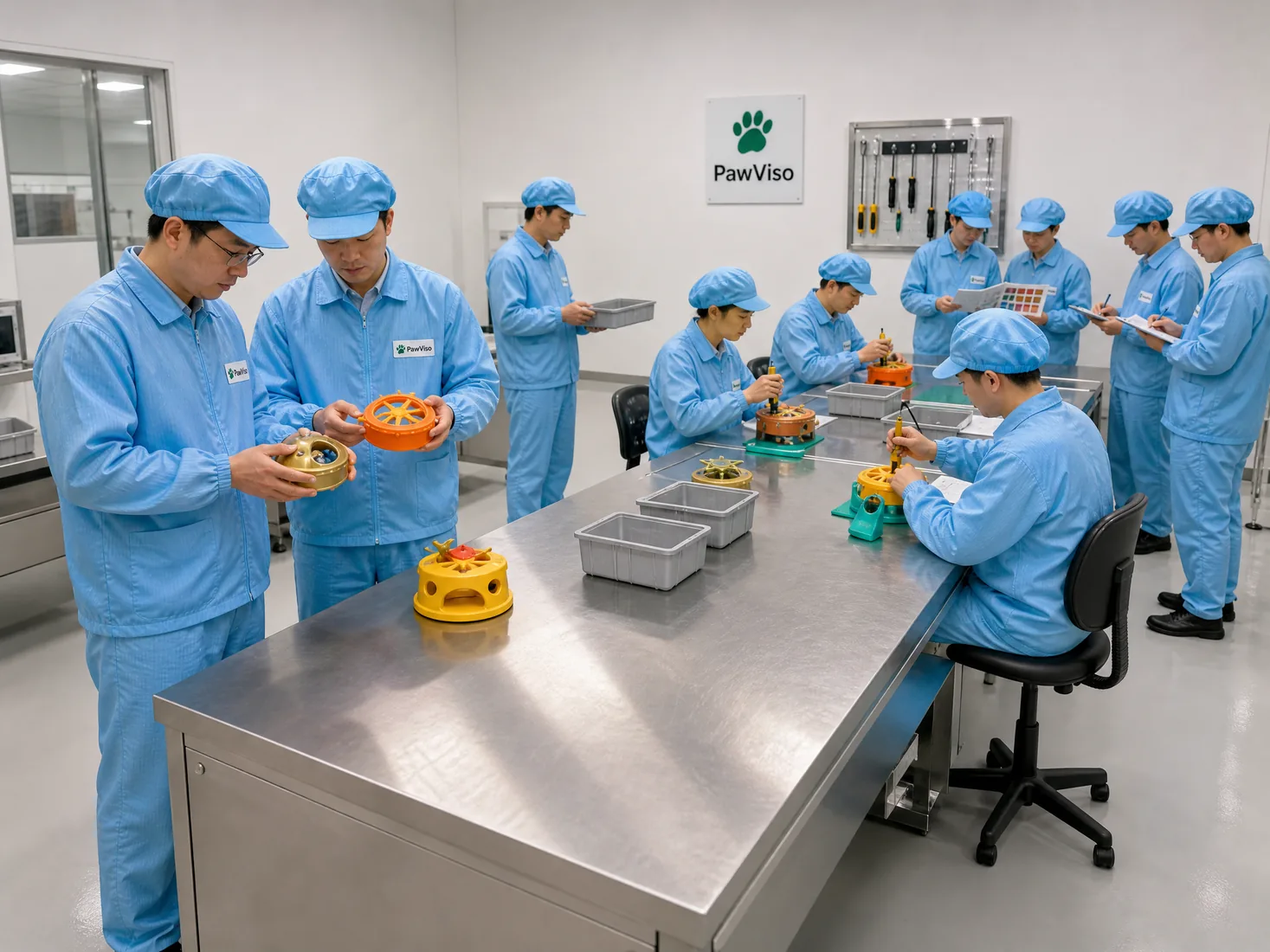
Pet toy mold development is a sequence of commercial choices and technical steps that lead from concept to repeatable production. For a buyer or procurement manager, the goal is to move through decisions—tooling investment, ownership, design freeze, DFM discussions, trials, revisions and production release—while keeping commercial risk, lead times and quality evidence visible. This guide focuses on the planning and buyer-side actions required to coordinate suppliers, confirm inputs, evaluate evidence and decide next steps, rather than providing engineering services or certifying compliance.
Your role is to translate product intent and market requirements into concrete specifications, acceptance gates and contractual terms. Early decisions—mold ownership, tolerances, expected lifecycle, sample allowances and packaging instructions—drive cost and supplier behavior. This article breaks the process into six buyer-oriented modules that frame the key decisions, supplier inputs and tradeoffs at each stage. Use the suggested evidence and actions to create a controlled record that will support production release and post-launch traceability.
Module 1 — Commercial decision: mold ownership, cost allocation and lifecycle assumptions
A primary commercial decision is who will own the tool. Buyers must weigh capital expenditure vs. unit pricing and flexibility. If the buyer purchases the mold, they control reuse and retrofits but take on storage, maintenance and eventual resale or disposal logistics. If the supplier funds the mold, unit prices typically include amortization and the buyer should get clear contractual terms about exclusivity, life expectancy and options for tool changeovers. Request written proposals that itemize mold cost, amortization per MOQ tier and any clauses for mold rework or replacement.
Required evidence and supplier inputs at this stage include a formal quotation with mold cost separated from unit price, an expected shot-life estimate, lead time to first samples and payment milestones for tooling. Buyers should specify lifecycle assumptions in the purchase order: expected number of cycles before major service, acceptable reset or rework intervals, and how subsequent batches will be priced once the mold cost is amortized. Tradeoffs: buying the tool reduces per-unit cost sensitivity to order volume but increases capital tied up; supplier-owned tooling can lower upfront cash but may limit supply flexibility and complicate supplier switching.
Suggested buyer actions:
- Request two pricing scenarios: buyer-owned tooling vs. supplier-owned tooling, with clear amortization and MOQ impacts.
- Include contractual language requiring controlled documentation of mold revisions, maintenance records and a condition for mold transfer or replication if switching suppliers.
- Define acceptance criteria for the delivered mold (first-article samples, visual and dimensional evidence) and link them to payment milestones.
Module 2 — Design freeze: formalizing the CAD, drawings and acceptance baselines
A design freeze marks the point at which changes to geometry, tolerances, and materials become controlled change requests. Buyers must control scope: any changes after the freeze should be evaluated for cost and lead-time impact. Ensure the freeze captures fully annotated drawings, CAD files in agreed formats, material specifications, color codes, surface finish instructions and packaging sketches. The supplier should confirm capability to translate the frozen design into tooling with documented assumptions (e.g., shrinkage allowances, gate positions, surface textures).
Evidence to request from the supplier includes a signed design-freeze checklist, baseline 2D drawings with revision numbers, a neutral step or IGES export of the 3D model and a traceable list of assumptions used in tool layout. Tradeoffs include allowing minor aesthetic tweaks late in development (which speeds initial production) versus enforcing a strict freeze to reduce downstream rework and additional mold machining. Buyers should consider staged freezes: a mechanical freeze for fit and function, followed by a cosmetic freeze for texture and color.
Compact table: Design Freeze Deliverables
| Buyer-delivered items | Supplier-confirmed items |
|---|---|
| Final CAD/3D files, 2D drawings with tolerances | Tooling layout, expected shrinkage compensation |
| Material and color specifications | Proposed gate locations, venting strategy |
| Packaging orientation and stacking requirements | Surface finish tooling details and texturing notes |
Buyer actions:
- Issue a formal design-freeze notice that lists deliverables and design items reserved for later change control.
- Require the supplier to produce a design-assumption log that documents any deviations or engineering judgments taken during tool design.
Module 3 — DFM discussions: manufacturability, cycle-time and concession planning
Design for Manufacturability (DFM) is an iterative exchange where the supplier flags features that may cause molding issues, longer cycle times, cosmetic risk or higher scrap rates. The buyer should expect structured DFM feedback that separates suggested optimizations (optional) from required changes (must-fix for producibility). Typical supplier feedback can include wall-thickness recommendations, undercut management, ejection strategy and recommended gate types. Buyers must decide which suggestions they accept, taking into account brand aesthetics, safety/market requirements and projected per-unit cost impacts.
Evidence to collect includes a DFM report with annotated drawings, expected cycle-time ranges, predicted rejection modes and recommended tolerances. For each suggested change, the report should include a tradeoff statement: impact on appearance, function, cost, and time-to-market. Buyers need to document accepted and rejected DFM items in a controlled change log that ties to the design freeze and the commercial terms. If some DFM suggestions are rejected, expect contingency planning—e.g., higher inspection levels or additional secondary operations.
Compact table: DFM Feedback Types and Buyer Responses
| DFM item | Supplier evidence | Typical buyer decision |
|---|---|---|
| Wall thickness non-uniformity | Annotated cross-sections, estimated sink marks | Accept change / approve concession with higher inspection |
| Complex undercut | Tooling sketch with side-action detail | Request alternative design or accept higher tooling cost |
| Gate location impacting aesthetics | Photos of simulated part and gate vestige | Negotiate gate type or accept secondary finishing |
Buyer actions:
- Require a DFM report with clear "must-fix" and "suggested" categorizations, and respond within a fixed timeframe.
- Maintain a controlled decision log mapping DFM items to contractual obligations, sample expectations and pricing adjustments.
Module 4 — Trial samples and first-article inspection: what buyers must inspect and accept
Trial samples are the first tangible evidence that the mold produces conforming product. Buyers should prepare a first-article inspection (FAI) checklist aligned with the design freeze: dimensional checks, color and texture confirmation, material lot traceability, packaging fit and any functional verifications that are within the buyer’s scope. Suppliers should supply a small batch of trial shots from production parameters, labeled with cycle counts and molding conditions. Do not assume a single sample equals production readiness—plan for a trial run with multiple shots across the expected cycle window.
Supplier inputs to request: a trial-sample report detailing molding parameters (melt temperature, injection pressure, cycle time), as-run dimensional data, and photos of key features. Evidence should include raw data for measured dimensions and a record of any deviations or visible defects. Tradeoffs: insisting on exhaustive inspection before production release increases lead time and cost but reduces risk of wide-scale defects; accepting more limited trials accelerates launch but requires stricter incoming inspection.
Buyer actions:
- Define the FAI acceptance criteria and the sample quantity required for meaningful statistical checks.
- Specify that trial samples must include cycle-count annotations so that buyers can judge early-cycle vs. mid-cycle appearance and dimensional stability.
Mid-article CTA — If you want PawViso to help assemble the buyer-side FAI checklist and procurement clauses for your project, contact us with your SKU list, expected order volumes and target launch date. We can provide a templated decision log and sample acceptance form to adapt to your procurement workflow.
Module 5 — Revision cycles: controlled changes, costs and version traceability
Revisions after trial samples are common. Buyers must treat each revision as a controlled change with cost and timeline consequences. Require suppliers to provide a revision plan that lists the proposed tooling changes, estimated machine hours for re-machining, expected impact on shot-life and any changes to inspection criteria. The buyer should insist on revised first-article samples after any tooling change that affects critical dimensions or appearance.
Evidence and records to collect include redlined drawings with revision numbers, a revision impact assessment and updated mold-maintenance logs. Track version traceability so that production batches can be linked to the specific mold configuration used. Tradeoffs: small cosmetic revisions may be deferred to a later batch to avoid tooling downtime, while dimensional fixes that affect fit or safety require immediate action. Purchase orders and quality agreements should define who pays for rework and how consequential delays are handled.
Buyer actions:
- Require a formal change request (CR) and approval workflow that includes cost estimates and re-sample requirements.
- Maintain a revision-indexed batch record for all production runs so that any field issue can be traced back to the mold revision and sample evidence.
Module 6 — Production release, packaging and controlled records: gates to full manufacturing
Production release is a contractual and operational gate that follows successful trials and any necessary revisions. Buyers must define the release criteria: validated FAI results, agreed production parameters, packaging confirmation, inspection plans and traceability records. Packaging is often overlooked but critical: specify pack counts, orientation for stacking (to avoid deformation in soft toys), labeling requirements including GTIN/product data, and any retail-ready constraints. Ensure the supplier provides pre-production photographs of packed pallets and a packaging confirmation sign-off.
The supplier should deliver a production release pack that includes the final FAI report, run-time molding parameters, sample retention policy, and inspection templates for routine incoming checks. Buyers must keep controlled records of these documents and attach them to the SKU-level file so that later sourcing or regulatory checks can reference them. Note the distinction between a quality-management system and SKU conformity: a QMS provides the framework for consistent processes, but conformity for a specific SKU requires evidence tied to that SKU’s tooling and batch records 1 2 3.
Buyer actions:
- Issue a written production release only after all required documents and samples are accepted; specify retention periods and access for audits.
- Confirm packaging and labeling details, and require photographic evidence of packed pallets and sample units before the first production shipment.
Final checklist for next steps:
- Confirm mold ownership and payment terms.
- Issue the design-freeze notice with all CAD and drawing deliverables.
- Approve DFM items via a controlled decision log.
- Define FAI criteria and sample quantity, and require cycle-counted trial shots.
- Require controlled change requests for any revision and updated FAIs.
- Approve production release only with complete release pack and packaging confirmation.
If you follow these modules, your procurement team will have a structured set of decision points, required supplier evidence and a controlled record trail for pet toy mold development. Use the document actions to convert technical conversations into clear commercial commitments and traceable quality evidence.
Module 7 — Design freeze and buyer sign-off for tooling release
Before any steel is ordered, the buyer must explicitly authorise a design freeze and tooling release. A design freeze is not a formality: it locks geometry, materials, tolerances, cosmetic finishes, and interfaces that affect mold features (e.g., gating, vents, lifters, and parting lines). The buyer should confirm which design items are fixed and which are “managed later” (for example, artwork and secondary finishes). A clear sign-off prevents late changes that lead to expensive die modifications or multiple trial cycles. Ask your supplier for a sign-off checklist that covers critical-to-function features (snap fits, thickness bosses, hollow sections for squeakers, etc.), dimensional targets, and cosmetic zones; retain that signed checklist with your project records for traceability and dispute resolution.
When you approve the freeze, specify the approval level: for example, “proceed to tooling manufacture” versus “proceed to prototype steel.” The difference controls cost, lead time and risk. If you want a limited run of pre-production parts before full hardening, record that instruction explicitly. Also confirm ownership and inspection rights tied to the release: who will receive first-article inspection (FAI) records, who may visit the mold shop to witness key operations, and who will own the tooling at handover. These ownership and witness decisions determine responsibilities for storage, maintenance, and export clearance at shipment 6. Keep the freeze decision and any conditional notes in the controlled record folder for the project.
Module 8 — Trial samples, validation runs and buyer acceptance criteria
Trial samples validate both the tool and the chosen process. Plan for a defined number of sample runs and specify acceptance criteria the supplier must meet for color, surface texture, dimensional tolerances, assembly fit, and functional interfaces. Be precise: instead of “looks good,” use measurable targets (e.g., critical dimensions ±0.5 mm, surface grade SPI A2 for visible zones). If the part includes insert components (squeakers, ropes, vacuum-formed liners), include acceptance protocols for those integrated assemblies. Where packaging or point-of-sale inserts are part of the delivered SKU, include package integrity checks during trials, because packaging can affect fit and transit performance 5.
Document the process conditions used during sample runs: machine model, clamp tonnage, melt temperature, cycle time, and any insert or overmold steps. These machine and process records help reproduce part quality when the production run scales or moves to a different plant. When trial parts fail, require a corrective action plan from the supplier that identifies root cause, corrective steps, and verification runs. For each revision cycle, update the controlled records and repeat buyer acceptance tests until the party responsible for release signs off. Consider a formal buyer witness at the final validation run to avoid ambiguity in acceptance and to align expectations across tooling, process and packaging teams.
Module 9 — Revisions, corrective tooling and change control for buyers
Revisions after tooling release are common but costly. Establish a change-control process before tooling begins: require written change requests that describe the scope, proposed drawings, reason, impact on lead time and a supplier cost estimate for tooling changes. Assign approval levels (e.g., buyer engineering approves minor cosmetic changes; commercial director approves dimensional changes that alter mold geometry). Make sure change orders are logged, versioned and attached to the original design freeze package so that the project retains an auditable trail for engineering decisions and commercial adjustments.
If a mold needs corrective machining (undercut removal, gate relocation, vent adjustment), require the supplier to provide a Repair Plan that explains exactly what will be done, where, and how the die hardness or alignment will be preserved. Consider contractual thresholds for who pays for which corrective actions: for example, defects caused by design issues may be the buyer’s responsibility, while machining errors or poor shop practice may be for the supplier to correct. Also confirm post-repair validation requirements: how many verification shots, what inspection reports, and whether the buyer must accept the revised tooling in person or by recorded data. Maintain a concise revision log in the project’s controlled records that lists revision number, date, authoriser, and a short summary of technical impact.
Compact revision-control checklist
| Item | Buyer action required | Typical supplier deliverable |
|---|---|---|
| Change request | Approve or reject in writing | Updated drawing and cost estimate |
| Corrective tooling | Approve Repair Plan | Photos and FAI of repaired mold |
| Validation runs | Sign acceptance report | Process settings and sample parts |
| Record update | Archive new revision sheet | Updated BOM and production control |
Module 10 — Production release, batch controls and lot traceability
A formal production release marks the transition from development to ongoing manufacturing. Require a production-release packet that contains: final tooling identification, process recipe (molding conditions), first-off inspection report, sample history, material certificates (as provided to you by the supplier), and packaging specifications. The buyer’s production release should state lot sizes, initial batch targets, and a plan for ramping to nominal volumes. This packet becomes the baseline for future audits, re-orders and any supplier transfers; treat it as a controlled document in your quality-management filing.
Agree on lot traceability before the first production shipment. Define lot codes or mould-cavity identifiers that allow a return to specific tool runs, raw-material batches, and operator shifts if a quality issue arises. Decide on retention policies for production tooling trials and retained samples: how many parts per lot are kept and for how long. If your market requires external testing of packaging or materials during production, incorporate those sampling plans into the batch-control protocol and note how any failing lots are to be handled (quarantine, rework, rejection). Clear traceability saves time and expense if post-market feedback triggers a corrective action and supports faster root-cause identification 4 5.
Module 11 — Packaging validation, labelling, and controlled records handover
Packaging often determines whether a tooling project is commercially viable. Validate packaging early in the trial phase: check fit, protective cushioning, transit orientation, and retail display requirements. If your SKU requires hang-tabs, blister cards, or shrink-wrap, include those secondary-process steps in the tooling validation schedule so packaging trials occur before bulk production. Ask for packaging-durability test records where applicable, and ensure labels and barcodes are finalised before production release; mislabelled shipments can block import clearance or retail acceptance 5.
Controlled records handover completes the buyer’s tooling file. Before final payment or shipment, request a handover package that includes the final CAD/CAM files authorised for manufacturing, tooling ID and serial number, all FAI and validation reports, material declarations supplied by the vendor, and a final production-run summary. Specify what the supplier must retain and for how long (e.g., tool maintenance logs, repair history). Clarify the handover method and trade terms for the tooling itself if ownership transfers across borders: record the agreed Incoterm or shipment-handover point and attach the trade documentation to the controlled record 6. Keep a copy of the handover packet in your quality-management system so future orders or transfers use the correct, authorised configuration.
Frequently asked questions
Q: When should I require a sign-off checklist? A: Before any mold machining begins—use it at the design freeze to record fixed features, acceptance criteria and who may request changes.
Q: How many validation runs are typical before production release? A: That depends on part complexity and market risk. Agree on a minimum number and specific acceptance criteria ahead of time, and include a witness run if you need stronger assurance.
Q: Who pays for corrective tooling after trial failures? A: This must be contractually defined: typically, design-driven issues are buyer costs, while manufacturing defects belong to the supplier. Require documented change requests and cost estimates before work begins.
Q: What records should I always get at handover? A: Final drawings, tooling ID, process recipes, FAI/validation reports, material declarations provided by the supplier, and the agreed packaging specification.
Q: How do I manage packaging changes after production starts? A: Treat packaging as a controlled item: any change needs a formal change request, validation run and updated packaging-label approvals before acceptance of affected batches.
Q: Can traceability be handled later if I’m confident in the supplier? A: No—establish lot codes and retention plans before production. Traceability is costly and slow to add retrospectively, and it’s critical if field issues occur.
Conclusion
Tooling and mold development for pet toys is a commercial project as much as an engineering one. Define approvals, change control, validation protocols and handover records before any steel is cut. Require measurable acceptance criteria for trial samples, retain a controlled revision log, and insist on a complete production-release packet and packaging validation. These steps reduce risk, shorten dispute cycles, and make future re-orders or facility transfers manageable.
Project requirements, market standards and regulatory obligations must be confirmed by the buyer/importer for each project.
Final CTA — Start a controlled pet-toy sourcing conversation with PawViso. Share the product concept, target market, customization route, package direction and estimated order structure for a focused B2B discussion. Email: info@PawViso.com WhatsApp: +86 186 8106 4480 — https://wa.me/8618681064480
Related PawViso resources
- Continue with How to Create a Custom Pet Toy Sampling Plan. Use this pet-toy guide to structure approvals, samples and evidence.
- Browse the PawViso product catalogue to identify product formats for a sourcing brief.
- Follow the PawViso sourcing process and review the B2B buyer FAQ before sharing project requirements.
External reference
For independent quality-management system context, review ISO 9001 quality-management systems overview. Confirm the requirements that apply to the selected product, target market and order.