
For an importer, retailer, distributor, or private-label buyer, evaluating pet supplies is a documentation and verification exercise, not simply a search for attractive colors or a low unit price. The question is whether the quoted version has a clear specification, repeatable construction, suitable packaging, and a defined process for quality questions.
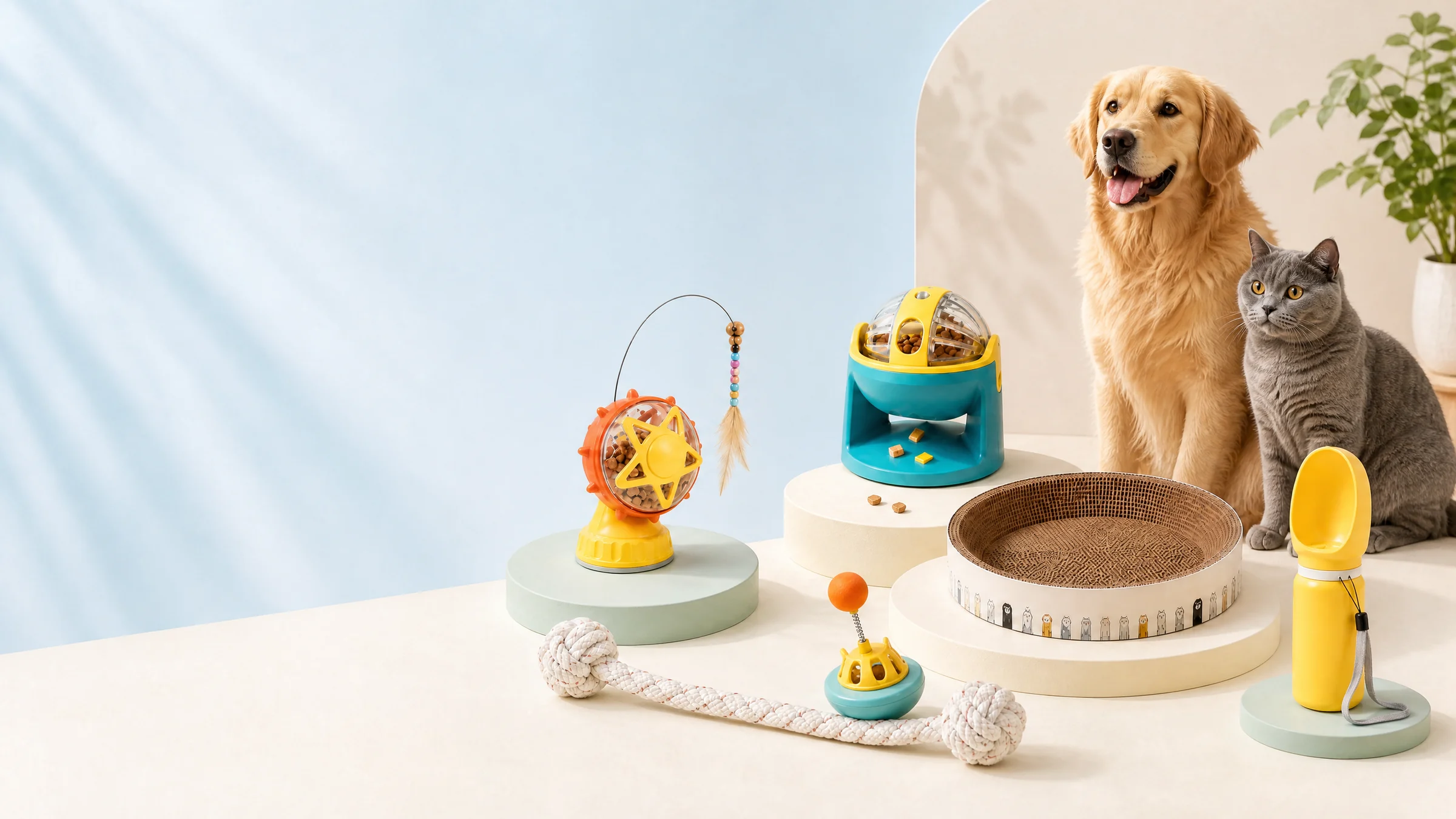
This guide presents a practical framework for reviewing interactive puzzle toys, cat scratchers, teaser toys, grooming tools, cotton-rope tug toys, travel water bottles, and slow-feeding bowls as non-food pet accessories. It does not provide food, formula, feeding-quantity, nutrition, allergy, medical, or veterinary advice. Product dimensions, materials, packaging, testing, labeling, and order terms must be confirmed with the supplier and buyer for the exact SKU and destination market.
Define the intended retail use and risk profile
Start with a written brief covering category, intended animal size, foreseeable use, supervision statement, channel, destination, packaging language, and restrictions. A slow-feeding bowl should be assessed as a physical accessory by checking shape, stability, cleanability instructions, and material documentation, without claims about diet, portions, or health outcomes.
For toys, consider foreseeable pulling, chewing, scratching, repeated assembly, and detachable components. For grooming tools, examine edges, pins, teeth, blades, hinges, and handles. For travel accessories, review closures and leakage-control design. These are procurement questions, not a substitute for market-specific legal or technical review.
Destination requirements can affect warnings, traceability, packaging, and testing. The U.S. Consumer Product Safety Commission explains that products intended for children can be subject to small-parts requirements; a pet product is not automatically a children’s product, but presentation and foreseeable use should be reviewed when a product may attract children 1. The EU General Product Safety Regulation also addresses consumer-product safety information and traceability 2. Confirm applicability with the buyer and supplier.
Evaluate materials and construction before comparing quotations
Request a specification sheet identifying components, dimensions, finishes, adhesives, coatings, fasteners, packaging, and accessories. Distinguish existing construction from proposed private-label changes. Do not accept material, odor, colorfastness, coating, or contact-related claims without exact-SKU documentation. Confirm all specifications with the supplier and buyer.
Inspect samples for unfinished edges, loose threads, unstable bases, sharp points, weak stitching, poorly seated parts, inconsistent surfaces, and difficult-to-clean areas. For rope toys, review knot security and end finishing; for scratchers, check base stability and surface bonding; for interactive toys, assess removable elements during the agreed use simulation. For grooming tools, check alignment and operation. For a slow-feeding bowl, focus on stability, surface condition, cleaning instructions, and material documentation, without claims about feeding performance or animal health.
A sample is only a snapshot. Agree on a written inspection method, critical dimensions, defect categories, and the exact approved sample that will anchor production review; a prototype does not prove that later batches will be identical.
Use a buyer-ready verification matrix
| Evaluation area | What the buyer should inspect or request | Evidence and decision point |
|---|---|---|
| Product identity | SKU, intended use, dimensions, components, version, and artwork | Approved specification and sample; confirm with supplier and buyer |
| Mechanical construction | Seams, knots, joints, bases, closures, moving parts, and edges | Agreed use simulation and defect limits; confirm the test method |
| Materials and finishes | Material list, coatings, dyes, adhesives, and surface consistency | Supplier declaration or applicable report for the exact SKU |
| Packaging and labeling | Carton protection, barcode, warnings, instructions, language, and traceability | Destination-market review and approved artwork |
| Batch consistency | Critical dimensions, color, assembly, accessories, and packing count | Pre-production sample, inspection plan, and batch records |
| Logistics readiness | Carton dimensions, gross weight, stacking, moisture protection, and marks | Confirm with supplier and buyer before quotation and booking |
| After-sales control | Complaint intake, photos, lot information, replacement or corrective-action process | Written escalation process and responsible contact |
Standards can provide useful benchmarks, but a buyer must confirm category and market applicability. ASTM F963 is a U.S. consumer safety specification for toys intended for children, not a universal pet-product certification 3. A supplier should not imply that a report or certification covers another SKU, material, or market without evidence.
Check documentation, labeling, and traceability
For wholesale and private-label purchasing, documentation is part of the product. Request the commercial specification, component list, packaging files, carton marks, inspection criteria, and available laboratory or material documentation. Check that the supplier name, SKU, revision, test date, sample description, and product configuration match the quotation. If a report is supplied, ask whether it covers the finished product or only a material, and whether the destination market recognizes the testing approach.
Traceability matters when colors, sizes, or packaging versions share a product family. The order confirmation should identify approved artwork, accessories, packing count, and revision date. Establish how a production lot and inspection record connect to a shipping carton. The EU GPSR addresses responsible economic operators and traceability for EU channels 2. Confirm required records with the buyer and supplier.
Packaging should communicate use limitations without unsupported promises. Avoid “indestructible,” “100% safe,” “for every pet,” or similar absolute language unless substantiated for the exact SKU and market. Where appropriate, include supervision, wear inspection, cleaning instructions, and removal from use when damaged.
Sample, pilot, and approve in stages
A controlled sourcing process uses staged approval rather than relying on a final inspection alone. Review the functional sample, specification, private-label artwork, packaging mock-up, warnings, instructions, and pre-production version in sequence. Then define an inspection plan for agreed critical points.
For a pilot order, compare received goods with the approved sample using photographs, measurements, assembly checks, packaging counts, and the agreed use simulation. Record deviations by SKU and batch. If a change is necessary, update the specification and approval record before production continues. Price, MOQ, capacity, and delivery timing are not assumed here; request and confirm them in writing with the supplier and buyer.
Frequently asked questions
What does “safe” mean when sourcing pet supplies wholesale?
For a B2B buyer, “safe” should be treated as a product- and market-specific evaluation, not a blanket marketing claim. It concerns foreseeable use, construction, materials, warnings, labeling, documentation, and applicable destination-market requirements. Confirm the exact scope with the supplier and qualified market reviewers.
How can a retailer assess durability without inventing a performance claim?
Use an agreed use simulation based on the product’s intended function, inspect the sample before and after the simulation, and define observable defect limits. Record the method and sample version. Do not publish a universal lifespan or “indestructible” claim unless it has been substantiated for the exact SKU and market.
Should a pet toy be tested to a children’s toy standard?
Not automatically. Applicability depends on design, intended use, presentation, and destination-market rules. ASTM F963 addresses children’s toys, so buyers should obtain a category-specific assessment rather than assume that the standard applies to a pet toy 3. Confirm the assessment scope with the supplier and buyer.
What should a private-label buyer approve before placing an order?
Approve the product specification, final component set, decoration, packaging artwork, warnings and instructions, carton information, inspection criteria, and applicable documentation. Confirm dimensions, materials, test scope, commercial terms, and timing in writing with the supplier and buyer.
CTA: Build a documented sourcing shortlist with PawViso
If you are comparing suppliers for a wholesale or private-label pet assortment, contact PawViso with your target market, category, channel, packaging needs, and approval documents. Request product versions, samples, and documentation. Confirm exact specifications, compliance scope, and commercial terms in writing with the supplier and buyer before finalizing.
Related PawViso resources
- Continue with How to Create a Custom Pet Toy Sampling Plan. Use this pet-toy guide to structure approvals, samples and evidence.
- Browse the PawViso product catalogue to identify product formats for a sourcing brief.
- Follow the PawViso sourcing process and review the B2B buyer FAQ before sharing project requirements.
External reference
For independent product identification and barcode context, review GS1 guidance on Global Trade Item Numbers (GTINs). Confirm the requirements that apply to the selected product, target market and order.