
Online catalogues help buyers discover pet toys and accessories, but a polished listing is not evidence that a supplier suits a wholesale, retail, distribution, or private-label program. A professional evaluation connects the product brief to documented requirements, a representative sample, production controls, packaging, and destination-market obligations.
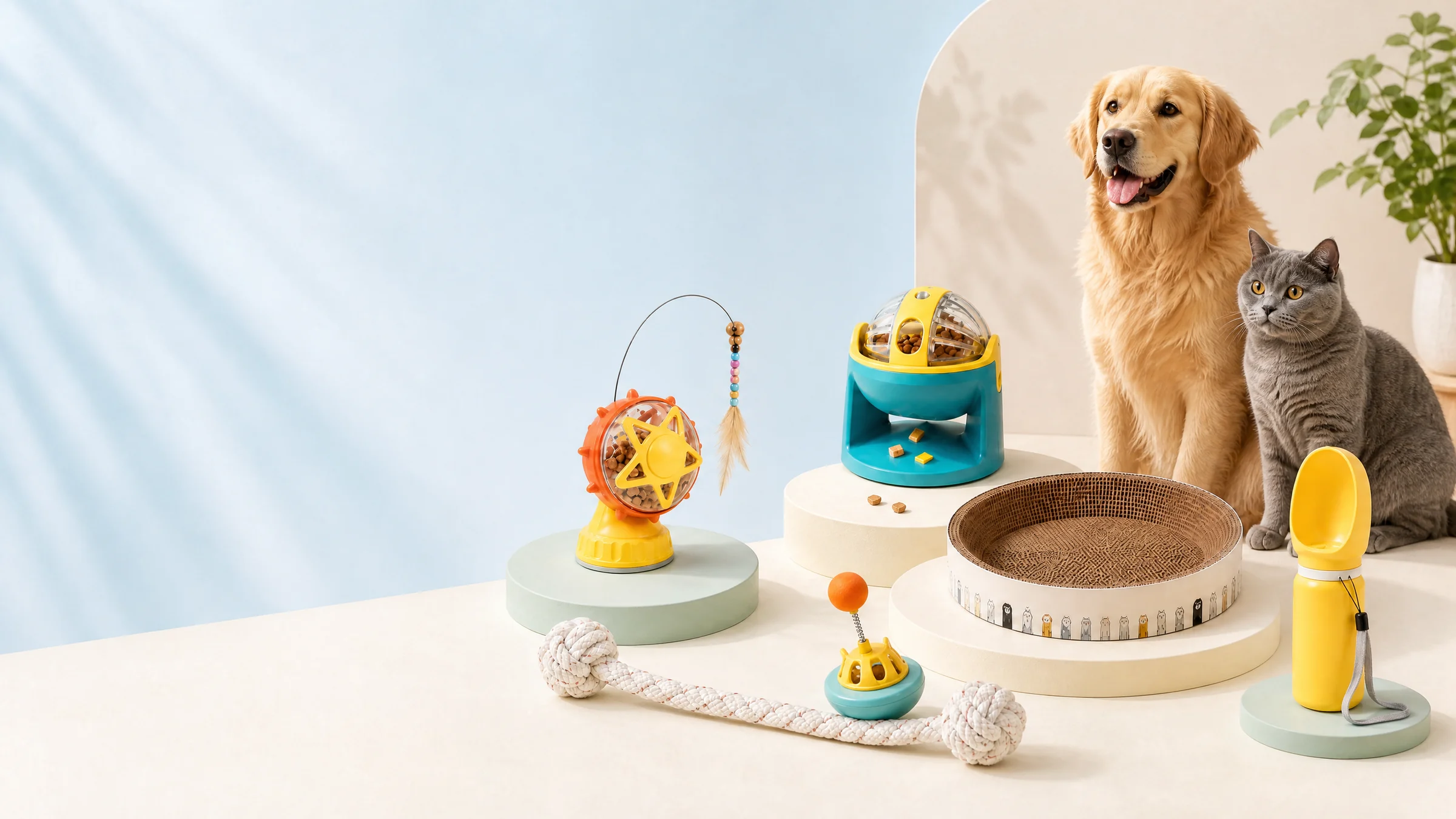
This framework applies to non-food pet accessories such as interactive puzzle toys, slow-feeding bowls used as non-food accessories, cat scratchers, teaser toys, grooming tools, cotton rope tug toys, and travel water bottles. It does not assess food, formulas, feeding quantities, nutrition, allergies, medical outcomes, or veterinary use. Actual product scope, materials, dimensions, packaging, compliance documents, and commercial terms must be confirmed with the supplier and buyer.
What should buyers define before comparing suppliers?
Start with a written product and market brief. Record destination markets, sales channel, intended animal size or use context, packaging language, required warnings, retail positioning, and buyer quality standard. Identify whether the item is a toy, household accessory, grooming tool, or another category, because applicable obligations may differ.
Avoid treating labels such as “safe,” “eco,” “non-toxic,” or “export quality” as approvals. In the United States, the Consumer Product Safety Commission explains retailer responsibilities and the role of applicable certificates for covered consumer products.1 In the European Union, the General Product Safety Regulation covers consumer products, including products offered online, and emphasizes risk assessment and responsible economic operators.2 Determine the applicable rules for the exact product and market with qualified advisers where necessary.
How can construction and product fit be assessed objectively?
Review construction rather than appearance alone. For a rope tug toy, examine the stated composition, joining points, finishing, loose fibers, and foreseeable separation risks. For a cat scratcher, inspect board structure, attachment, stability, edges, and the relationship between the scratching surface and its base. For grooming tools and travel water bottles, examine moving parts, seals, closures, handles, and cleanability as relevant to the intended use. For a slow-feeding bowl treated as a non-food accessory, assess geometry, surface finish, stability, and cleanability without making claims about diet, nutrition, or health.
Ask the supplier to identify the proposed material, component, revision, and manufacturing method. Every dimension, weight, material percentage, colour expectation, load or function limit, packaging configuration, and test method should be confirmed with the supplier and buyer before approval. A home check is not a substitute for a required laboratory, regulatory, or market assessment. Keep a retained reference sample with its model code and revision.
Which evidence should an online supplier provide?
Request an evidence pack tied to the exact quoted model: specification sheet, bill of materials, packaging and label artwork, applicable reports or declarations, inspection checklist, corrective-action record, and batch or lot identification approach. Ask for revision dates and model references, not undated screenshots or generic certificates. Confirm the document list with the supplier and buyer.
For U.S. retail programs, CPSC guidance states that manufacturers and importers furnish applicable certificates to distributors or retailers, including electronically where appropriate.1 For EU sales, the European Commission identifies Safety Gate as a rapid alert system for dangerous non-food products.3 The practical rule is that documents should be retrievable, current, and tied to the item being sold; these sources do not establish that any PawViso item meets a buyer’s requirements.
How should buyers compare suppliers without unsupported claims?
Use the same questions, sample brief, evidence request, and scoring method for every shortlisted supplier. Score evidence, not presentation quality or claimed market position. Mark missing information as “open” and assign an owner and deadline for follow-up. Do not infer certification, capacity, customer history, pricing, minimum order quantity, lead time, customization capability, or production volume unless the supplier provides project-specific written information and the buyer confirms it.
| Evaluation area | Evidence to request | Decision question | Confirmation point |
|---|---|---|---|
| Product fit | Sample, specification, use-case brief | Does the item suit the channel and positioning? | Confirm with supplier and buyer |
| Materials and construction | BOM, component details, revision record | Can the proposed build be checked against the sample? | Confirm exact materials and revisions |
| Safety and compliance | Applicable reports, certificates, declarations, warnings | Are the required documents identified for the market? | Confirm scope, validity, and responsibility |
| Durability and function | Test method, inspection criteria, failure records | Can acceptance criteria be agreed before production? | Confirm product-specific parameters |
| Traceability | Model code, lot approach, production records | Can affected goods be isolated if an issue occurs? | Confirm record availability |
| Packaging and labels | Artwork, carton details, language and warnings | Is the launch presentation suitable for the market? | Confirm buyer approval before production |
| Quality process | Sample approval, in-process checks, final inspection | Is quality controlled throughout the order? | Confirm inspection timing and criteria |
| Commercial readiness | Written quotation and project terms | Are commercial assumptions documented? | Confirm each project in writing |
What sample and inspection process reduces purchasing risk?
Request a sample representing the proposed production version, including materials, colours, attachments, packaging, and labels. If the buyer supplies private-label artwork, approve a physical or digital proof before production. Keep the approved sample for later comparison.
Before the first order, agree on inspection timing and acceptance criteria. Depending on the buyer’s risk assessment, the plan may include pre-production confirmation, in-process checks, and final inspection. Review appearance, dimensions, workmanship, function, packaging, markings, and carton information as applicable. The precise scope, sampling method, defect classification, and release decision must be confirmed with the supplier and buyer.
When a discrepancy appears, request a written root-cause explanation and corrective action. Re-sampling after correction is more informative than a verbal promise. Keep the purchase order, inspection records, approved artwork, and retained sample together for replenishment decisions.
Which commercial details require written confirmation?
Online communication should test evidence quality as well as responsiveness. Send a consistent questionnaire and check whether answers are complete, internally consistent, and tied to the quoted model. Clarify material substitutions, artwork control, sample charges, packaging options, inspection arrangements, payment terms, minimum order quantity, lead time, after-sales communication, and any private-label workflow. None of these details should be presented as a PawViso guarantee; they must be confirmed for the specific project by the supplier and buyer.
Frequently Asked Questions
Is a supplier certificate enough to approve a pet accessory?
No. A certificate or report is only one part of an evidence pack. Confirm the correct model, material, revision, test scope, destination-market requirement, sample, packaging, traceability, and production controls. If the document is incomplete or outside its stated scope, keep the approval open.
How can a retailer compare two online suppliers fairly?
Give both suppliers the same brief, sample criteria, documentation request, and scorecard. Separate verified evidence from claims awaiting confirmation, then compare product fit, launch risk, inspection requirements, and documented commercial terms rather than unit price alone.
Should private-label buyers inspect every shipment?
The appropriate frequency depends on the product, supplier history, market obligations, and buyer risk assessment. Establish an approval sample, acceptance criteria, and a nonconformity response process. Confirm the inspection plan with the supplier and buyer before the order is released.
What should an importer do when product information is incomplete?
Pause approval, list the missing evidence, and request a written response tied to the exact model. If the gap concerns a legal or regulatory obligation, obtain market-specific professional advice before placing or releasing the order.
How should a buyer document the final supplier decision?
Create a supplier file showing why the item fits, supporting evidence, open points, follow-up owners, and re-approval triggers. This helps prevent marketing statements from becoming undocumented purchasing assumptions.
To discuss a product brief, sample-review questions, packaging direction, or private-label requirements, contact PawViso. Share the target market, sales channel, product category, and documentation checklist; confirm all specifications, compliance responsibilities, and commercial terms with the supplier and buyer before purchase.
Related PawViso resources
- Continue with How to Create a Custom Pet Toy Sampling Plan. Use this pet-toy guide to structure approvals, samples and evidence.
- Browse the PawViso product catalogue to identify product formats for a sourcing brief.
- Follow the PawViso sourcing process and review the B2B buyer FAQ before sharing project requirements.
External reference
For independent product identification and barcode context, review GS1 guidance on Global Trade Item Numbers (GTINs). Confirm the requirements that apply to the selected product, target market and order.
References
- 1U.S. Consumer Product Safety Commission — Retailers: Product Safety and Your Responsibilities
- 2European Commission Access2Markets — EU General Product Safety Regulation
- 3European Commission — Product Safety
This article provides general B2B sourcing information, not legal, regulatory, food, nutrition, medical, or veterinary advice. Importers, retailers, distributors, and private-label buyers should confirm applicable obligations and product parameters for each destination market with the supplier and buyer.