
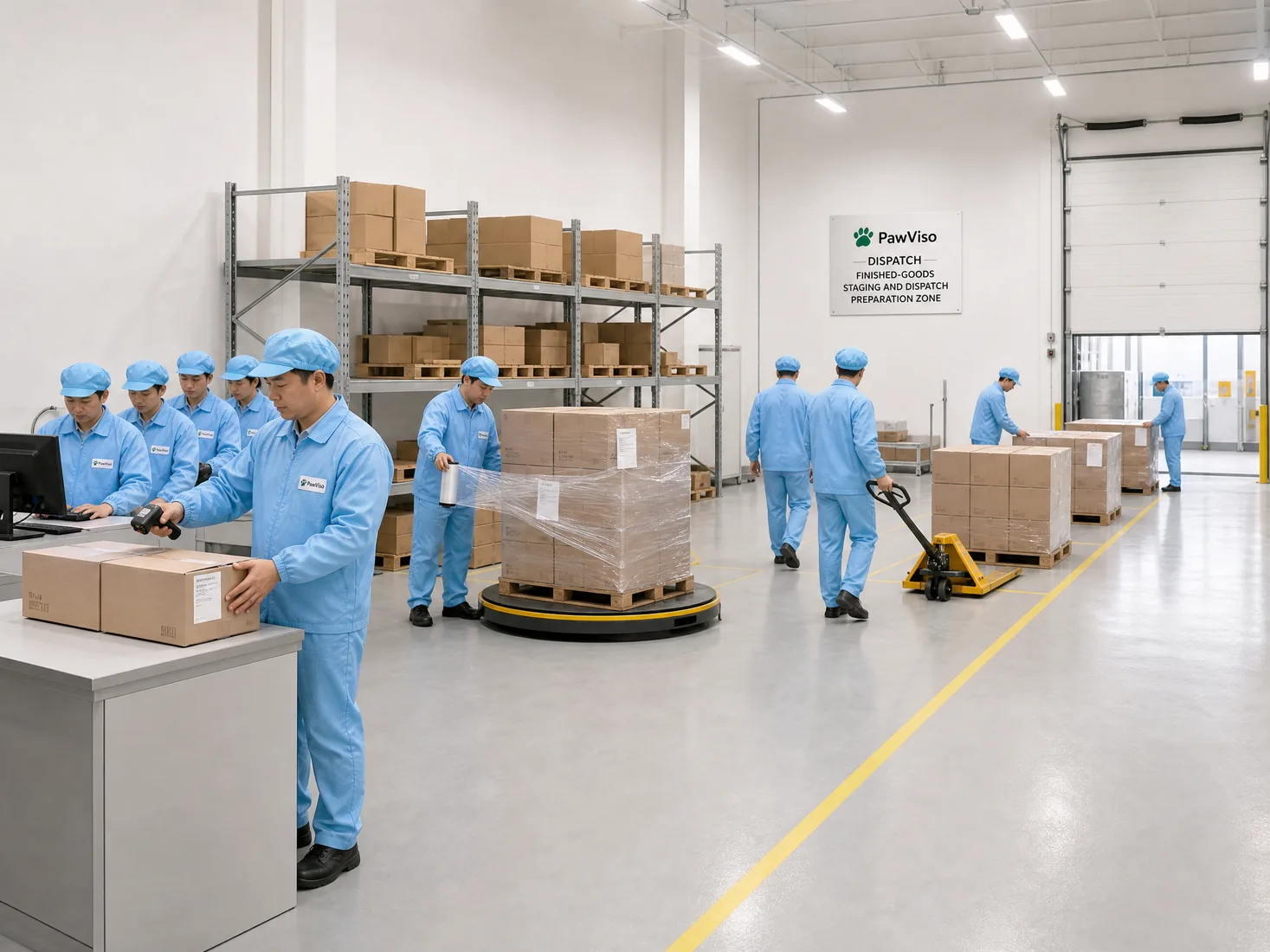
Choose the Incoterms® 2020 rule that matches the handover you can actually manage, then name the precise place or port and compare the same scope across every supplier quote. For a pet-product buyer, the term is not a freight-price label. It is a working allocation of delivery, transport tasks, risk, documentation and clearance responsibilities. The International Chamber of Commerce (ICC) describes the rules as a framework for allocating cost, risk and obligations; they do not replace a complete sales contract.1
From a Chinese pet-product factory and procurement-partner perspective, unclear terms create avoidable friction at the exact moment an order becomes physical: cartons are completed, a forwarder asks for pickup details, a booking changes, or the buyer needs release documents. A useful decision identifies the SKU scope, mode, named place, carrier or forwarder authority, document route and the person allowed to release the shipment. Market, customs, insurance and contract requirements must be confirmed by the responsible buyer or importer for the actual shipment. This guide is a commercial coordination framework, not legal advice.
Module 1 — Decide which party should control the journey after factory handover
Start by deciding whether your team controls main carriage and destination coordination, or the seller arranges a defined portion. Do not select a familiar term or shorter quote. Map the order from cargo readiness to receipt. Identify who appoints the forwarder, gives instructions, approves route changes, arranges insurance where needed, handles import formalities and receives cargo. The rule should support that model.
This decision determines the information a Chinese factory needs before dispatch. A buyer controlling transport must provide a handover contact, pickup or carrier instructions, and a meaningful delivery point. A buyer requesting seller-arranged transport must define the destination, information flow and line between transport coordination and import obligations. Incoterms® rules clarify delivery tasks but do not settle ownership, payment, product conformity, delay remedies or every clearance document.2 Address those matters in the purchase order or related agreement.
| Buyer operating model | Practical Incoterms question | Information the factory needs early | Control risk to avoid |
|---|---|---|---|
| Buyer-appointed forwarder | Where and to which carrier should goods be handed over? | Forwarder contact, booking path, named handover location, pickup instructions | Factory-ready cargo with no actionable pickup authority |
| Seller-arranged carriage | To what named destination should carriage be arranged? | Destination wording, routing preferences, required milestone updates | A destination label treated as a full door-delivery specification |
| Buyer-managed import | Who prepares entry and pays destination charges under the agreed arrangement? | Importer or broker contact and document-data requirements | Treating factory export activity as destination clearance |
| Integrated delivery request | Which physical point ends the seller’s agreed delivery task? | Exact facility, hours, unloading expectation and receiving contact | “Delivered” being interpreted differently by warehouse and seller |
Module 2 — Choose the rule family that fits the transport mode before comparing terms
Choose the transport-mode family first: use an any-mode rule when the shipment will be handed to a carrier in a multimodal or containerised movement, and consider sea/inland-waterway rules only when that is the actual transport context. Incoterms® 2020 groups seven rules for any mode or modes of transport and four rules for sea and inland-waterway transport.2 This is a suitability screen, not a slogan about which term is always best for a pet-product category.
Pet products often move as parcel consignments, consolidated cargo, containerised loads or mixed-SKU pallets. The physical unit may leave a factory by truck, enter a terminal, travel by vessel or air, and continue inland. Ask where the relevant contractual delivery occurs—not merely which vehicle completes the longest leg. A forwarder can explain the operational routing, but the buyer should confirm the term, version and named place with its own commercial and qualified advisers. Selecting the wrong family can obscure the actual handover point and make an apparently comparable quotation unlike the others.
| Shipment situation | Buyer decision | Rule-family direction to review | Factory-facing implication |
|---|---|---|---|
| Courier, air, rail, road, consolidated or multimodal movement | Name the carrier handover or agreed destination point | Any-mode rules: EXW, FCA, CPT, CIP, DAP, DPU or DDP | Confirm exactly who can instruct the carrier and where cargo is made available or delivered |
| Port-to-port waterway arrangement with a true vessel-side delivery concept | Name the relevant loading or destination port | Waterway rules: FAS, FOB, CFR or CIF | Confirm port, terminal process, booking responsibilities and document expectations |
| Containerised cargo moving through a terminal | Identify the point before the vessel leg where the carrier receives cargo | Usually examine an any-mode rule before assuming a port rule | Align factory dispatch with carrier cut-off and terminal handover instructions |
| Mixed order with different modes | Decide whether each shipment has a separate commercial basis | Review each movement separately | Do not carry one rule from an ocean order into an air or courier shipment without checking fit |
Module 3 — Decide whether factory collection or carrier handover gives the cleaner control point
If the buyer has a capable forwarder and wants a controlled export-side handover, compare EXW and FCA carefully rather than treating them as interchangeable. The buyer’s decision is not simply “pickup from China.” It is whether the seller makes goods available at its premises or delivers them to a carrier or other named party at a specified place under the selected rule. Write the factory address, loading location and operating-contact details only after agreeing the commercial meaning of that point.
For pet-product orders, a clean handover record should identify the purchase-order number, shipment reference, SKU and carton count, package marks, collection date or readiness window, condition at handover, and receiving carrier or driver. This is especially useful when the order contains branded retail boxes, mixed variants or several factories consolidated by a buyer’s forwarder. Ask the factory to flag any mismatch between the booking instruction and the released packing data before cargo leaves. A carrier collection is a logistics event; it should not silently amend artwork, pack-out, document or payment requirements.
Module 4 — Decide how much carriage and destination coordination the seller should arrange
Choose CPT, CIP, DAP, DPU or DDP only after separating the seller’s transport-arrangement role from the point at which risk, import work and unloading are to be handled. A seller-arranged freight quotation can be convenient for a buyer who has limited logistics capacity, but it gives the buyer less direct control of carrier selection and information flow unless the order spells out the required milestones. The ICC notes that the 2020 rules place the relevant costs in Articles A9/B9, which makes a disciplined scope review valuable.1
Do not treat insurance wording as a general promise that every loss, product issue or commercial delay is covered. Where a rule contemplates insurance, confirm the scope, insured party, evidence, exclusions and claims process with the appropriate qualified parties before shipment. Likewise, “delivered” needs a named physical point: a port, warehouse gate, distribution-centre address or other agreed place. The buyer should confirm whether unloading, appointment booking, access conditions, local handling and import clearance are in or out of the project scope. No term removes the need to decide who pays or manages a cost that arises outside the mutually defined quote.
| Buyer objective | Handover question to resolve | Commercial control to document | Common scope ambiguity |
|---|---|---|---|
| Seller arranges carriage to a named point | Where does delivery occur versus where carriage ends? | Named destination, carrier-update cadence, document transmission | A destination place is assumed to include local delivery work not quoted |
| Buyer wants an insurance-linked transport arrangement | What evidence and coverage details are required? | Insurance document route and review owner | “Insured” is accepted without checking the stated scope |
| Buyer wants arrival at a facility | Is cargo delivered ready for unloading, or must it be unloaded? | Address, delivery appointment, unloading party and receiving hours | Warehouse team and seller have different assumptions about unloading |
| Buyer asks for an all-in import-side arrangement | Who is the importer and who controls destination compliance? | Importer identity, broker route, taxes/duties treatment and exceptions path | DDP is used without confirming destination-side roles and feasibility |
Module 5 — Decide whether a waterway rule truly reflects the vessel-side handover
Use FAS, FOB, CFR or CIF only when their waterway and named-port framework describes the real transaction; otherwise return to the any-mode analysis. These rules are grouped specifically for sea and inland-waterway transport.2 A buyer should not choose a port term just because ocean freight is involved somewhere in the route. The decision is whether the agreed delivery and risk-transfer structure genuinely belongs at the waterway stage and can be executed consistently with the carrier, terminal and seller’s shipment process.
Where a waterway rule is under consideration, name the loading or destination port precisely and ask for the full quotation assumptions: origin movement, terminal handling, booking, carrier selection, freight basis, document path, insurance where relevant, and destination exclusions. The factory’s export desk may coordinate some steps, while a forwarder executes others. That division should be stated rather than inferred. A booking reference or a vessel name is not, by itself, an agreement that all port-side charges or later destination services are included.
Module 6 — Decide what must be identical before you compare quotations
Compare quotations only after normalising the commercial basis, not by comparing a unit price or freight line in isolation. Build one quotation sheet with the same SKU configuration, quantity, packaging version, currency, Incoterms® 2020 rule, named place or port, quotation validity, and list of included and excluded services. A lower product line can reflect a shorter scope, different carton pack-out, an unpriced origin activity, or a destination item outside the supplier’s responsibility. It is a commercial comparison problem, not proof that one factory is cheaper.
Ask each supplier to respond in the same fields and mark assumptions as assumptions. Separate the finished-goods value from transport-related charges when that helps your team understand the scope, but do not invent fixed logistics costs or expect a supplier to guarantee charges controlled by third parties. If a seller-arranged term is requested, ask which carrier or forwarder quotation date and route assumptions support it, and what triggers a reconfirmation. If the buyer arranges transport, ask for readiness location and cargo data rather than an unsupported freight estimate.
| Comparison field | Buyer asks every supplier to state | Why it matters at approval | Status to use |
|---|---|---|---|
| Goods scope | SKU, variant, retail pack, carton pack-out and quantity | Confirms the same physical order is priced | Confirmed / deviation / open |
| Trade basis | Incoterms® 2020 rule and exact named place or port | Locates the intended delivery and task allocation | Confirmed / deviation / open |
| Origin services | Export packing, marking, factory-to-handover activity and stated handling | Reveals whether a local step is assumed or priced | Included / excluded / assumption |
| Main carriage and insurance | Carrier arrangement, route basis and insurance wording if relevant | Stops a freight label from hiding a different service scope | Included / excluded / buyer to arrange |
| Destination and import-side items | Delivery point, unloading, clearance, taxes/duties and local charges as applicable | Identifies buyer-controlled or unresolved work | Included / excluded / confirm locally |
Module 7 — Decide who coordinates each logistics milestone before goods are ready
Appoint one accountable coordinator for each milestone, even if the buyer, factory and forwarder each perform different tasks. The buyer should nominate a logistics owner who can approve the commercial basis, release the forwarder’s contact details and decide whether a late change is acceptable. The factory or procurement partner should identify a dispatch owner who can confirm production readiness, pack-out data, carton marks and physical availability. The forwarder should have a clear instruction source. A shared chat group is useful for speed, but it is not a substitute for a controlled shipment instruction.
Use a milestone sheet that runs from cargo readiness through pickup, carrier handover, document draft review, departure notice and arrival-side instruction. Add a decision deadline and escalation contact beside each event. This protects mixed pet-product orders in which one missing colourway, an artwork revision or a carton-count discrepancy can stop a consolidation. Do not authorise the carrier to collect based solely on “ready soon.” The buyer should confirm that goods are released against the agreed product and packaging baseline, then issue or approve the collection instruction under the selected term.
Mid-article CTA — Make the handover visible before booking. Share the product list, intended destination, preferred transport mode, named handover point, forwarder role and current packing status with PawViso. A structured shipment-planning brief can make supplier, buyer and logistics conversations comparable before goods are staged.
Module 8 — Decide which documents must be checked before shipment release
Release a shipment only when the buyer’s required document and data set is identified, linked to the final goods and routed to the correct recipients. Do not wait until the vessel or aircraft departs to ask whether the commercial invoice description, packing list, transport document, origin information, carrier instruction or other required record matches the actual order. The specific required set depends on the product, destination, transport mode, buyer’s customs arrangement and contractual requirements. Incoterms® rules do not themselves prescribe every document required for import clearance.2
A practical release check matches four things: the purchase order and approved changes; the packed goods and carton count; the commercial and packing data; and the carrier or forwarder booking details. For United States imports, Customs and Border Protection advises importers to understand commodity-specific requirements in advance and notes that the importer of record remains responsible for entry-document correctness even when using a customs broker.3 That is an example of importer accountability, not a universal clearance procedure or a substitute for destination-specific advice.
Create a document register with a field for document owner, draft reviewer, source data, revision, issue date and release recipient. Ask the factory to identify data it generated versus information supplied by the buyer or broker, such as importer details, tariff classification direction or destination wording. A commercial invoice should never be treated as a generic afterthought: product identity, quantities, value and other project-specific fields require alignment with the actual shipment and the importer’s confirmed instructions. Hold a clear exception when a record is still pending; do not convert an unreviewed draft into implied approval.
Module 9 — Decide how cartons, pallets and shipment references will be traceable at handover
Make the physical load traceable to the documents and booking before it leaves the dispatch zone. At a minimum, establish how the purchase order, shipment reference, SKU or carton range, quantity, package marks and any buyer-required labels connect. For branded pet-product orders, a visually similar carton may carry a different variant, retail-pack revision or destination allocation. The handover record should let a receiver reconcile what was collected against the packing list without guessing.
Where the buyer’s supply chain uses GS1 logistic labels, agree the data owner and label level in advance. GS1 defines a logistic unit as an item assembled for transport or storage and says its logistic label can uniquely identify that unit for tracking and tracing; the Serial Shipping Container Code (SSCC) is the mandatory identifier in that standard.4 This does not mean every pet-product shipment needs a GS1 label. It means that, where the buyer requires one, the physical label, the electronic data and the dispatch advice must describe the same unit.
| Physical level | Buyer decision | Dispatch record to reconcile | Handover failure prevented |
|---|---|---|---|
| Retail unit | Is the sellable SKU and pack revision correct? | SKU/variant and packaging approval reference | Correct product in an obsolete retail pack |
| Master carton | Which SKUs and units are inside each carton? | Carton mark, count and gross/net data if required | Carton count cannot be reconciled with packing list |
| Pallet or logistic unit | Does the receiver require a unique shipment-level label? | Pallet ID or SSCC where specified, pallet count and contents link | Pallet is separated from its electronic shipment data |
| Consolidated shipment | Which factory cartons belong to this booking? | Purchase-order and forwarder shipment reference | Cargo is collected under the wrong consolidation or destination |
Module 10 — Decide the exception path before a booking, document or delivery condition changes
Agree in advance who may change the named place, carrier instruction, route, pack-out, document data or delivery appointment, and who must approve the consequence. Shipment disruptions are normal operating events, but an informal workaround can change a buyer’s risk or cost exposure without a visible decision. A factory should escalate a carrier no-show, changed terminal instruction, carton discrepancy or document-data conflict before acting outside the released plan. A buyer should provide a reachable decision owner rather than requiring factory staff to choose a commercial remedy.
Use a short change record: what changed, why, which orders and cartons are affected, whether the Incoterms basis or named place is affected, commercial impact to be confirmed, revised instruction, approver and timestamp. This record is not a legal amendment by itself. Its value is operational: it keeps the forwarder from executing a stale booking and gives finance, receiving and customer-service teams a shared reference. If the change may affect the sales contract, insurance, customs position or buyer’s import process, obtain the appropriate qualified review before release.
Module 11 — Decide the purchase-order wording and release gate that will govern the shipment
Put one complete shipping instruction into the purchase order or its controlled annex: the rule, version, named place, product scope, handover contact, document list, milestone owners and shipment-release authority. A term without its version and precise location is incomplete for operational use. The ICC calls Incoterms® 2020 the current set of eleven rules and provides selection guidance, while the parties’ sale contract supplies the wider commercial terms.1 Make the controlled order record the single source that the factory, buyer and forwarder can consult.
Before approving production dispatch, conduct a brief release meeting or written gate. Confirm that the product and pack were released under the current revision; quantities and cartons reconcile; the commercial basis and named place match the quote and purchase order; booking instructions are actionable; document drafts have an owner and route; and destination-side contacts are ready. Any open point should have a named owner, deadline and explicit decision to hold or proceed. This turns Incoterms selection from a procurement field into a repeatable shipment-control process.
For repeat orders, retain a post-shipment review. Note what worked: whether the named handover was practical, the quotation scope matched invoices and service, documents arrived when required, labels reconciled, and exception escalation was fast enough. Then update the template, not the past order. A repeat shipment may use the same rule, but a changed product mix, destination, consolidation model, customer warehouse or forwarder can justify a new decision.
Frequently asked questions
Which Incoterm is best for a first pet-product order from China?
There is no universal best rule. For a first order, choose the term whose handover and responsibilities your team can administer with the least ambiguity. A buyer with an established forwarder may prefer a structure that gives that forwarder a defined carrier handover. A buyer that needs seller-arranged carriage should define the destination, information flow and import-side responsibilities before accepting a freight-inclusive quotation. The right answer depends on the actual mode, named location, importer setup and logistics capability—not the product category alone.
Can we compare an EXW quote with a DAP or DDP quote?
Yes, but not by subtracting or adding a guessed freight amount. Rebuild the comparison on a common scope: identical SKUs and packaging, same quantity, same destination, stated origin handling, carriage assumptions, insurance wording where applicable, import-side items, delivery point and exclusions. Then ask each supplier to distinguish included services from open assumptions. If a service cannot be normalised, record it as a decision item rather than forcing a false all-in comparison.
Does an Incoterms rule decide when we own the pet products?
No. The International Trade Administration states that Incoterms do not determine when title or ownership passes, payment method or timing, product conformity, delay liability or dispute resolution.2 The buyer and seller should address those subjects in their sales documentation with appropriate advice where needed. For operations, separately record the delivery and risk point specified by the agreed rule and the project’s ownership, payment and acceptance provisions.
What should the factory receive before it can dispatch goods?
The factory needs the current purchase order or shipping annex, final product and packaging release status, the rule/version/named place, forwarder or carrier contact and booking details where buyer-arranged, carton and packing data, document instructions, consignee or destination details as applicable, and a release authority. If the buyer has not confirmed one of those inputs, keep it marked as open. A factory should not infer an import arrangement, document recipient or delivery appointment from a prior project.
Conclusion
Select Incoterms for pet product orders by designing the actual handover first. Choose the transport-mode family, decide who controls onward carriage and import-side coordination, name the exact location, and test the choice against the factory’s dispatch process and the buyer’s receiving process. Then use the same defined basis to compare quotations, give bookings, review documents and release cargo.
A strong China sourcing workflow does not promise fixed freight economics or assume a shipping term solves every commercial issue. It makes the remaining choices visible: product and package version, carrier authority, insurance and clearance review, data ownership, logistics labels, exceptions and shipment release. That clarity is valuable whether the order is a small mixed launch, a recurring retail programme or a consolidated multi-factory shipment.
Final CTA — Plan the handover before your pet-product order is freight-ready. Send PawViso your SKU list, target destination, preferred transport mode, current quotation basis and forwarder setup so the shipment plan can be structured around clear responsibilities. Email: info@PawViso.com. WhatsApp: +86 186 8106 4480.
Disclaimer: This article provides general B2B sourcing information only. Project requirements, including the actual SKU, buyer/importer role, market, customs, insurance, contractual, documentation and logistics requirements, need buyer/importer confirmation with qualified parties.
Related PawViso resources
- Continue with How to Prepare Pet Product Packaging Artwork. Use this guide to organize artwork, barcode and pack-out inputs.
- Browse the PawViso product catalogue to identify product formats for a sourcing brief.
- Follow the PawViso sourcing process and review the B2B buyer FAQ before sharing project requirements.
External reference
For independent shipping-term and handover context, review International Chamber of Commerce Incoterms® 2020 overview. Confirm the requirements that apply to the selected product, target market and order.